Healthy food in Bangalore starts with the darshini menu
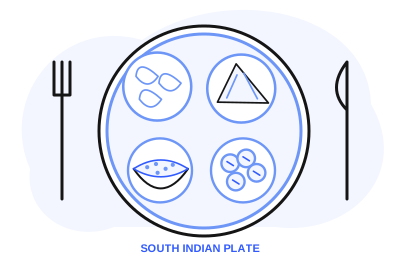
A lot of Bengaluru’s eating happens standing up at a darshini counter: idli-vada, a dosa, a plate of chow chow bath, a filter coffee. None of it is junk food, and you don’t need to give it up to lose fat or build muscle. What changes the result is what you pair, how much chutney and ghee come with it, and whether there is any protein on the plate. This guide puts numbers on Bengaluru’s everyday food so you can choose with your eyes open.
Every figure below comes from a published database. Cooked dishes use the Indian Nutrient Databank (INDB), a peer-reviewed set of 1,014 standard Indian recipes calculated from India’s food composition tables, or USDA FoodData Central, which lists idli, dosa, vada and upma with set portion weights. Raw ingredients such as ragi, milk and horse gram use the Indian Food Composition Tables 2017 (IFCT) from ICMR-NIN. Where we built a value from ingredients (a ragi mudde, a cup of filter coffee), the table says so and shows the recipe. Your darshini’s portions will differ, so treat these as a starting point.
| Dish | Serving | Calories | Protein | Source |
|---|---|---|---|---|
| Idli | 2 idlis, 76 g | 97 kcal | 4.8 g | USDA |
| Medu vada | 1 vada, 30 g | 80 kcal | 3.8 g | USDA |
| Sambar | 1 bowl, 257 g | 249 kcal | 8.6 g | INDB |
| Coconut chutney | 1 tablespoon, 25 g | 67 kcal | 0.9 g | INDB |
| Plain dosa | 1 medium, 80 g | 168 kcal | 4.6 g | USDA |
| Masala dosa | 1 dosa, 210–267 g | 345–491 kcal | 6.9–14.6 g | INDB, USDA |
| Khara bath (rava upma) | 1 bowl, 106 g | 157 kcal | 3.5 g | INDB |
| Kesari bath | 1 bowl, 177 g | 432 kcal | 4.2 g | INDB |
| Chitranna (lemon rice) | 1 plate, 319 g | 563 kcal | 13.6 g | INDB |
| Ragi mudde | 1 ball from 50 g ragi flour | 160 kcal | 3.6 g | IFCT (flour value) |
| Horse gram saaru (huruli) | 1 bowl, 361 g | 201 kcal | 10.5 g | INDB |
| Chicken curry (stand-in for naati koli saaru) | 1 bowl, 248 g | 320 kcal | 29.2 g | INDB |
| Mutton biryani | 1 plate, 208 g | 396 kcal | 15.3 g | INDB |
| Filter coffee | 100 ml milk, 1 tsp sugar | 89 kcal | 3.3 g | IFCT milk, USDA sugar |
A better darshini breakfast: idli-vada, dosa and how to order
The classic Bengaluru breakfast of two idlis and one vada with sambar and chutney comes to roughly 560 kcal if you finish a full bowl of sambar and two spoons of coconut chutney (97 + 80 + 249 + 134). That is a reasonable meal. The weak spot is protein: about 19 g, nearly half of it from the sambar. Here is how the same counter can do better:
- Swap the vada for a third idli. You save about 30 kcal and lose very little, and the steamed idli carries no frying oil.
- Drink the sambar, ration the coconut chutney. Sambar gives 8.6 g of protein a bowl; coconut chutney gives 0.9 g a spoon for 67 kcal. Ask for the red or mint chutney if it’s offered, or take one spoon of coconut.
- Pick a plain dosa over a masala dosa on fat-loss days. A plain dosa is about 168 kcal against 345–491 kcal for a masala dosa, mostly because of the potato filling and the butter or ghee on top.
- Treat chow chow bath as two dishes. Khara bath alone is about 157 kcal a bowl; the kesari bath beside it is about 432 kcal for a full bowl of 177 g, from semolina, sugar and ghee. Share the kesari or skip it on weekdays.
- Add protein from home. Two boiled eggs (about 13 g of protein) or a 150 g katori of curd (about 5 g) eaten before you leave turns a darshini breakfast into a high-protein one.
If you searched for a healthy breakfast in Bangalore, this is the honest answer: idli-sambar is one of the most predictable restaurant breakfasts in India. The calories that sneak in come from the vada, the butter on the dosa, the kesari and the chutney refills, not from the idli.
Ragi mudde, saaru and the military hotel meal
Ragi mudde is Karnataka’s most useful staple for anyone trying to eat well. IFCT lists ragi (finger millet) at 321 kcal and 11.2 g of fibre per 100 g, against 2.8 g in milled rice, so a mudde fills you up for its energy. It is not a protein food, though: 7.2 g per 100 g, slightly below rice. A ball made from 50 g of flour works out at about 160 kcal and 3.6 g of protein, since the water adds no calories. Sizes vary from kitchen to kitchen, so scale up: a ball from 100 g of flour is about 320 kcal.
That is why the saaru matters. Bengaluru’s military hotels, whose origins are uncertain (the Shivaji Military Hotel, one of the oldest, opened in 1924), mainly serve non-vegetarian food: biryani, mutton chaap, keema, chicken and ragi mudde. A bowl of chicken curry carries about 29 g of protein in the INDB recipe, which makes mudde with naati koli saaru one of the best high-protein meals in Bangalore. We don’t have a published figure for country chicken saaru itself, so the table uses INDB’s generic chicken curry as a stand-in. A vegetarian version is huruli saaru made with horse gram, which IFCT puts at 21.7 g of protein per 100 g raw; a 361 g bowl gives about 10.5 g.
The military hotel biryani is the heavier choice. INDB’s mutton biryani is 396 kcal for a 208 g plate with 15.3 g of protein, and a restaurant plate may well be larger, so scale the numbers to what you’re served. If you’re eating for fat loss, order the mudde and a meat saaru and share a biryani. If you’re eating to gain muscle, the biryani with an extra piece of chicken or mutton is a perfectly good meal.
Filter coffee in Bengaluru: count the cups, not just the meals
Karnataka grows most of India’s coffee: the Coffee Board’s 2021–22 estimate put the state at about 71% of national production. In Bengaluru that shows up as three or four filter coffees a day. One cup made with 100 ml of cow’s milk (73 kcal and 3.3 g of protein, IFCT) and a teaspoon of sugar (about 16 kcal) is roughly 89 kcal. Four cups is about 360 kcal, as much as a masala dosa, before you have eaten anything. Buffalo milk raises the milk part to about 107 kcal per 100 ml.
You don’t need to give it up. Cut the sugar a little each week, keep it to two cups, and count the milk as part of your protein. The coffee is fine; the sugar and the fourth cup are the problem.
High protein meals in Bangalore from local food
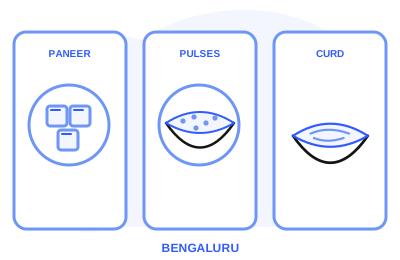
Bengaluru has plenty of delivery services selling high-protein meal boxes, but you can hit a protein target from ordinary local food. These are the best-value options per serving in our sources, from the local menu rather than a gym-food kitchen:
| Food | Serving | Protein | Calories |
|---|---|---|---|
| Chicken curry / saaru | 1 bowl, 248 g | 29.2 g | 320 kcal |
| Mutton biryani | 1 plate, 208 g | 15.3 g | 396 kcal |
| Two boiled eggs | 2 eggs, 100 g | 13.4 g | 144 kcal |
| Horse gram saaru | 1 bowl, 361 g | 10.5 g | 201 kcal |
| Paneer | 50 g | 9.4 g | 153 kcal |
| Sambar | 1 bowl, 257 g | 8.6 g | 249 kcal |
| Majjige (salted buttermilk) | 1 tall glass, 423 g | 5.7 g | 80 kcal |
| Curd | 150 g katori | 5.2 g | 92 kcal |
Eggs and curd are from IFCT and USDA; the rest are INDB recipes; paneer is the IFCT 2017 value of 18.9 g of protein and 305 kcal per 100 g. To find out how much protein you personally need, use our protein intake calculator; people who strength train usually need more than the basic adult allowance. Our protein in Indian food chart covers 80+ other foods.
A 1,800 kcal day built from Bengaluru food
Here is one way a Bengaluru day can land near 1,800 kcal with plenty of protein, using only the database values above. It assumes a darshini breakfast, a mudde lunch and a home dinner. Adjust the portions to your own number from the calorie deficit calculator.
| Meal | What to eat | Calories | Protein |
|---|---|---|---|
| Breakfast at a darshini | 3 idlis, 1 bowl sambar, 1 tbsp coconut chutney | 463 kcal | 16.7 g |
| Mid-morning | 1 filter coffee with 1 tsp sugar | 89 kcal | 3.3 g |
| Lunch | Ragi mudde (50 g flour), chicken saaru, cabbage and peas palya, 150 g curd | 678 kcal | 43.4 g |
| Evening | Sprouted moong salad (kosambari-style), 1 glass majjige | 157 kcal | 10.4 g |
| Dinner | 2 chapatis, horse gram saaru, cabbage and peas palya | 453 kcal | 20.1 g |
Vegetarian? Swap the chicken saaru for a bowl of palak paneer (230 kcal, 11.9 g of protein in INDB) and the day comes to about 1,750 kcal and 77 g of protein. For a full week of South Indian meals at 1,500 kcal, see our South Indian diet plan for weight loss.
VV Puram food street and Bengaluru’s evening snacking
VV Puram Food Street, or Thindi Beedi, in Basavanagudi near Sajjan Rao Circle packs more than 20 vegetarian stalls into under 150 metres and gets busy after 6 PM. Every December and January it hosts an Avarekai Mela built around hyacinth beans. A visit is a treat, not a problem: eat the dishes you came for, share plates so you taste more and eat less of each, and choose a steamed or griddled item over a second fried one.
The bigger issue for most people is the daily evening snack: bajji, bonda or a masala puri with a 4 PM coffee. Because fried items don’t have reliable published figures, the safest rule is to make them a weekend thing and keep weekday evenings to sprouts, kosambari, a fruit, buttermilk or a boiled egg from home.
Tech park canteens and office lunches in Bengaluru
If you work at Manyata, along the Outer Ring Road, in Whitefield or Electronic City, lunch is usually a canteen counter or a delivery app. Both can work:
- Start with the protein counter. Pick the dal, egg, chicken or paneer dish first, then add rice or rotis to fill the rest of the plate.
- Half a plate of rice is plenty. A plate cooked from 100 g of raw rice is about 352 kcal; most people losing fat do well on half that with an extra vegetable.
- Take curd, skip the sweet. Curd adds protein; a bowl of rice kheer is about 301 kcal and kesari bath about 432 kcal in INDB recipes.
- Order meal boxes by protein grams. On delivery apps, look for a stated protein figure and around 25–40 g per meal. A box without numbers is hard to plan around.
- Keep a backup at your desk. Roasted chana, a fruit or a pack of buttermilk stops the 5 PM vada-and-coffee run.
Healthy staples and markets in Bengaluru
The best healthy food options in Bengaluru are often raw ingredients. K. R. Market in Kalasipalya, established in 1928, is the city’s largest wholesale market, with flowers and vegetables on the lower ground floor. Neighbourhood markets and pushcarts sell the same greens: keerai, dill, methi and amaranth all cost little and fill half a plate for very few calories. Stock ragi flour for mudde or dosa, horse gram for saaru, whole moong and chana for sprouts and kosambari, curd, and eggs if you eat them.
For a cheap, simple meal, the Karnataka government’s Indira Canteens charge ₹5 for breakfast and ₹10 for lunch or dinner; the state said in June 2023 that those rates would not change and that there were 175 canteens in Bengaluru. Breakfast includes idlis with coconut chutney, and lunch and dinner include sambar and curd rice. It is a filling, low-fat plate, though light on protein, so add curd or eggs later in the day.
Food is half the plan; the other half is training that keeps the muscle while you lose fat. Personal Gym Training in Bengaluru puts a coach on your phone at your apartment or office gym, and group classes in Bengaluru cost ₹499 per person for a live session. If you also run, the running tracks in Bangalore guide covers Cubbon Park and the lake loops, and marathons in Bangalore lists the race calendar. Compare the cost of coaching with gym fees in Bangalore, see calories in Indian food for 100+ more dishes, and read about online personal training in Bengaluru.
Sources
- Indian Food Composition Tables 2017 (Longvah, Ananthan, Bhaskarachary, Venkaiah), ICMR-National Institute of Nutrition, Hyderabad
- Indian Nutrient Databank (INDB): an open-access database of Indian foods and recipes (Vijayakumar et al., 2024), Current Developments in Nutrition
- Indian Nutrient Databank: recipe data files, Jaacks Lab, GitHub
- FoodData Central datasets (FNDDS and SR Legacy), U.S. Department of Agriculture
- Coffee Board database, January 2022: coffee production by states, 2021–22, Coffee Board of India
- Military hotels in Bengaluru, Wikipedia
- VV Puram Food Street, Wikipedia
- K. R. Market, Wikipedia
- Indira Canteen, Wikipedia
- Karnataka Chief Minister asks officials to open 250 Indira Canteens in Bengaluru city (PTI, 13 June 2023), South First
Written by the MakeMyFitness team from the sources above. First published , last updated . Spotted something out of date? Tell us at hello@makemyfitness.com.