Healthy food in Ludhiana starts with the waistline
Ludhiana eats richly. Winter brings sarson da saag with makki di roti and white butter, pinnis made with ghee, and gajar halwa; the rest of the year runs on parathas, dhaba dal, egg bhurji from roadside carts and chicken from the tandoor. The National Family Health Survey shows what that does over time. In NFHS-5 (2019–21), 45.1% of women aged 15–49 in Ludhiana district were overweight or obese, up from 35.5% in 2015–16, and 80.8% had a high-risk waist-to-hip ratio, a sign of fat carried around the middle.
The same survey found 64.3% of women in the district anaemic, and about 15% of women and of men aged 15 and over with high blood sugar or on medicine for it. So healthy food in Ludhiana has two jobs: fewer empty calories from ghee and sugar, and more protein and iron. For a full week of Punjabi meals, see our Punjabi diet plan for weight loss. This page sticks to the food you actually meet in Ludhiana.
Our numbers come from two public sources: the Indian Nutrient Databank (INDB), which works out nutrient values for over 1,000 Indian recipes from cookery manuals and the ICMR-NIN food tables, and the Indian Food Composition Tables 2017 (IFCT) from ICMR-NIN for raw ingredients. We leave out INDB's deep-fried recipes, which count the whole pan of frying oil as eaten. A dhaba's version of any dish will usually carry more ghee than these recipes.
Sarson da saag and makki di roti: Ludhiana's winter plate, measured
When Ludhiana's January nights fall to about 6°C on average (IMD normals), saag and makki di roti arrive on every table. The greens themselves are light: IFCT lists raw mustard leaves at 30 kcal and 3.5 g of protein per 100 g. Maize flour is about 334 kcal and 8.8 g of protein per 100 g, much like wheat. What changes the plate is the ghee worked into the roti and stirred into the saag.
| Item | Serving | Calories | Protein | Fat |
|---|---|---|---|---|
| Sarson da saag | 1 bowl (about 142 g) | about 124 kcal | 4.3 g | 8.3 g |
| Makki di roti | 1 roti (about 85 g) | about 224 kcal | 3.0 g | 14.3 g |
| Plain wheat chapati, for comparison | 1 chapati (about 36 g) | about 73 kcal | 2.1 g | 1.3 g |
| Usual plate: 2 makki, 1 bowl saag | – | about 573 kcal | 10.3 g | 36.9 g |
| Lighter plate: 1 makki, 1 chapati, saag, cucumber raita | – | about 512 kcal | 15.6 g | 27.1 g |
Each teaspoon (5 g) of ghee or white butter on top adds up to 45 kcal, so a generous dollop on the saag takes the usual plate past 650 kcal. The lighter plate keeps the taste, adds curd for protein and saves about 60 kcal before any butter. If saag is dinner most nights in winter, that difference adds up.
Pinni, gajar halwa and the season of sweets
Ludhiana homes make pinnis through the cold months, from wheat flour, ghee, sugar or jaggery and dry fruit. We found no analysed value for pinni, so the nearest INDB recipe is the besan ladoo, another flour-and-ghee sweet: about 168 kcal and 8 g of fat in a 35 g ladoo. A pinni of the same size is likely similar, and many homemade pinnis are bigger.
| Sweet | Serving | Calories | Protein |
|---|---|---|---|
| Besan ladoo, as a stand-in for pinni | 1 ladoo (about 35 g) | about 168 kcal | 3.1 g |
| Gajar halwa | 1 bowl (about 168 g) | about 290 kcal | 5.2 g |
| Moong dal halwa | 1 small bowl (about 95 g) | about 334 kcal | 8.0 g |
| Rice kheer | Half a bowl (about 200 g) | about 150 kcal | 4.6 g |
- Pick one sweet a day, not one with every meal. ICMR-NIN's 2024 guidelines suggest adults avoid sugar or keep it to 20–25 g a day.
- Make pinnis smaller. Rolling them half the size halves the calories without anyone at home noticing much.
- Have the sweet after a protein-rich meal, not as a mid-morning snack with tea.
Ludhiana's dhabas, paratha shops and egg carts: what to order
Whether it's a dhaba on Ferozepur Road, a paratha shop near the clock tower or an egg cart in a market, the same menu comes round. Here are typical choices from INDB, with the protein that makes a meal filling.
| Dish | Serving | Calories | Protein |
|---|---|---|---|
| Aloo paratha | 1 paratha (about 93 g) | about 191 kcal | 3.5 g |
| Keema paratha | 1 paratha (about 100 g) | about 238 kcal | 9.4 g |
| Egg bhurji | Per egg | about 109 kcal | 7.2 g |
| Dal makhani | 1 bowl | about 262 kcal | 11.7 g |
| Rajma | 1 bowl (about 120 g) | about 172 kcal | 7.1 g |
| Palak paneer | 1 bowl | about 230 kcal | 11.9 g |
| Kadhai paneer | 1 bowl | about 344 kcal | 13.8 g |
| Chicken curry | 1 bowl (about 250 g) | about 320 kcal | 29.2 g |
| Tandoori chicken | 100 g | about 145 kcal | 16.3 g |
- One paratha plus protein beats three plain ones. An aloo paratha with a 2-egg bhurji is about 410 kcal and 18 g of protein; three aloo parathas are about 574 kcal and only 10.5 g.
- At the egg cart, ask for less butter and two eggs, not four with extra pav.
- Pick chicken curry or tandoori chicken over butter chicken when you want the most protein for the calories.
- Skip the reused oil. ICMR-NIN warns that oil heated again and again for frying forms harmful compounds, so keep pakoras and samosas from all-day kadhais occasional.
Milk, dahi and paneer in India's top milk state
Punjab has more milk per person than almost anywhere in India: about 1,245 g a day in 2023–24, against a national average of 471 g, according to the National Dairy Development Board. In Ludhiana that means buffalo milk, home-set dahi and fresh paneer are easy to find. They are good protein, but the type of milk matters.
| Food | Calories | Protein | Fat |
|---|---|---|---|
| Buffalo milk, whole | 107 kcal | 3.7 g | 6.6 g |
| Cow milk, whole | 73 kcal | 3.3 g | 4.5 g |
| Paneer | 305 kcal | 18.9 g | 24.8 g |
A 200 g glass of buffalo milk is about 214 kcal with 7.4 g of protein; the same glass of cow milk is about 146 kcal with 6.5 g. If you're cutting, cow or toned milk gives nearly the same protein for less. Paneer is dense in both protein and fat, so 50–75 g in a bhurji or tikka is a good portion; a rich shahi paneer gravy is a calorie serving more than a protein one. ICMR-NIN's “My Plate for the Day” includes 300 ml of milk or curd a day.
Iron matters in Ludhiana: 64% of women are anaemic
With nearly two in three women in Ludhiana district anaemic in NFHS-5, a healthy plate here should be iron-aware. ICMR-NIN's guidelines note that green leafy vegetables are rich in iron but it is poorly absorbed, and recommend vitamin C-rich fruit such as guava or orange after meals to help. They also advise keeping tea and coffee at least an hour before or after meals, because tannins interfere with iron absorption. For a city that drinks tea with every paratha, that one habit is worth changing.
- Saag with lemon, guava after. Squeeze lemon on the saag and eat a guava or a kinnow afterwards.
- Pulses every day. Rajma, kale chane and moong all add iron and protein.
- Move the chai. Have it mid-morning and mid-afternoon, not with breakfast and lunch.
- Get tested if you're tired all the time. A simple blood test tells you whether you need treatment, which only a doctor should prescribe.
A winter day of Ludhiana food at about 1,700 kcal
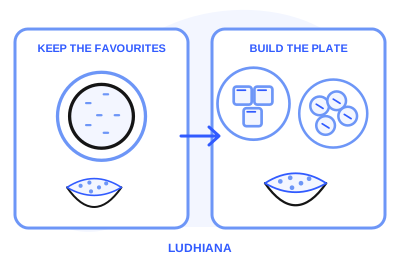
This day uses the INDB values above for someone losing fat steadily, about 0.5–1 kg a week. Work out your own target with the calorie deficit calculator.
| When | What | Calories | Protein |
|---|---|---|---|
| Breakfast | 1 moong dal cheela, a bowl of cucumber raita | about 442 kcal | 22.1 g |
| Mid-morning | A cup of chai, away from meals | about 34 kcal | 0.8 g |
| Lunch | 2 chapatis, rajma, palak paneer | about 548 kcal | 23.2 g |
| Afternoon | A tall glass of salted lassi | about 80 kcal | 5.7 g |
| Dinner | Sarson da saag, 1 makki di roti, a 2-egg bhurji | about 567 kcal | 21.7 g |
There's room in this day for one small pinni (roughly 170 kcal) if the rest of the week stays on track. Vegetarians can swap the egg bhurji for 75 g of paneer bhurji, which IFCT values put at about 229 kcal and 14 g of protein before cooking fat. For more dishes and their protein, see our guides to protein in Indian food and calories in Indian food.
For coaching in the city, see online personal training in Ludhiana, personal gym training in Ludhiana and home training in Ludhiana. To burn some of the pinni off, read our guide to cycling in Ludhiana, and compare gym fees in Ludhiana before you join.
Sources
- Indian Food Composition Tables 2017, ICMR-National Institute of Nutrition, Hyderabad
- Indian Nutrient Databank (INDB) recipe dataset, University of Edinburgh (Jaacks Lab), GitHub
- Development of an Indian Food Composition Database, 2024 (the INDB paper), Current Developments in Nutrition (PMC)
- Dietary Guidelines for Indians (2024), ICMR-NIN
- NFHS-5 (2019–21) district fact sheets for Punjab, including Ludhiana, MoHFW and IIPS, compiled by OpenCity
- Per capita availability of milk by state, 2023–24, National Dairy Development Board
- Ludhiana: climate data, IMD normals 1991–2020, Wikipedia
Written by the MakeMyFitness team from the sources above. First published , last updated . Spotted something out of date? Tell us at hello@makemyfitness.com.