Healthy food in Kolkata starts with maach-bhaat
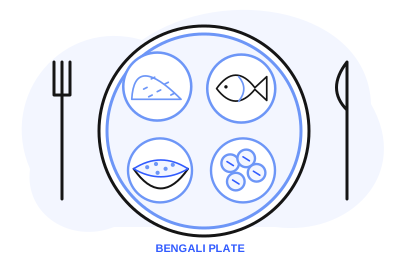
Kolkata has an advantage most Indian cities don’t: its everyday meal is fish and rice. River fish such as rui and katla are lean, high-protein foods, and a light jhol uses far less oil than a kalia or a fry. The Indian Food Composition Tables 2017 (IFCT) put rohu at 102 kcal and 19.7 g protein per 100 g raw, katla at 94 kcal and 17.9 g, and bhetki at just 68 kcal and 15.3 g. For comparison, chicken breast is 168 kcal and 21.8 g. If you eat fish once or twice a day, you are already close to a good protein intake.
What changes a Kolkata day from lean to heavy is rarely the fish. It’s the second and third helping of bhaat, the bhaja on the side, the evening telebhaja with cha, a roll on the way home and mishti after dinner. This page puts numbers on the city’s favourite food so you can choose where to spend your calories. For a full seven-day home plan, see the Bengali diet chart for weight loss; this guide is about eating in Kolkata itself: the office para, the street stall, the Sunday biryani and the sweet shop.
Cooked dishes use the Indian Nutrient Databank (INDB), a peer-reviewed database of 1,014 Indian recipes calculated mainly from ICMR-NIN data (Vijayakumar et al., 2024). Where INDB had no good match, we used the UK’s CoFID tables or USDA FoodData Central, and we say so in the table.
Kolkata street food calories: rolls, telebhaja, muri and biryani
Kolkata street food is varied enough that one rule doesn’t cover it. Some of it is steamed, boiled or raw and suits any plan; some is deep-fried in oil that has been used all day. Here is what we could source for the city’s most common street orders:
| Food | Serving | Calories (kcal) | Protein (g) |
|---|---|---|---|
| Paneer kathi roll (INDB) | 1 roll, 148 g | 424 | 10.3 |
| Muri (puffed rice), the base of jhal muri (IFCT) | 30 g | 109 | 2.2 |
| Dried white peas, the base of ghugni (IFCT) | 30 g raw | 91 | 6.1 |
| Onion bhajia, closest match to piyaji (CoFID) | 50 g | 135 | 5.6 |
| Aubergine bhajia, closest match to beguni (CoFID) | 50 g | 147 | 4.0 |
| Puri, closest match to luchi (USDA) | 1 piece, 36 g | 147 | 2.5 |
| Boiled egg (INDB) | 1 egg | 69 | 6.7 |
| Mutton biryani (INDB) | 1 plate, 208 g | 396 | 15.3 |
| Chicken biryani, takeaway (CoFID) | 300 g | 489 | 25.5 |
| Potato, raw (IFCT) | 100 g | 70 | 1.5 |
| Daab (tender coconut water) (IFCT) | 250 ml | 38 | 0.7 |
| Cha with milk (INDB) | 1 cup | 34 | 0.8 |
Healthy street food in Kolkata: what to pick
ICMR-NIN’s Dietary Guidelines for Indians (2024) describe street foods as generally wholesome and fresh, with two things to watch: food high in fat, sugar or salt, and hygiene. Repeatedly heated frying oil is the other concern the guidelines raise. With that in mind, these are the healthier street choices in Kolkata:
- Jhal muri with chana, cucumber and onion. Thirty grams of muri is about 109 kcal (IFCT). Ask for extra boiled chana and vegetables, a few drops of mustard oil and less chanachur, which is fried.
- Ghugni. Dried white peas give about 6 g protein per 30 g raw (IFCT), so a plate of ghugni is one of the few street snacks with real protein. Skip the fried papri on top.
- Phuchka, in a sensible round. Kolkata phuchka uses atta shells that are thinner and slightly larger than most panipuri, filled with mashed potato and chilli, with sour tamarind water. The shells are fried, so one round is a snack; three rounds is a meal.
- Boiled eggs and dimer jhol from a rice stall: about 69 kcal and 6.7 g protein per egg.
- Fruit and daab. Cut guava, papaya or cucumber with salt and chilli, and tender coconut water at about 38 kcal for 250 ml.
- Cha without the biscuit. A cup of milky tea is about 34 kcal (INDB); the biscuits and toast alongside add more than the tea.
The orders to keep occasional are telebhaja (beguni, piyaji, aloor chop), Mughlai paratha, fish fry and fish kabiraji, and double-egg rolls with extra sauce. None of them is off limits. Count them as the day’s treat rather than an everyday snack.
Kathi rolls in Kolkata: making a roll fit the plan
The kati roll is said to have started at Nizam’s, a Mughlai restaurant in Kolkata founded in 1932: kebab wrapped in a layered paratha, often with an egg cracked onto the tawa and the paratha laid on top. Chicken and egg rolls are the most common versions. The closest value we found, INDB’s paneer kathi roll, is about 424 kcal with 10.3 g protein for a 148 g roll, and most of its energy comes from the paratha and the fat it is cooked in.
- Choose chicken over egg-only or potato. The chicken pieces add protein; a single-egg roll with potato is mostly paratha.
- Single egg, not double, and ask for less oil on the tawa.
- Onion, chilli, lime and cucumber, light on the sauce. The sweet ketchup and mayonnaise-style sauces add calories without protein.
- One roll is a meal. Have it instead of dinner, not as a snack on the way home before dinner.
The office-para lunch in Kolkata
From Dalhousie to Sector V, many Kolkata office workers eat lunch at rice stalls and small hotels: bhaat, dal, a torkari, and fish or egg curry. That format suits a fat-loss plan, because you can choose each part of the plate. The numbers below show why the order matters more than the cuisine.
| Item | Serving | Calories (kcal) | Protein (g) |
|---|---|---|---|
| Bhaat (boiled rice) | 1 plate (100 g raw rice) | 352 | 7.8 |
| Bhaat, smaller portion | Three-quarters of a plate | 264 | 5.9 |
| Rui macher jhol-style fish curry | 1 bowl, 254 g | 282 | 22.3 |
| Bengali fish curry in mustard oil | 1 bowl, 310 g (15 ml oil) | 340 | 22.5 |
| Murgir jhol (chicken curry) | 1 bowl, 248 g | 320 | 29.2 |
| Dimer jhol (egg curry) | 1 bowl (1 egg) | 178 | 8.2 |
| Moong dal | 1 bowl (30 g dal, 1 tsp oil) | 139 | 7.4 |
| Bandhakopi with peas | 1 bowl | 106 | 5.4 |
Three-quarters of a plate of bhaat, a rui jhol and a bowl of moong dal comes to about 685 kcal with 36 g protein: a full, satisfying lunch that fits a fat-loss day. Two full plates of rice with the same fish and dal is about 1,125 kcal before any bhaja. The swaps that matter most: one plate of rice, not two; jhol rather than kalia or fry; the dal and a vegetable rather than a second fish fry; and plain water rather than a sweet drink. If the stall sells a boiled egg, add it for 6.7 g of protein at about 69 kcal.
High-protein food in Kolkata: fish, meat and eggs per 100 g
Kolkata’s markets make high-protein eating easy and fairly cheap. New Market (the Sir Stuart Hogg Market, opened in 1874) has over 2,000 stalls, including raw meat, fish, vegetables and fruit, and every neighbourhood has its own fish bazaar. This is what the common choices give you, per 100 g raw, from IFCT:
| Food | Calories (kcal) | Protein (g) |
|---|---|---|
| Bhetki (betki) | 68 | 15.3 |
| Golda chingri (giant river prawn) | 91 | 19.2 |
| Katla | 94 | 17.9 |
| Rui (rohu) | 102 | 19.7 |
| White pomfret | 123 | 19.0 |
| Whole egg | 135 | 13.3 |
| Goat meat (mutton), leg | 160 | 22.1 |
| Chicken breast, skinless | 168 | 21.8 |
| Ilish (hilsa) | 259 | 21.8 |
| Chhena or paneer | 305 | 18.9 |
Ilish is about two and a half times as energy-dense as rui because of its fish oil, which is good fat, so enjoy it in season in a single piece, steamed or in a light jhol. Chhena is the vegetarian protein Kolkata knows best, but at 305 kcal per 100 g it brings fat too: 50 g gives about 9.4 g protein for 153 kcal. Our guide to protein in Indian food lists more than 80 foods, and the protein intake calculator gives your daily target.
Kolkata biryani, Mughlai paratha and the Sunday splurge
Kolkata biryani traces back to Nawab Wajid Ali Shah, exiled to Calcutta after the British deposed him in 1856, and is known for a lighter blend of spices than Lucknow’s, with an egg and a large piece of potato alongside the meat. The potato is the part people ask about. IFCT puts raw potato at about 70 kcal per 100 g, which is modest on its own, but it soaks up the fat and spices of the biryani. The meat, egg and rice still dominate: INDB’s mutton biryani is about 396 kcal and 15.3 g protein for a 208 g plate, and CoFID’s takeaway chicken biryani about 489 kcal and 25.5 g protein for 300 g. Restaurant portions vary and are often larger than these servings.
- Order one plate and share the extra rice, or take half home. Keep the meat, egg and potato.
- Pair it with a salad or raita, not a chaap or a firni.
- Make it the main meal of the day, with a light, protein-led breakfast and dinner.
Mughlai paratha (a paratha stuffed with egg and often keema, then shallow-fried) and luchi with kosha mangsho belong in the same weekend category. There’s no reliable figure for either dish. The nearest analysed match for luchi, USDA’s puri, is about 147 kcal per 36 g piece, so four luchis are close to 600 kcal before the mangsho.
Mishti in Kolkata: making room for sweets
Rosogolla, sandesh, mishti doi and winter nolen gur sweets are part of life in Kolkata, and a plan that bans them won’t last. We found no reliable per-piece values, but all of them combine chhena or milk with sugar or jaggery syrup. ICMR-NIN suggests limiting added sugar to about 25 g a day, so a practical approach is to choose one sweet on purpose, a few times a week, rather than one after every meal. Squeezing the syrup from a rosogolla and choosing a small sandesh over a large one both help. Plain doi after lunch gives the same cooling finish with protein instead of sugar: 100 g is about 61 kcal with 3.5 g protein (USDA).
A 1,800 kcal Kolkata day from local food
This sample day uses food you can buy or cook anywhere in Kolkata, with values from the tables above. It suits many men losing fat and many women at maintenance. Find your own target with the calorie deficit calculator and scale the rice and rutis.
| Meal | What to eat | Calories (kcal) | Protein (g) |
|---|---|---|---|
| Breakfast | 2 rutis, 2 boiled eggs, 1 cup cha | 317 | 18 |
| Office lunch | Three-quarters plate bhaat, rui macher jhol, moong dal | 685 | 36 |
| Evening | Jhal muri made with 30 g muri and 30 g boiled chana (dry weight), 1 cup cha | 229 | 9 |
| Dinner | 2 rutis, murgir jhol, bandhakopi with peas | 572 | 39 |
| Day total | About 1,800 | About 101 |
That is about 101 g of protein, enough for most people who strength train. For a bigger deficit, use one ruti at dinner and half a plate of bhaat at lunch, which brings the day to about 1,640 kcal. For muscle gain, add a full plate of bhaat at lunch, 150 g of doi with dinner and a banana in the evening to reach roughly 2,100 kcal. Our calories in Indian food guide covers dishes from other cuisines if you eat them in Kolkata too.
Fat loss or muscle gain on Kolkata food
The same Kolkata menu works for both goals; only the amounts change. For fat loss, keep fish, eggs, chicken, dal or chhena at every meal, take three-quarters of a plate of bhaat or less, measure the mustard oil by the teaspoon (about 45 kcal each) and keep fried snacks and mishti to a few times a week. ICMR-NIN describes typical weight-loss diets as a 500 to 750 kcal daily deficit. For muscle gain, the International Society of Sports Nutrition suggests 1.4 to 2.0 g of protein per kg of body weight a day for people who train, spread as 20 to 40 g a meal. In Kolkata that usually means a second piece of fish at lunch, eggs at breakfast and chicken or mutton at dinner, plus enough rice to fuel training.
Ordering in and eating out in Kolkata
- Order the protein first: fish jhol, chicken, egg or a dal, then decide on the rice, ruti or luchi.
- Choose jhol, bhapa or tandoor over kalia, fry or kabiraji. Steamed and lightly sauced dishes keep the oil down.
- One plate of rice. Ask for the second plate only if you have trained hard that day.
- On delivery apps, skip the combo. Biryani plus chaap plus firni is two meals and a dessert.
- Drink daab, nimbu pani without sugar or plain water instead of soft drinks or sweet lassi.
- Plan the Puja and wedding season. Pick the dishes you love most and get back to normal at the next meal.
Training around Kolkata food
Food decides your direction; training decides how much of the weight you lose is fat and how much is muscle. If you want to train outdoors before the humid day sets in, see running tracks in Kolkata, and if you are weighing up a membership, gym fees in Kolkata. Already at a gym in Salt Lake or Ballygunge? Personal Gym Training in Kolkata puts a coach on your phone there. Prefer to train with friends? Group classes in Kolkata are ₹499 per person a session. For everything else, see online personal training in Kolkata.
Sources
- Indian Food Composition Tables 2017, ICMR-National Institute of Nutrition
- Development of an Indian Food Composition Database (Vijayakumar et al., 2024), Current Developments in Nutrition
- McCance and Widdowson's composition of foods integrated dataset (CoFID) 2021, UK Government (Public Health England / OHID)
- FoodData Central datasets (FNDDS and SR Legacy), U.S. Department of Agriculture
- Dietary Guidelines for Indians (2024), ICMR-National Institute of Nutrition (PDF hosted by Nutrition Connect)
- International Society of Sports Nutrition position stand: protein and exercise (Jäger et al., 2017), Journal of the International Society of Sports Nutrition
- Kati roll, Wikipedia
- Kolkata biryani, Wikipedia
- Panipuri (Kolkata phuchka), Wikipedia
- New Market, Kolkata, Wikipedia
Written by the MakeMyFitness team from the sources above. First published , last updated . Spotted something out of date? Tell us at hello@makemyfitness.com.