What healthy eating in Coimbatore looks like
Coimbatore is the heart of the Kongu region, which also takes in Tiruppur, Erode, Pollachi, Salem and Karur, and its everyday food is simpler than its biryani shops suggest. Kongu cooking leans on what grows locally: coconut, groundnut, sesame, ginger and turmeric. Lunch at home is often arisi paruppu sadam, rice and toor dal cooked together, with rasam, a vegetable and curd. Millets, ragi, kambu (pearl millet), cholam (sorghum), samai and varagu, are older staples that are back on many tables. And in the city famous for wet grinders, idli and dosa batter is always in the fridge.
Most of that suits a fat-loss or muscle-gain plan. The two things to watch are the same as anywhere in Tamil Nadu: how much rice goes on the plate, and whether there is enough protein beside it. The numbers below show both.
Calories and protein in Coimbatore’s everyday food
| Dish | Serving | Calories | Protein | Source |
|---|---|---|---|---|
| Idli | 1 idli, 25 g | 34 kcal | 1.2 g | INDB |
| Sambar | 100 g (about half a katori) | 97 kcal | 3.4 g | INDB |
| Coconut chutney | 1 tablespoon, 25 g | 67 kcal | 0.9 g | INDB |
| Groundnut chutney | 1 tablespoon, 21 g | 54 kcal | 2.5 g | INDB |
| Masala dosa | 1 dosa, 210 g | 345 kcal | 6.9 g | INDB |
| Arisi paruppu sadam | 60 g raw rice, 20 g toor dal, 5 g ghee | about 325 kcal | 9.1 g | Built from IFCT |
| Ragi kali | 60 g ragi flour | 192 kcal | 4.3 g | Built from IFCT |
| Kambu koozh | 40 g kambu flour, before buttermilk | 139 kcal | 4.4 g | Built from IFCT |
| Kollu (horse gram), cooked as sundal or rasam | 30 g dry | 99 kcal | 6.5 g | IFCT |
| Curd rice | 1 plate, 216 g | 423 kcal | 12.4 g | INDB |
| Pallipalayam-style chicken | 150 g breast, 15 g coconut, 40 g shallots, 10 g oil | about 426 kcal | 34.0 g | Built from IFCT |
| Chicken curry | 1 bowl, 248 g | 320 kcal | 29.2 g | INDB |
| Mutton biryani | 1 plate, 208 g | 396 kcal | 15.3 g | INDB |
| Boiled egg | 1 egg, 50 g edible | 74 kcal | 6.7 g | IFCT |
| Neer mor (buttermilk) | 200 ml (INDB salted lassi) | 38 kcal | 2.7 g | INDB |
Arisi paruppu sadam: Coimbatore’s one-pot lunch
Arisi paruppu sadam is the Kongu answer to a quick, filling lunch: rice and toor dal pressure-cooked together with shallots, garlic and a tempering, usually eaten with rasam, curd, papad and pickle. Built from IFCT values, a plate made from 60 g of raw rice, 20 g of toor dal and one teaspoon of ghee comes to about 325 kcal and 9.1 g of protein. That is more protein than the same amount of plain rice (4.8 g) because of the dal, which IFCT lists at 21.7 g of protein per 100 g.
To make it work harder for fat loss, change the ratio rather than the dish. Cooking 50 g of rice with 30 g of dal brings protein to about 10.5 g for slightly fewer calories, and a bowl of curd or two boiled eggs on the side lifts the meal past 20 g. Keep the ghee to a teaspoon: every extra teaspoon adds about 45 kcal and no protein.
Millets in Coimbatore: ragi, kambu, cholam, samai and varagu compared
Millets are having a revival in Coimbatore kitchens and on restaurant menus, sold as the healthy food option. IFCT shows what they actually offer. Compared with milled rice, most millets give a little more protein and two to four times the fibre, for about the same calories. None of them is a protein food; you still need dal, curd, eggs, fish or meat beside them.
| Grain | Calories | Protein | Fibre |
|---|---|---|---|
| Rice, raw, milled | 214 kcal | 4.8 g | 1.7 g |
| Rice, parboiled, milled | 211 kcal | 4.7 g | 2.2 g |
| Samai (little millet) | 208 kcal | 6.1 g | 4.6 g |
| Varagu (kodo millet) | 199 kcal | 5.4 g | 3.8 g |
| Ragi (finger millet) | 192 kcal | 4.3 g | 6.7 g |
| Kambu (pearl millet) | 209 kcal | 6.6 g | 6.9 g |
| Cholam (sorghum) | 200 kcal | 6.0 g | 6.1 g |
The practical win is fullness. A plate of samai or kambu instead of white rice keeps most people satisfied for longer at the same calories, which makes a calorie deficit easier to hold. Kambu koozh, the fermented pearl-millet drink thinned with buttermilk, is a good choice on a hot Coimbatore afternoon: about 139 kcal from 40 g of flour, before the buttermilk.
For the whole day’s balance, ICMR-NIN’s Dietary Guidelines for Indians 2024, as summarised in the Indian Journal of Medical Research, suggest about 250 g of cereals and millets (raw), 85 g of pulses, of which 30 g can be swapped for meat, fish or eggs, and 300 ml of milk or curd for an adult, with no more than 5 g of salt and about 25–30 g of oil. Kongu food fits that pattern well when the rice is measured and the dal is generous.
Protein on Kongu plates: Pallipalayam chicken, eggs and kollu
Pallipalayam chicken, from the town of that name near Erode, is a dry Kongu dish of small chicken pieces cooked with shallots, coconut slivers, chillies and black pepper, without a marinade. A home recipe on Essence of Life uses half a kilo of chicken, 2–3 tablespoons of oil, half a cup of coconut and 20 shallots. Built from IFCT, a serving of 150 g boneless chicken breast with 15 g of coconut, 40 g of shallots and 10 g of oil is about 426 kcal and 34 g of protein. Use thigh or bone-in pieces and the protein per plate drops while the fat rises.
Other easy protein in the city: eggs (IFCT lists a boiled egg at 13.4 g of protein per 100 g, about 6.7 g in a 50 g egg), mackerel (21.5 g of protein per 100 g raw, for 101 kcal), groundnuts (23.7 g of protein per 100 g, but 520 kcal, so measure them) and kollu, horse gram, which Kongu cooks use for rasam and sundal: 30 g dry gives about 6.5 g of protein for 99 kcal.
How much is enough? ICMR-NIN’s 2020 requirement for healthy adults is 0.83 g of protein per kg of body weight a day, rising to 1 g per kg for people whose diet is mostly cereal with little high-quality protein. For a 70 kg adult that is 58–70 g. People lifting weights to build muscle usually aim higher; our protein intake calculator gives a number for you, and our guide to protein in Indian food lists the best sources.
A 1,750 kcal day of Coimbatore food for fat loss
This day keeps the city’s favourites and reaches about 88 g of protein, enough for most adults training three times a week. Whether 1,750 kcal is a deficit for you depends on your size and how active you are; larger or very active people can add a second helping of rice at lunch. Use the calorie deficit calculator to find your own target.
| Meal | What to eat | Calories | Protein |
|---|---|---|---|
| Breakfast | 4 idlis (100 g), 200 g sambar, 2 boiled eggs | 480 kcal | 24.8 g |
| Lunch | Arisi paruppu sadam (60 g rice, 20 g dal, 5 g ghee), kollu rasam from 30 g horse gram, 200 ml neer mor | 462 kcal | 18.3 g |
| Evening | 20 g roasted groundnuts and 1 banana (120 g) | 230 kcal | 6.2 g |
| Dinner | Pallipalayam-style chicken (150 g breast) with 2 chapatis | 572 kcal | 38.2 g |
| Total | about 1,744 kcal | about 87.5 g |
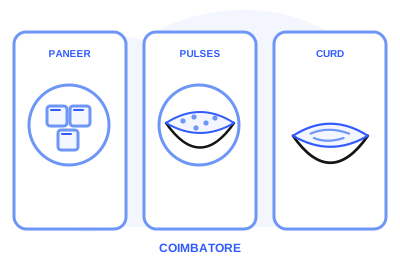
Vegetarian? Replace the eggs with another 100 g of sambar and a 200 ml glass of cow’s milk (IFCT: 146 kcal, 6.5 g of protein), and the chicken with 100 g of paneer cooked the same way; IFCT puts paneer at 305 kcal and 18.9 g of protein per 100 g. The day then comes to about 1,890 kcal and 70 g of protein, so drop the groundnuts or one chapati if you need to stay nearer 1,750. For more meal ideas built on idli, rice and dal, see our South Indian diet plan for weight loss.
Healthy lunch in Coimbatore when you eat out or order in
Searches for healthy restaurants, healthy lunch and healthy food delivery in Coimbatore mostly come from people eating near the office in Peelamedu, Saravanampatti or on Avinashi Road. We don’t review restaurants, but the same rules work anywhere:
- Full meals: eat one helping of rice, not two, and take a second ladle of sambar, kootu or poriyal instead. Ask for curd rather than payasam.
- Tiffin: idli or plain dosa with sambar beats parotta and kurma for calories. Add an omelette or egg podimas if the shop makes one.
- Biryani day: one plate is about 396 kcal in INDB’s recipe, but shop portions are often much bigger. Share, skip the extra gravy, and have raita.
- Millet meals: a good choice if the plate still has dal, curd or meat. A millet thali with only vegetables is light on protein.
- Meal subscriptions: before paying for a healthy food subscription, ask how many grams of protein each meal carries and how much oil goes in. A plan that can’t tell you isn’t planning your food.
Healthy staples are easy to find in the city’s markets: millets, horse gram, groundnuts, coconut, curd and seasonal vegetables from the Nilgiris and the farms around Pollachi. Keep the national guide to calories in Indian food bookmarked for dishes not listed here.
Pairing Coimbatore food with training
Food sets the direction; training decides whether the weight you lose is fat or muscle. Two or three strength sessions a week keep muscle while you eat less. With online personal training in Coimbatore, a coach on live video fits sessions around your working day and checks in on your food. If you trek or run, see treks near Coimbatore and marathons in Coimbatore for how to fuel those days.
Sources
- Indian Food Composition Tables 2017 (Longvah, Ananthan, Bhaskarachary, Venkaiah), ICMR-National Institute of Nutrition
- Development of an Indian Food Composition Database (Vijayakumar et al., 2024), Current Developments in Nutrition
- Indian Nutrient Databank (INDB): recipe data files, Jaacks Lab, GitHub
- Nutrient Requirements for Indians 2020: brief note (protein 0.83 g/kg/day), ICMR-National Institute of Nutrition
- Dietary guidelines across different countries and comparisons to Dietary Guidelines for Indians, 2024, Indian Journal of Medical Research
- Pallipalayam chicken (Kongunadu recipe and ingredients), Essence of Life
Written by the MakeMyFitness team from the sources above. First published , last updated . Spotted something out of date? Tell us at hello@makemyfitness.com.