Healthy food in Ghaziabad: a western UP kitchen next door to Delhi
Ghaziabad eats like the western Uttar Pradesh district it is. Kitchens in Kavi Nagar, Raj Nagar and the older colonies cook urad and moong dal, seasonal greens such as bathua, and milk, curd and paneer, while the towers of Indirapuram and Raj Nagar Extension add office lunches and delivery. Sugar runs through the region too: Modinagar, a Ghaziabad district town on the Delhi–Meerut road, has long been associated with sugar mills, and the district’s summer drinks, ganne ka ras and shikanji, are part of daily life from April to June.
This guide is built around those foods rather than restaurant menus. Raw ingredient values come from ICMR-National Institute of Nutrition’s Indian Food Composition Tables 2017 (IFCT). Cooked dishes come from the Indian Nutrient Databank (INDB), which calculates standard Indian recipes from IFCT values; we have left out INDB’s deep-fried recipes, because they count all the frying oil as eaten. Limits on sugar and the safe pace of weight loss come from ICMR-NIN’s Dietary Guidelines for Indians (2024). Home portions vary, so treat every number as a typical value.
Ganne ka ras, gur and Modinagar shikanji: counting the sugar
The single biggest food change most Ghaziabad residents can make in summer is to notice what they drink. ICMR-NIN’s 2024 guidelines ask adults to avoid sugar or keep it to 20–25 g a day. Sugarcane juice, which IFCT 2017 analysed directly, contains 12.85 g of free sugars per 100 g and almost no protein, so one ordinary glass takes you past that limit before lunch.
| Drink or food | Serving | Energy | Sugar | Source |
|---|---|---|---|---|
| Ganne ka ras (sugarcane juice) | 250 g glass | 145 kcal | 32 g | IFCT 2017 |
| Ganne ka ras, large | 350 g glass | 202 kcal | 45 g | IFCT 2017 |
| Sweetened lemonade (shikanji with sugar) | 349 g glass | 73 kcal | 19 g | INDB |
| Gur (cane jaggery) | 10 g piece | 35 kcal | 8.4 g | IFCT 2017 |
| Sweet lassi | 442 g glass | 158 kcal | 29 g | INDB |
The good news is Modinagar’s own version. The Delhi Walla’s 2026 account of Modinagar ki danedar shikanji describes its basic recipe as lemon, water, zeera and black salt, churned with finely crushed ice for its grainy texture, and notes that a typical shikanji includes sugar but doesn’t list sugar in the danedar mix. Ask for it salted, without sugar, and you get the cooling drink for close to no calories. You’ll find it well beyond Modinagar, including in Sita Ram Bazar, the market also known as Turab Nagar.
- Ganne ka ras: have a small glass after a long walk or a hot commute, not alongside lunch, and count it as your sweet for the day.
- Shikanji: order it namkeen (salted), or ask for half the sugar.
- Gur after meals: one 10 g piece is 35 kcal. The habit is fine; three pieces a day is about 25 g of sugar, the whole ICMR-NIN allowance.
Urad, moong and chana: the dals that carry protein in Ghaziabad homes
Western UP cooking leans on urad, both dhuli (washed) and sabut (whole), plus moong, chana dal and arhar. Weight for weight they are similar, so the amount in the bowl matters more than which dal you choose. The table uses IFCT 2017 values for 30 g of dry dal, a typical single serving before cooking.
| Dal (dry) | Energy | Protein | Fibre |
|---|---|---|---|
| Moong dal (green gram, split) | 98 kcal | 7.2 g | 2.8 g |
| Dhuli urad (black gram, split) | 97 kcal | 6.9 g | 3.6 g |
| Sabut urad (black gram, whole) | 87 kcal | 6.6 g | 6.1 g |
| Chana dal (Bengal gram, split) | 99 kcal | 6.5 g | 4.5 g |
| Arhar (red gram, split) | 99 kcal | 6.5 g | 2.7 g |
| Rajma (red kidney beans) | 90 kcal | 6.0 g | 5.0 g |
Cooked the INDB way, a bowl of dhuli urad dal (296 g) comes to 182 kcal and 7.4 g of protein, and a bowl of whole urad dal (339 g) to 183 kcal and 7.5 g. Washed moong dal is lighter at 139 kcal and 7.4 g for a 277 g bowl, because the recipe uses less fat. Most of the extra calories in a dal come from the tadka, so the ghee spoon decides more than the lentil does.
The catch is that one bowl of dal gives only about 7 g of protein, a small share of what most adults need in a day. Plan dal at two meals, then add milk, curd, paneer, eggs or soya. Our protein intake calculator sets your own target, and our protein in Indian food guide ranks every common source.
Bathua, gajar halwa and rabri: Ghaziabad’s winter food in numbers
From November to February, Ghaziabad’s mandis fill with bathua, carrots and mustard greens, and kitchens turn to gajar ka halwa and rabri. The greens are among the cheapest nutrition you can buy: IFCT lists raw bathua leaves at 28 kcal and 2.5 g of protein per 100 g. The sweets are where the winter weight comes from.
| Dish | Serving | Energy | Protein | Sugar |
|---|---|---|---|---|
| Bathua raita | 203 g bowl | 111 kcal | 8.4 g | 8.3 g |
| Besan-bathua cheela | 1 cheela, 30 g | 113 kcal | 3.5 g | 0.4 g |
| Bathua bhujia (dry sabzi) | 198 g bowl | 180 kcal | 4.5 g | 2.1 g |
| Gajar ka halwa | 168 g bowl | 290 kcal | 5.2 g | 28.3 g |
| Rabri | 220 g bowl | 226 kcal | 7.7 g | 22.2 g |
Bathua raita is the winter win: it has more protein than most sabzis because the base is curd, and it costs little. A bowl of gajar ka halwa, on the other hand, carries 28 g of sugar, more than a full day’s ICMR-NIN allowance, and 16 g of fat. If halwa is a family tradition, make it a weekend dessert in a small katori rather than a nightly one, and skip the gur that day.
Milk and paneer: using Uttar Pradesh’s dairy for protein
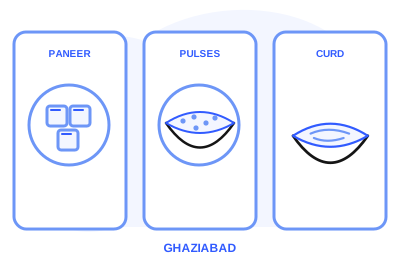
Uttar Pradesh produced about 38.8 million tonnes of milk in 2023–24, more than any other state, according to the National Dairy Development Board, so milk, dahi and paneer are easy to buy across Ghaziabad. Per IFCT 2017, a 250 g glass of whole cow’s milk gives 182 kcal and 8.2 g of protein, and the same glass of buffalo milk 268 kcal and 9.2 g. Paneer is 305 kcal and 18.9 g of protein per 100 g, so a 50 g portion adds about 153 kcal and 9.4 g. For fat loss, choose cow’s or toned milk and keep paneer to 50–75 g a meal; for muscle gain, buffalo milk is an easy way to add calories and protein together.
Healthy food options in Ghaziabad when you eat out or order in
People in Ghaziabad search for healthy restaurants and healthy food menus, but the same rules work at a dhaba in Raj Nagar or a cloud kitchen delivering to Crossings Republik:
- Pick a dal or a protein first: dal, chicken curry, egg curry, paneer or soya, then decide on the roti.
- Tandoori roti or phulka over paratha: a plain chapati is about 73 kcal in INDB; a tawa paratha with ghee on top is much more.
- Raita over boondi raita: INDB’s cucumber raita is 90 kcal with 6.2 g of protein; boondi is fried.
- Drinks: namkeen shikanji or chaas instead of ganne ka ras, sweet lassi or cold drinks.
- Sweets: share the halwa or rabri, and don’t add gur on the same day.
The swaps are the same ones that work in a Punjabi kitchen, so our Punjabi diet plan for weight loss is a good next read; most of its meal patterns fit a western UP home with almost no change.
A Ghaziabad commuter’s day at about 1,750 kcal
This day suits someone who leaves early on the Blue Line or Namo Bharat and carries a tiffin. It comes to about 1,750 kcal and 82 g of protein, a fat-loss intake for many moderately active adults. ICMR-NIN advises losing no more than about half a kilogram a week and never eating below 1,000 kcal a day, so find your own number with our calorie deficit calculator and adjust the roti count.
| When | What | Energy | Protein |
|---|---|---|---|
| Before leaving | 2 besan-bathua cheela, bathua raita, chai | 370 kcal | 16.2 g |
| On the way | 30 g peanuts | 156 kcal | 7.1 g |
| Tiffin lunch | 2 chapati, whole urad dal, half bowl matar paneer, cucumber raita | 605 kcal | 27.1 g |
| Evening | Chai and 1 boiled egg | 103 kcal | 7.5 g |
| Dinner | 2 chapati, soyabean curry (120 g), sabut moong dal | 485 kcal | 24.0 g |
| After dinner | 10 g gur | 35 kcal | 0.2 g |
Values: cheela, raita, chai, chapati, dals, matar paneer, egg and soyabean curry from INDB; peanuts and gur from IFCT 2017. Vegetarian? Swap the egg for a plate of sprouted moong chaat (83 kcal, 3.5 g of protein in INDB) and the day comes to about 1,730 kcal and 78 g. For more dishes, see our calories in Indian food chart.
If you already use a society gym, Personal Gym Training in Ghaziabad adds a coach on video to your sessions there, and Group Classes in Ghaziabad let neighbours from one tower train together. For costs, read gym fees in Ghaziabad and personal trainer fees in Ghaziabad; if you run, our guide to running tracks in Ghaziabad covers where to go and when the air allows it. Everything else is at online personal training in Ghaziabad.
Sources
- Indian Food Composition Tables 2017 (Longvah, Ananthan, Bhaskarachary, Venkaiah), ICMR-National Institute of Nutrition
- Dietary Guidelines for Indians (2024), ICMR-National Institute of Nutrition
- Indian Nutrient Databank (INDB): recipe nutrient dataset, Jaacks Lab, University of Edinburgh (GitHub)
- Development of an Indian Food Composition Database (Vijayakumar et al., 2024), Current Developments in Nutrition (via PubMed Central)
- City food: Modinagar ki danedar shikanji, around town (11 May 2026), The Delhi Walla
- Modinagar, Wikipedia
- State-wise milk production, National Dairy Development Board
Written by the MakeMyFitness team from the sources above. First published , last updated . Spotted something out of date? Tell us at hello@makemyfitness.com.