Kathiyawadi food in Rajkot: what it does well, and where it slips
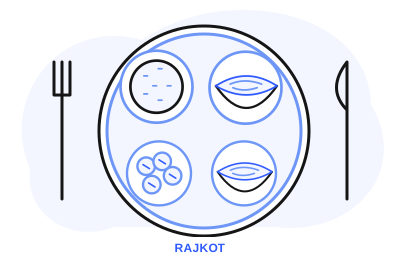
Rajkot eats Kathiyawadi. Restaurant India’s 2025 guide to the cuisine places it on “the dry, hot plains of the Saurashtra region” and lists its building blocks as garlic, red chilli, bajra, jaggery and onion, with Rajkot named first among cities for authentic Kathiyawadi meals. Wikipedia notes that, as in much of Gujarat, Rajkot’s people are primarily vegetarian.
For anyone trying to lose fat or build muscle, that is a strong starting point. Pearl millet is a whole grain, buttermilk comes with almost every meal, and dishes like ringan no olo are mostly vegetables. The weak spots are just as clear: dollops of white butter on hot rotla, jaggery in the shaak and on the side, generous oil in the masala, and ganthiya with morning tea. This page counts each one so you can decide where to cut.
Bajra rotla, with and without the butter
The thick pearl-millet rotla is the heart of a Kathiyawadi meal, served hot with white butter and chaas; a Saurashtra cook interviewed by Sahapedia in Jamnagar explains that bajra is preferred over wheat in winter. On the numbers, the flour itself is excellent: IFCT 2017 lists bajra at about 348 kcal, 11.0 g of protein and 11.5 g of dietary fibre per 100 g, a little more protein than whole wheat atta (10.6 g) and similar fibre.
| How it’s served | Calories | Protein | Values from |
|---|---|---|---|
| Plain rotla | about 174 kcal | 5.5 g | IFCT 2017 (bajra flour) |
| With 10 g of white butter | about 248 kcal | 5.5 g | Plus CoFID butter, 744 kcal per 100 g |
| With butter and 10 g of jaggery | about 284 kcal | 5.7 g | Plus IFCT 2017 jaggery, 354 kcal per 100 g |
So the rotla isn’t the problem; what goes on it can add more than half its energy again. If you love the butter, keep it to a thin layer on one rotla rather than a dollop on each, and save gol or jaggery for the end of the meal, if at all. ICMR-NIN’s 2024 guidelines advise keeping added sugars, jaggery included, below 5% of daily energy, which is about 90 kcal on an 1,800 kcal day.
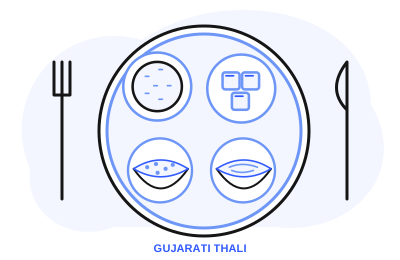
A Kathiyawadi thali, dish by dish
Where we have an analysed value, it’s from the Indian Nutrient Databank (INDB), a peer-reviewed set of 1,014 Indian recipes calculated from ICMR-NIN’s food composition tables, or the UK’s CoFID tables for a close match. Where we don’t, we say so.
| Dish | What’s in it | Calories and protein | Lighter move |
|---|---|---|---|
| Ringan no olo | Roasted brinjal mashed with garlic, chilli and onion | About 212 kcal and 4.5 g a bowl (INDB baingan bharta) | Ask for less oil; Kathiyawadi versions use more than most |
| Sev tameta nu shaak | Tomato curry topped with sev | No analysed value; sev is 478 kcal per 100 g (CoFID) | Sev on the side, one spoonful |
| Lasaniya bataka | Small potatoes in garlic and chilli masala | About 161 kcal and 2.2 g per 100 g (CoFID dry potato curry, closest match) | A side, not the main dish |
| Kadhi khichdi | Rice and moong dal khichdi with spicy besan-curd kadhi | Vegetable khichdi about 143 kcal and 5.6 g per 100 g (INDB); no value for kadhi | Ask whether the kadhi is sweetened |
| Raasawala methi thepla | Thepla soaked in a curd-based gravy | A methi thepla alone is about 126 kcal and 3.3 g (INDB) | Two thepla is plenty |
| Chaas | Salted buttermilk | About 80 kcal and 5.7 g a tall glass (INDB) | Keep it; it’s the best thing on the table |
| Gol papdi | Wheat flour, jaggery and ghee | No analysed value | A small square, on festival days |
The pattern is the same across the thali: the vegetables and pulses are light, and the energy arrives through oil, butter, sev and jaggery. Restaurant India also notes that Kathiyawadi ringan no olo uses more garlic and oil than North Indian baingan bharta, so treat the INDB figure as a floor, not a ceiling.
Ganthiya, farsan and morning tea in Rajkot
Ganthiya is the farsan most of Saurashtra grew up on. Wikipedia describes it as chickpea-flour dough with chilli, turmeric and ajwain, pressed through a thick sev mould into hot oil and fried until crisp, and notes that nearby Bhavnagar is famous for its varieties. The UK’s CoFID tables measure homemade sev/ganthia at 478 kcal, 18.8 g of protein and 25.1 g of fat per 100 g.
- A 50 g plate with tea is about 239 kcal and 12.6 g of fat before the chutney, more than a plain bajra rotla.
- Weigh it once. Pour your usual morning portion onto a kitchen scale; most people are surprised.
- Swap two days a week for something steamed or sprouted: a bowl of sprouted moong chaat is about 83 kcal in INDB.
- Keep fresh, not reheated, oil at home. ICMR-NIN advises against reheating and reusing frying oil.
Getting enough protein on a Rajkot vegetarian plate
ICMR-NIN puts the protein allowance for healthy adults at 0.83 g per kg of body weight a day, about 54 g for a 65 kg adult, and notes that above about 1.6 g per kg there is no further benefit for muscle gained from strength training. A Kathiyawadi thali usually lands short of the first number because bajra, potato and brinjal dominate the plate. The fixes are local and easy:
- A pulse at lunch and dinner: whole moong, chana or tuvar dal alongside the shaak, not instead of it. CoFID’s Gujarati whole moong curry is about 126 kcal and 6.0 g of protein per 100 g.
- Dairy at every meal: chaas, curd or raita. A bowl of raita gives about 6 g of protein in INDB.
- Paneer three or four times a week: 50 g is about 153 kcal and 9.4 g of protein by IFCT 2017 values.
- Groundnuts for snacks, in a measured handful: IFCT 2017 lists raw groundnut at about 520 kcal and 23.7 g of protein per 100 g.
Work out your own target with the protein intake calculator, and see our guide to protein in Indian food for more vegetarian sources.
Eating through a Rajkot summer
Rajkot’s heat changes what and how you should eat. India Meteorological Department normals for 1991–2020 give an average high of 39.6 °C in April and 41.0 °C in May, and almost no rain until June. ICMR-NIN notes that high temperatures and vigorous activity increase the sodium lost in sweat, so this is the season to keep salted chaas on the table rather than cut it.
- 1
Chaas over sherbet
A glass of salted chaas is about 80 kcal with 5.7 g of protein; sweet sherbets and cold drinks bring sugar and nothing else.
- 2
Lighter lunches
Khichdi, curd and a light shaak sit better in 40 °C afternoons than a butter-heavy rotla thali.
- 3
Train early
Exercise before 8 AM in April and May, when the city is at its coolest, and drink water through the morning.
- 4
Keep salt sensible
ICMR-NIN still advises about 5 g of salt a day for most adults; farsan and pickles add up even in summer.
A Kathiyawadi day at about 1,830 kcal
This vegetarian day uses the IFCT, INDB and CoFID values on this page and comes to about 1,830 kcal and 75 g of protein, with no butter, jaggery or farsan. Add them back deliberately, using the tables above, rather than by habit.
| Meal | What to eat | Calories | Protein |
|---|---|---|---|
| Breakfast | 2 methi thepla, a bowl of mint raita, tea with milk | about 368 kcal | 13.3 g |
| Mid-morning | A tall glass of salted chaas | about 80 kcal | 5.7 g |
| Lunch | A bajra rotla (75 g flour), a bowl of ringan no olo, 150 g whole moong | about 662 kcal | 21.7 g |
| Evening | Sprouted moong chaat, tea with milk | about 117 kcal | 4.3 g |
| Dinner | 250 g vegetable khichdi, cucumber raita, 50 g paneer | about 601 kcal | 29.6 g |
For fat loss: ICMR-NIN treats about half a kilogram a week as a safe rate of loss and says reducing diets shouldn’t fall below 1,000 kcal a day; set your own number with the calorie deficit calculator. For muscle gain: add a second pulse or another 50 g of paneer and train with steadily heavier loads. For a full week of Gujarati meals, see the Gujarati diet plan for weight loss, and calories in Indian food for many more dishes.
Healthy restaurants in Rajkot: ordering at a Kathiyawadi thali
Search for healthy restaurants in Rajkot and you’ll find cafes and diet-meal services alongside the city’s Kathiyawadi dhabas and thali restaurants. We don’t review them. At an unlimited thali, though, these habits keep the meal reasonable:
- Decide your rotla count before the first one arrives, and ask for butter on the side.
- Fill up on the shaak, dal and salad, and take the kadhi and sweet in a small katori.
- Skip the farsan plate that comes before the meal, or share it.
- Drink chaas, not cold drinks, and refuse the second round of gol papdi.
- Make the next meal light, such as khichdi and curd, instead of skipping it.
Comparing your options? See personal trainer fees in Rajkot and gym fees in Rajkot. Train at home with Personal Home Training in Rajkot or at your gym with Personal Gym Training in Rajkot, and find everything else at online personal training in Rajkot.
Sources
- Dietary Guidelines for Indians (2024), ICMR-National Institute of Nutrition
- Indian Food Composition Tables 2017 (Longvah et al.), ICMR-National Institute of Nutrition
- Indian Nutrient Databank (INDB): recipe nutrient dataset, Jaacks Lab, University of Edinburgh (GitHub)
- Development of an Indian Food Composition Database (Vijayakumar et al., 2024), Current Developments in Nutrition
- Composition of foods integrated dataset (CoFID), 2021, Public Health England, GOV.UK
- 8 famous veg Kathiawadi cuisines you should try on your next visit (5 November 2025), Restaurant India
- Kathiawadi cuisine: a meal in Latipur, Jamnagar, Sahapedia
- Ganthiya, Wikipedia
- Rajkot: culture and climate data, 1991–2020 normals (India Meteorological Department), Wikipedia
Written by the MakeMyFitness team from the sources above. First published , last updated . Spotted something out of date? Tell us at hello@makemyfitness.com.