Healthy food options in Mangalore start at the fish market
Coastal Karnataka cooks with rice, coconut and fish every day, and Mangaluru’s kitchens draw on Tuluva, Bunt, Konkani, Catholic and Beary traditions, alongside the strictly vegetarian Udupi tradition that began at the Sri Krishna Matha. For fat loss or muscle gain, that mix is a strong starting point. The fish is lean and cheap, the meals are built on steamed and boiled rice rather than fried bread, and the Udupi side brings dal-based saaru and sambar to every table. The problems are specific: ghee in the roasts, fresh coconut ground into almost every masala, and rice served until you say stop.
The numbers on this page come from three government or peer-reviewed sources. Raw ingredients are from the Indian Food Composition Tables 2017 (IFCT) published by ICMR-National Institute of Nutrition. Cooked dishes are from the Indian Nutrient Databank (INDB), a set of 1,014 Indian recipes analysed mainly from NIN data. Daily limits for oil and sugar are from ICMR-NIN’s Dietary Guidelines for Indians (2024). Where none of them has a Mangalorean dish, we say so rather than guess.
Protein in Mangalore’s everyday fish
Bangude, boothai and anjal are the fish most Mangaluru households know best, and they differ more than you’d think. Mackerel is among the leanest; oil sardine carries roughly half as much energy again because of its fish oil, which is useful fat but still counts. Prawns and clams have less protein per 100 g because they hold more water.
| Local name | IFCT entry | Energy (kcal) | Protein (g) |
|---|---|---|---|
| Bangude | Mackerel | 101 | 21.5 |
| Boothai | Sardine | 152 | 17.9 |
| Anjal | Vanjaram (seer fish) | 136 | 22.3 |
| Manji | Pomfret, white | 123 | 19.0 |
| Small fry for chutneys and sukka | Anchovy | 88 | 19.9 |
| Prawns | Tiger prawns, brown (marine) | 65 | 14.9 |
| Marvai | Clam, green shell | 58 | 12.1 |
| Squid | Squid, white, small | 84 | 17.4 |
| Crab | Crab, sea | 68 | 15.4 |
IFCT has no entry for kane (ladyfish), so we can’t give it a number. A 150 g piece of bangude, a typical home portion, comes to roughly 32 g of protein before any masala or oil is added, which is more than most people get from their whole breakfast.
Bangude pulimunchi, gassi and fry: how the cooking changes the count
Bangude pulimunchi, the tamarind-and-chilli mackerel the Ministry of Tourism’s Incredible India guide calls a traditional Mangalorean Sunday dish, is about the best way to eat fish here: the gravy is ground spices, onion, garlic and tamarind, with little or no coconut. A gassi, by contrast, is built on ground coconut, and fresh coconut is about 409 kcal per 100 g (IFCT); two heaped spoons of grated coconut, say 25 g, add about 100 kcal to the pot. The closest analysed dish, INDB’s fish curry with coconut milk, still comes out well: about 281 kcal and 28 g protein for a 326 g serving. Fry is the outlier. Rava-coated fish takes up oil in the pan, and INDB’s fried-fish recipe counts all the frying oil, so we don’t quote it; treat kane or anjal fry as the occasional plate, not the daily one.
| Dish | Per 100 g | INDB serving | Protein per serving |
|---|---|---|---|
| Fish curry with coconut milk | 86 kcal | 326 g dish, 281 kcal | 28.2 g |
| Fish curry, general recipe | 111 kcal | 254 g bowl, 282 kcal | 22.3 g |
| Prawn curry with coconut | 110 kcal | 286 g bowl, 313 kcal | 24.4 g |
| Chicken curry (closest to kori gassi) | 129 kcal | 248 g bowl, 320 kcal | 29.2 g |
| Boiled rice, cooked | 117 kcal | 1 plate from 100 g raw, 352 kcal | 7.8 g |
| Idli (same batter as kottige) | 138 kcal | 1 idli, 34 kcal | 1.2 g |
| Sambar | 97 kcal | 1 bowl, 249 kcal | 8.6 g |
| Saaru (tamarind rasam) | 27 kcal | 1 curry bowl, 104 kcal | 4.4 g |
| Huli anna (tamarind rice) | 373 kcal | 1 plate, 477 kcal | 9.5 g |
| Majjige (salted buttermilk) | 19 kcal | 1 tall glass, 80 kcal | 5.7 g |
Kori rotti and chicken ghee roast
Kori rotti is the city’s signature non-vegetarian plate: crisp, dry rice rotti broken into a coconut chicken gravy until they soften. The chicken itself is a good protein food. IFCT lists skinless broiler breast at 168 kcal and 21.8 g protein per 100 g, and country-hen breast with skin at 180 kcal and 22.1 g, which matters here because many Mangalorean recipes, including the Tulu kori ajadina, call for native chicken. INDB’s chicken curry gives about 29 g protein a bowl. The rotti is where the plate gets heavy, since each one is mostly rice and they are easy to keep adding. Ask for the curry first, take a measured stack of rotti, and fill out the plate with a vegetable palya.
Chicken ghee roast, which Incredible India traces to the Kundapur region of coastal Karnataka, is served with neer dosa or ghee rice. Ghee is pure fat, about 9 kcal a gram according to ICMR-NIN’s tables, so every 10 g left in the masala adds 90 kcal. ICMR-NIN suggests keeping all cooking oils and fats to about 25–30 g a day, and a restaurant ghee roast can use much of that on its own. Have it with two or three neer dosas rather than ghee rice, and keep it for weekends.
Udupi meals: the vegetarian plate and its protein gap
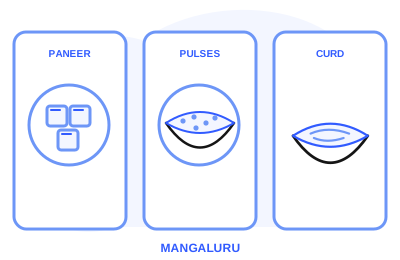
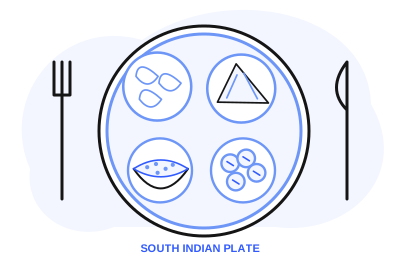
Udupi cuisine grew out of the Sri Krishna Matha, and Udupi hotels, which went on to spread across India, are also where the masala dosa is usually said to have been invented. A meals plate in Mangaluru follows that tradition: rice, saaru, sambar, palya, gojju, kosambari, a payasa and buttermilk. It is light on oil and heavy on vegetables, which suits fat loss. Its weakness is protein. Using INDB values, a full plate of rice with a bowl of sambar and a bowl of saaru is about 705 kcal with 21 g protein. Swap the sambar for a coconut fish curry and cut the rice to three-quarters, and the same lunch is about 649 kcal with 38 g protein.
- Ask for more sambar and less rice. Sambar carries most of the plate’s protein.
- Eat the kosambari. It is a salad of soaked moong dal; 30 g of dry moong dal is about 98 kcal and 7 g protein by IFCT values.
- Finish with majjige, not a second payasa. A glass of salted buttermilk is about 80 kcal with 5.7 g protein.
- Breakfast idli over dosa when protein is low. Three idlis are about 103 kcal, which leaves room for an egg or a bowl of sambar.
Rice in Mangaluru: boiled red rice and the size of the scoop
Many Mangalorean homes cook boiled (parboiled) red rice rather than polished white rice. ICMR-NIN advises getting at least half your cereals as whole or minimally polished grains, so that habit helps with fibre. The energy is much the same, though: IFCT lists parboiled milled rice at 352 kcal per 100 g raw, and white raw rice at 356. In practice a plate cooked from 100 g of raw rice, about 352 kcal by INDB, is where Mangalorean lunches start, and refills take it from there. For most people losing fat, three-quarters of a plate with fish and a vegetable is plenty. Ganji (rice gruel) with nungel meen chutney is lighter per bowl because it is mostly water, but it is still rice, so the same rule applies to the second bowl.
A 1,750 kcal day of Mangalorean food
This day uses dishes you can cook at home or order anywhere in Mangaluru, with INDB and IFCT values. It suits many men cutting fat and many women maintaining. Work out your own target with the calorie deficit calculator and change the rice and chapati to fit.
| When | Food | kcal | Protein (g) |
|---|---|---|---|
| Breakfast | 3 idlis, a bowl of sambar, 1 boiled egg | 421 | 18.8 |
| Mid-morning | A tall glass of majjige | 80 | 5.7 |
| Lunch | Three-quarters plate of boiled rice, coconut fish curry, a bowl of saaru | 649 | 38.5 |
| Evening | Tea with milk, 1 banana (100 g) | 139 | 2.0 |
| Dinner | 2 chapatis, chicken curry | 466 | 33.5 |
| Total | About 1,755 | About 98 |
For muscle gain, eat the full plate of rice at lunch, add a second egg at breakfast and a fourth idli, which together add about 190 kcal and 10 g protein; then add a second portion of fish or chicken on training days. For a vegetarian Udupi version, replace the fish curry with extra sambar and kosambari and the chicken curry with dal and curd; you will land nearer 60–70 g protein, so add milk, curd or paneer to close the gap. Our South Indian diet plan for weight loss has a full week of meals in this style.
Ordering in and eating out in Mangaluru
Healthy food delivery in Mangalore mostly means ordering the right dish from an ordinary restaurant, not finding a salad bar. These rules work on any menu, from a fish-meals hotel near Hampankatta to an Udupi restaurant in Kodialbail:
- Pick the fish or chicken by cooking method: pulimunchi, tawa-grilled or curry before fry, ghee roast or sukka with extra coconut.
- Count the carbohydrate pieces. Decide on two neer dosas, one plate of rice or a set of rotti before the food arrives.
- Add a vegetable. Palya, kosambari or a thoran-style dry vegetable fills the plate for little energy.
- Keep goli baje, buns and fried snacks for occasions. They are deep-fried, and the evening tea-time plate adds up fast.
- Watch the sweet drinks. ICMR-NIN suggests no more than 20–25 g of added sugar a day; a sweet tea or a milkshake can use half of it.
Training around Mangalorean food
A plan that keeps the rice and fish you like is easier to stick to than one that bans them, and two or three strength sessions a week make sure the weight you lose is mostly fat. For more foods by protein per serving, see protein in Indian food, and for calories in dishes from the rest of India, calories in Indian food. Set a daily protein target with the protein intake calculator. If you already lift at a gym, Personal Gym Training in Mangaluru puts a coach on your phone there; Personal Home Training in Mangaluru works in your living room through the monsoon. Fuelling for a long day in the hills? See treks near Mangaluru, and compare local options in gym fees in Mangaluru. Everything else is on online personal training in Mangaluru.
Sources
- Indian Food Composition Tables 2017, ICMR-National Institute of Nutrition
- Development of an Indian Food Composition Database (Vijayakumar et al., 2024), Current Developments in Nutrition
- Indian Nutrient Databank (INDB): recipe data, Jaacks Lab, University of Edinburgh (GitHub)
- Dietary Guidelines for Indians (2024), ICMR-National Institute of Nutrition (PDF hosted by Nutrition Connect)
- Food guide: 10 must-try local dishes in Mangalore, Incredible India, Ministry of Tourism
- Udupi cuisine, Wikipedia
Written by the MakeMyFitness team from the sources above. First published , last updated . Spotted something out of date? Tell us at hello@makemyfitness.com.