Healthy food in Agra: where the calories really are
Agra’s food has two faces. One is what visitors carry home: boxes of petha, packets of dalmoth and gajak. The other is what people who live here eat every week: bedai and jalebi for breakfast, thick parathas, the chaat stalls of Sadar Bazaar and the Mughlai kebabs, curries and naan that Incredible India credits to the city’s years as the Mughal capital. Almost all of it can fit a fat-loss or muscle-gain plan. What decides it is how often, how much, and how much ghee comes with it.
Every figure below has a named source. Raw ingredients such as ash gourd and guava come from ICMR-NIN’s IFCT 2017 tables. Cooked dishes come from INDB, the open Indian recipe database published by Vijayakumar and colleagues in 2024. For fried breads we use USDA survey data instead, because INDB’s deep-fried recipes assume every drop of the frying oil ends up in the food. Agra’s own versions of most dishes have never been analysed, so each row names the nearest dish that has.
| Agra food | Closest analysed match | Calories (kcal) | Protein (g) |
|---|---|---|---|
| Petha (before the syrup) | Ash gourd, raw, 100 g (IFCT) | 17 | 0.8 |
| Bedai | Plain puri, 36 g (USDA) | 147 | 2.5 |
| Aloo sabzi with bedai | Aloo ki sabzi, 1 bowl (INDB) | 181 | 3.1 |
| Stuffed paratha | Aloo paratha, 1 (INDB) | 191 | 3.5 |
| Paneer paratha | Paneer paratha, 1 (INDB) | 224 | 6.8 |
| Ghee on top | Ghee, 1 teaspoon (5 g), at 9 kcal per g of fat | 45 | 0 |
| Cheela from a chaat stall | Moong dal cheela, 1 (INDB) | 352 | 15.9 |
| Tandoori chicken | Tandoori chicken, 100 g (INDB) | 145 | 16.3 |
| Naan | Naan, 1 (INDB) | 152 | 4.3 |
Is Agra petha healthy? What it is made of
Petha is Agra’s signature sweet, and the Agra district administration lists it as the district’s dish under Uttar Pradesh’s One District, One Cuisine scheme, describing it as translucent, soft and made in a range of flavours. A handbook on petha making from NIFTEM, the Ministry of Food Processing Industries’ institute, says about 1,500 cottage units in Agra produce 700–800 tonnes of petha a day, with petha making concentrated in areas such as Noori Darwaza, Rawalpur and Johari Bazaar.
The process explains the calories. Ash gourd (white pumpkin) is cut, cured in lime water (calcium hydroxide) so the pieces keep their shape, boiled, and then cooked in sugar syrup brought to 65–70° Brix, which means the syrup is 65–70% sugar by weight. The gourd itself is almost nothing: IFCT gives 17 kcal and 0.8 g protein per 100 g of raw ash gourd, and NIFTEM’s handbook gives 13 kcal. Nearly all of the energy in a piece of petha comes from the syrup it soaks up, and there is almost no protein or fat to go with it.
- Is petha healthier than other mithai? It has no ghee or khoya, which helps, but it is still mostly sugar, and India’s national nutrition institute advises adults to keep added sugar to about 25 g a day.
- Flavoured versions such as kesar, angoori, paan and chocolate petha differ mainly in flavouring, and some add coconut or nuts. None of them changes the sugar much.
- Dalmoth and gajak are Agra’s other take-home foods; Incredible India describes dalmoth as a savoury lentil snack. We found no reliable figures for either, so pour a small bowl instead of eating from the packet.
A side note on history: NIFTEM’s handbook repeats the popular story that petha was created in Shah Jahan’s kitchens while the Taj Mahal was being built, but Wikipedia’s petha article points out that the sweet does not appear in Shah Jahan’s own cookbook and calls the legend highly unlikely. Either way, it is an old Agra sweet, and an occasional piece is part of living here.
Bedai and jalebi: the Agra breakfast, in numbers
Outlook Traveller describes the bedai as essentially a kachori made of black lentils, served with a spicy potato curry, followed by jalebi to balance the spice, and calls bedai-jalebi Agra’s popular breakfast. It is a fried bread with a fried sweet, so it is a weekend breakfast rather than a weekday one. We found no usable figure for bedai itself; the nearest analysed food, a 36 g plain puri, is about 147 kcal, and a bedai stuffed with dal is not going to be lighter. Two bedai with a bowl of aloo sabzi start at about 475 kcal, before the jalebi, which is batter fried and soaked in syrup and has no reliable published value either.
On the other five or six mornings, a breakfast with 15–25 g of protein tends to keep you fuller until lunch and leaves room for bedai on Sunday. Any of these works in an Agra kitchen:
| Breakfast | Calories (kcal) | Protein (g) | Why it helps |
|---|---|---|---|
| Paneer-stuffed cheela | 436 | 24.3 | Most protein of any breakfast here |
| Moong dal cheela with salted lassi | 432 | 21.6 | Vegetarian, no frying |
| Two-egg bhurji with one chapati | 291 | 16.5 | Quick before work |
| Paneer paratha with salted lassi | 303 | 12.5 | Keeps the paratha, adds protein |
| Vegetable poha with two boiled eggs | 314 | 18.2 | Light, and easy to pack for work |
Thick parathas in ghee: ordering one in Agra
Agra’s paratha shops are known for their generosity: Outlook Traveller describes one Belanganj shop as famed for “thick parathas doused in ghee”. The paratha is not the problem; the ghee is. INDB puts a home-style aloo paratha at about 191 kcal and a paneer paratha at about 224 kcal with 6.8 g protein. Ghee is pure fat at 9 kcal per gram, so every teaspoon poured on top adds about 45 kcal. Three teaspoons on two parathas is another 135 kcal, and the Dietary Guidelines for Indians suggest limiting ghee or butter to one or two teaspoons a day in total.
- Choose paneer or dal-stuffed over plain or aloo: more protein for a similar count.
- Ask for ghee on the side and add one teaspoon yourself.
- Two parathas, not three, with curd or raita. A bowl of cucumber raita is about 90 kcal with 6 g protein.
- Make it lunch, not breakfast and lunch. A paratha meal is a full meal.
Sadar Bazaar’s Chaat Gali: the lighter plates
Agra’s famous chaat street is the Chaat Gali in Sadar Bazaar. Incredible India lists bhalla, raj kachori and gol gappe among Agra’s street food, and Outlook Traveller adds dahi bhalla, pav bhaji and cheela. Most of these are fried or buttered, but the cheela is a real meal: INDB’s moong dal cheela, the closest analysed version, is about 352 kcal with 15.9 g protein, and a paneer-stuffed cheela about 436 kcal with 24.3 g. If you are eating in Sadar on a training day, that is the order.
- Cheela, with green chutney rather than the sweet one.
- Gol gappe, one round, as a snack rather than a meal. The puris are fried.
- Dahi bhalla and raj kachori are fried dough with sweet chutney and curd. Share a plate.
- Pav bhaji comes with buttered pav; ask for less butter and have one pav, not two.
- Sprouted moong chaat, where a stall offers it, is about 83 kcal a plate (INDB).
There is a second reason to keep fried plates occasional. ICMR-NIN advises against frying in the same oil again and again, because reheated oil breaks down into harmful compounds, and a stall frying bhallas all evening is the obvious example.
Mughlai food in Agra: kebabs, curries and naan
For a high-protein meal out in Agra, the Mughlai menu is the best place to look, as long as you order from the tandoor rather than the cream gravies. These are INDB values per serving:
| Order | Portion | Energy (kcal) | Protein (g) |
|---|---|---|---|
| Mutton seekh kebab | One | 60 | 5.1 |
| Tandoori chicken | 100 g | 145 | 16.3 |
| Boti kebab | 1 kebab | 73 | 5.0 |
| Chicken curry | 1 bowl | 320 | 29.2 |
| Palak paneer | 1 bowl | 230 | 11.9 |
| Kadhai paneer | 1 bowl | 344 | 13.8 |
| Paneer tikka | 1 plate | 412 | 22.4 |
| Mutton korma | 1 bowl | 424 | 26.0 |
| Mutton biryani | 208 g plate | 396 | 15.3 |
| Naan | One | 152 | 4.3 |
A plate of 200 g of tandoori chicken, a naan and a salad comes to about 570 kcal with close to 46 g protein. Swap the chicken and salad for mutton korma and a plate of biryani and the total jumps to about 970 kcal, for the same 46 g. Same protein, very different day. Vegetarian? Paneer tikka or palak paneer with dal is the order, and the high-protein vegetarian Indian diet guide builds a whole week that way.
Looking for healthy restaurants in Agra? Big chains and centrally licensed hotel restaurants must, under FSSAI’s 2022 menu-labelling guidance, print each dish’s energy in kcal beside it, so a calorie column on the menu is worth looking for. In smaller places, ask whether the paneer or chicken goes into the tandoor or into a cream gravy.
A 1,700 kcal day of Agra food
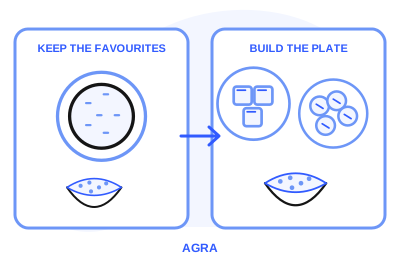
This example day is about 1,670 kcal with 95 g of protein, leaving room for a piece of petha or a small sweet. The right total for you will differ with your weight, height, age and how active you are; use the calorie deficit calculator to find your own number and scale the portions.
| Time of day | On the plate | Energy (kcal) | Protein (g) |
|---|---|---|---|
| Morning | Paneer paratha with no extra ghee, a glass of chaach-style salted lassi | 303 | 12.5 |
| Midday | Two chapatis, sabut moong dal with tadka, palak paneer, cucumber raita | 609 | 29.6 |
| Tea time | Chai, a plate of moong sprouts chaat, 200 g guava | 181 | 7.2 |
| Night | 200 g tandoori chicken, one naan, a bowl of curd-dressed vegetables | 573 | 46.0 |
| Whole day | 1,666 | 95.3 |
- No chicken: INDB’s plate of paneer tikka (412 kcal, 22.4 g protein) plus one chapati takes the place of the tandoori chicken and naan.
- For muscle gain: add a second paratha in the morning and an extra bowl of dal at night, and check your target with the protein intake calculator.
- Bedai Sunday: have bedai with aloo sabzi in the morning, drop the tea-time plate and leave the rest of the day alone.
Our national guides to protein in Indian food and calories in Indian food cover the wider Indian plate beyond Agra’s own dishes.
Everything we offer in the city is on online personal training in Agra; for one-to-one coaching, see personal home training in Agra and personal gym training in Agra. If you’re comparing costs, see gym fees in Agra and personal trainer fees in Agra. And if a race is the goal, our guide to the Agra Taj Half Marathon has a training plan.
Sources
- One District One Cuisine: Petha, District Administration Agra, Government of Uttar Pradesh
- Handbook of Preparation of Petha (PM FME scheme), NIFTEM, Ministry of Food Processing Industries
- Agra, Incredible India, Ministry of Tourism
- Foodie’s Delight: A Guide To Eating Through Agra (June 2024), Outlook Traveller
- Petha, Wikipedia
- Indian Food Composition Tables 2017 (Longvah, Ananthan, Bhaskarachary, Venkaiah), ICMR-National Institute of Nutrition
- Development of an Indian Food Composition Database (INDB) (Vijayakumar et al., 2024), Current Developments in Nutrition
- Dietary Guidelines for Indians (2024), ICMR-National Institute of Nutrition
- FoodData Central datasets: FNDDS 2021–2023 (puri), U.S. Department of Agriculture
- Guidance note on menu labelling (23 February 2022), Food Safety and Standards Authority of India
Written by the MakeMyFitness team from the sources above. First published , last updated . Spotted something out of date? Tell us at hello@makemyfitness.com.