Healthy food in Delhi: start with the numbers
Delhi eats out more boldly than most cities: chole bhature for a Sunday breakfast, paranthas in Old Delhi, momos at every Metro exit, kebabs and butter chicken for dinner. None of it is off limits on a fat-loss or muscle-gain plan, but the gap between the best and worst order on the same menu is often 300 kcal or more. This guide puts approximate calories and protein on Delhi’s signature dishes so you can see that gap, then builds a full day of Delhi food at about 1,800 kcal.
The numbers come from the Indian Food Composition Tables 2017 (IFCT, ICMR-National Institute of Nutrition), the open Indian Nutrient Databank (INDB), which calculates standard recipes from IFCT values, USDA FoodData Central for dishes INDB lacks, and a lab study of snacks bought from vendors in north-east Delhi. Restaurant versions vary, so treat every figure as typical, not exact.
Calories and protein in Delhi’s signature dishes
The table lists Delhi’s most-ordered dishes with the serving the source uses. INDB recipes come from Indian cookery textbooks, so dhaba and restaurant versions finished with extra butter, cream or oil will be higher. Where a dish needed two sources, the note says how we combined them.
| Dish | Serving | Calories | Protein | Source |
|---|---|---|---|---|
| Chole (white chickpea curry) | 1 bowl, 120 g | 196 kcal | 7.3 g | INDB |
| Bhatura | 1 bhatura, about 52 g | about 190–215 kcal | about 3.6 g | Delhi lab weight, USDA fried puri values |
| Chole bhature plate | 1 bowl chole, 2 bhature | about 570–620 kcal | about 14 g | Sum of the two rows above |
| Aloo paratha (tawa) | 1 paratha, 93 g | 191 kcal | 3.5 g | INDB |
| Paneer paratha (tawa) | 1 paratha, 85 g | 224 kcal | 6.8 g | INDB |
| Keema paratha (tawa) | 1 paratha, 100 g | 238 kcal | 9.4 g | INDB |
| Samosa | 1 samosa, 47–100 g | about 145–310 kcal | 2.4–5.1 g | USDA, per 100 g scaled |
| Rajma chawal | 1 bowl rajma, 300 g rice | 524 kcal | 14.9 g | INDB |
| Butter chicken | 275 g serving | 377 kcal | 30.1 g | INDB |
| Tandoori chicken | 100 g | 145 kcal | 16.3 g | INDB |
| Mutton seekh kebab | 1 kebab, 45 g | 60 kcal | 5.1 g | INDB |
| Momos, steamed (meat) | 6 pieces, 150 g | about 170 kcal | about 10.4 g | USDA steamed dumpling |
| Momos, fried (meat) | 6 pieces, 150 g | about 288 kcal | about 13.1 g | USDA fried dumpling |
| Lassi, sweet / salted | 1 tall glass, about 440 g | 158 / 80 kcal | 5.7 g | INDB |
Old Delhi street food: what the fryer adds
The Delhi snacks with the worst ratio of calories to protein are the deep-fried ones, and there is local lab evidence for how much fat they carry. In a study published in 2016 in the Journal of Nutrition Education and Behavior, researchers bought freshly made snacks from vendors in Chanderpuri, a low-income neighbourhood in north-east Delhi, in February and March 2013, and measured the fat in a lab:
- Kachori: a 54 g kachori held 25.1 g of fat. At 9 kcal per gram, that is about 225 kcal from fat alone, before the flour and dal filling.
- Samosa: a 47 g samosa held 13.6 g of fat, about 122 kcal from fat.
- Aloo tikki: a 45 g tikki held 12.4 g of fat, about 112 kcal from fat, before any chole, curd or chutney goes on top.
- Bhatura: a 52 g bhatura held 10.2 g of fat, the lowest of the fried breads tested.
The oils the researchers sampled from vendors contained anywhere from 0.1% to 29.9% trans fat, and freshly fried, unpackaged snacks had more fat and trans fat than packaged ones. ICMR-NIN’s Dietary Guidelines for Indians (2024) also advise against reheating and reusing frying oil, which is exactly what a busy street kadhai does all day. None of this means you can never eat a samosa in Chandni Chowk; it means a fried snack is a treat you plan for, not an everyday 5 PM habit.
Chaat without the extra 300 kcal
Delhi chaat is built on a fried base (papdi, tikki or bhalla) and finished with curd and two chutneys. The curd helps: it adds protein. The sweet tamarind chutney is the quiet extra, at about 25 kcal per teaspoon serving in INDB’s saunth chutney recipe. Ask for extra curd and less saunth, choose a chickpea or sprouts chaat over a papdi or tikki base, and share a plate rather than finishing two. INDB’s sprouted moong chaat is just 83 kcal and 3.5 g of protein for a 256 g plate, about the cheapest chaat you can eat on a diet.
Paranthas: count the ghee, not just the stuffing
A tawa aloo paratha from a textbook recipe is about 191 kcal and a paneer paratha about 224 kcal (INDB). Restaurant and street paranthas usually use more ghee or butter than a textbook recipe, and every teaspoon (5 g) adds about 45 kcal. For a breakfast that keeps you full, pick one keema or paneer parantha (6.8–9.4 g of protein), add a bowl of curd or raita, and skip the second parantha rather than the curd.
High protein meals in Delhi: kebabs, tikka and the tandoor
Delhi’s Mughlai and Punjabi grills are the city’s best high-protein food. ICMR-NIN’s guidelines note that grilling helps lower calorie intake because fat melts and drips off, and they advise turning meat often so it doesn’t char. The difference shows in the numbers: tandoori chicken, Afghani chicken and fish tikka give 10 to 14 g of protein per 100 kcal, while butter chicken, made from similar chicken, gives about 8 g because of the butter and cream sauce.
| Dish | Serving | Calories | Protein |
|---|---|---|---|
| Tandoori chicken | 200 g | 290 kcal | 32.6 g |
| Afghani chicken | 190 g plate | 288 kcal | 29.7 g |
| Fish tikka | 4 pieces, 144 g | 167 kcal | 22.8 g |
| Mutton seekh kebab | 4 kebabs, 180 g | 241 kcal | 20.4 g |
| Mutton boti kebab | 4 pieces, 220 g | 291 kcal | 20.0 g |
| Keema matar | 344 g bowl | 457 kcal | 29.0 g |
| Butter chicken | 275 g | 377 kcal | 30.1 g |
| Paneer tikka | 439 g plate | 412 kcal | 22.4 g |
| Dal makhani | 354 g bowl | 262 kcal | 11.7 g |
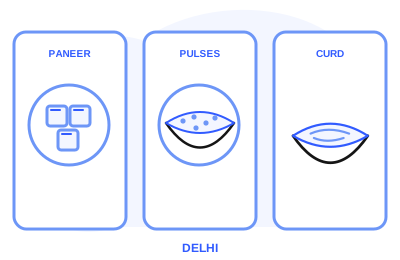
For vegetarians, paneer tikka is the Delhi menu’s best protein, and dal makhani is a fair second if the cream and butter are light. Use roti instead of naan or a butter-brushed laccha paratha, and order one gravy dish to share with a dry tandoor dish rather than two gravies. Our national chart of protein in Indian food has the raw values for paneer, dals, eggs and meat if you cook at home.
Momos in Delhi: steamed beats fried
Momos are one of Delhi’s favourite evening snacks, sold from carts all over the city. There is no Indian lab analysis of Delhi momos that we could find, so we use USDA’s values for meat dumplings. Steamed, they come to about 113 kcal and 6.9 g of protein per 100 g; fried, about 192 kcal and 8.8 g. USDA counts a dumpling as about 25 g, so a plate of six steamed chicken momos is roughly 170 kcal and 10 g of protein, while six fried ones are about 288 kcal. Momo sizes vary a lot, so weigh your usual plate once if you track closely.
- Choose steamed. ICMR-NIN’s guidelines prefer steam or pressure cooking over deep frying, and here it saves about 120 kcal a plate.
- Choose chicken over veg when you want protein. Cabbage and onion fillings add little.
- Skip the creamy versions. Afghani and cream-coated momos add fat; red chilli chutney is the lighter dip.
If you want to try regional dumplings and grills in one place, Dilli Haat INA, the crafts and food bazaar opposite INA Market set up by Delhi Tourism and NDMC, has food stalls from different states and union territories, including momos from Sikkim and kahwa and kebabs from Jammu. Delhi Tourism’s page lists it as open daily from 11 AM to 8 PM, with a small entry ticket (₹20–30 for an adult on the same page; checked October 2026), and INA is the nearest Metro station on the Yellow Line. A cup of Kashmiri kahwa is about 64 kcal in INDB’s recipe, far lighter than a sweet lassi.
Winter food in Delhi: halwa, daulat ki chaat and saag
Delhi’s cold months bring their own menu, and it leans rich. Gajar ka halwa is about 290 kcal and 5.2 g of protein for a 168 g bowl, and a 220 g bowl of rabri about 226 kcal and 7.7 g (INDB). Sarson ka saag is light on its own, about 124 kcal a bowl, but a makki di roti is about 224 kcal before the white butter goes on.
Old Delhi’s daulat ki chaat is the season’s most famous sweet: milk churned into a froth and finished with khoya, sugar, saffron and cardamom. Outlook Traveller reports it is sold only from November through January, from vendors in the lanes around Chandni Chowk such as Dariba Kalan, Kinari Bazaar and Chawri Bazaar. We couldn’t find a reliable calorie analysis for it, so we haven’t put a number on it here. Winter is also smog season, when many Delhiites stop walking and running outdoors; if that’s you, see our guide to running tracks in Delhi for the months with cleaner air, and keep the halwa to weekends while your activity is down.
Better and worse orders on a Delhi menu
For fat loss, the aim is fewer calories for the same protein. For muscle gain, the aim is more protein, with calories from food that also brings protein. These swaps use the values above:
| Instead of | Try | What changes |
|---|---|---|
| Chole bhature (about 570–620 kcal, 14 g protein) | Chole with 2 phulkas and a bowl of raita | About 432 kcal and 17.7 g protein: roughly 140–190 kcal less, more protein |
| Six fried momos (about 288 kcal) | Six steamed chicken momos | About 170 kcal: saves roughly 120 kcal |
| Butter chicken (377 kcal, 30.1 g) | 200 g tandoori chicken | 290 kcal and 32.6 g: fewer calories, more protein |
| Two aloo paranthas with 2 tsp ghee on top | One keema paratha and a bowl of raita | About 472 kcal and 7 g protein becomes 328 kcal and 15.6 g |
| Sweet lassi (158 kcal) | Salted lassi or chaas | 80 kcal, same 5.7 g of protein |
| A 100 g samosa (about 310 kcal, 5.1 g) | Sprouts chaat with extra curd | Under 200 kcal with more protein and fibre |
On a muscle-gain plan you can keep the paranthas and rajma chawal; just make sure each meal has a protein anchor such as paneer, dahi, eggs, chicken or a second bowl of dal. Work out your daily number with our protein intake calculator.
A day of Delhi food at about 1,800 kcal
This sample day uses only Delhi staples and comes to about 1,820 kcal and 92 g of protein, Your own target may be higher or lower. ICMR-NIN considers losing about half a kilogram a week safe and says weight-loss diets should not drop below 1,000 kcal a day. Find your own target with the calorie deficit calculator, then scale portions up or down.
| When | What | Calories | Protein |
|---|---|---|---|
| Breakfast | 1 paneer paratha (tawa, no butter on top), 1 bowl cucumber raita, chai | 348 kcal | 13.8 g |
| Mid-morning | 150 g guava, 20 g roasted peanuts | 152 kcal | 6.9 g |
| Lunch | Rajma (120 g bowl), 150 g rice, 1 roti, salted lassi | 501 kcal | 18.8 g |
| Evening | 6 steamed chicken momos, red chutney | 170 kcal | 10.4 g |
| Dinner | 150 g tandoori chicken, 2 roti, dhuli moong dal, onion-cucumber salad | 502 kcal | 36.1 g |
| Bedtime | 200 ml cow’s milk | 146 kcal | 6.5 g |
Values: paratha, raita, chai, rajma, rice, roti, lassi, tandoori chicken and dal from INDB; guava, peanuts and milk from IFCT 2017; momos from USDA. Vegetarian? Swap the tandoori chicken for half a plate of paneer tikka (about 206 kcal, 11.2 g protein) and the momos for 200 g of dahi with roasted jeera; the day comes to about 1,760 kcal with about 76 g of protein. For a full week of North Indian meals, see the Punjabi diet plan for weight loss, and for more dishes, the calories in Indian food chart.
Eating out and office lunches in Delhi
Most Delhi office lunches are a canteen thali, a dabba from home or a quick order near the Metro. A few habits make all three work:
- 1
Build the thali around dal and dahi
A bowl of dhuli moong dal is about 139 kcal and 7.4 g of protein, and a bowl of raita about 90 kcal and 6.2 g (INDB). Take both, then add roti before rice.
- 2
Order one dry protein dish
Tandoori chicken, fish tikka, seekh kebab or paneer tikka with roti and salad beats two gravies and naan.
- 3
Ask for less
“Butter kam”, “cream mat daalo” and “chutney alag se” are normal requests in Delhi. Each teaspoon of ghee or butter you skip saves about 45 kcal.
- 4
Keep the fried snack for the weekend
Plan a samosa, kachori or chole bhature into one meal a week, and eat lighter around it, instead of a daily 5 PM pakora.
- 5
Drink chaas, not sweet lassi or soft drinks
ICMR-NIN advises keeping added sugar under 5% of your daily calories. A salted lassi saves about 78 kcal over a sweet one.
If you already have a colony or society gym, Personal Gym Training in Delhi puts a coach on your phone for every set, and Group Classes in Delhi are ₹499 a session per person. Compare costs in our guides to gym fees in Delhi and personal trainer fees in Delhi, or see everything on online personal training in Delhi.
Sources
- Indian Food Composition Tables 2017 (Longvah, Ananthan, Bhaskarachary, Venkaiah), ICMR-National Institute of Nutrition
- Dietary Guidelines for Indians (2024), ICMR-National Institute of Nutrition
- Indian Nutrient Databank (INDB): recipe nutrient dataset, Jaacks Lab, University of Edinburgh (GitHub)
- Development of an Indian Food Composition Database (Vijayakumar et al., 2024), Current Developments in Nutrition
- FoodData Central datasets (FNDDS survey foods: samosa, puri, dumplings), U.S. Department of Agriculture
- Unhealthy fat in street and snack foods in low-socioeconomic settings in India (Gupta et al., 2016), Journal of Nutrition Education and Behavior (via PubMed Central)
- Dilli Haat INA, Delhi Tourism
- The snack of wealth (daulat ki chaat), Outlook Traveller
Written by the MakeMyFitness team from the sources above. First published , last updated . Spotted something out of date? Tell us at hello@makemyfitness.com.