Healthy food in Noida: the office day decides it
Noida’s eating pattern is set by work. Weekday lunch is usually a food court or canteen around the Sector 62 offices or a quick bite in Sector 18, dinner after a long Expressway commute is often delivered, and weekends bring back the Uttar Pradesh home breakfast: bedmi puri, aloo sabzi and jalebi. Greater Noida adds a large student population eating hostel and mess thalis. So this guide is less about famous restaurants and more about the orders you repeat five days a week.
Values come from the Indian Nutrient Databank (INDB), which calculates 1,014 standard Indian recipes from ICMR-NIN’s Indian Food Composition Tables 2017 (IFCT), from IFCT itself for raw foods, and from USDA FoodData Central where INDB has no usable entry. Food-court and cloud-kitchen portions vary, so treat these as typical values and check the calories shown on the menu when there are any.
Food-court lunches in Sector 18 and Sector 62: calories and protein
Noida’s office food courts serve the same short list almost everywhere: rolls, Indo-Chinese, biryani, South Indian, rajma or chole rice, sandwiches and a thali counter. Here is how they compare. The last column is the one that matters most if you are trying to stay full on fewer calories.
| Order | Serving | Calories | Protein | Protein per 100 kcal |
|---|---|---|---|---|
| Chicken sandwich, toasted | 2 triangles, 170 g | 286 kcal | 20.6 g | 7.2 g |
| Chicken biryani (USDA, home-style) | 1 cup, 196 g | 204 kcal | 14.0 g | 6.9 g |
| Chicken manchurian | 445 g plate | 633 kcal | 42.4 g | 6.7 g |
| Paneer-matar sandwich, toasted | 2 triangles, 178 g | 444 kcal | 22.0 g | 5.0 g |
| Chilli chicken | 387 g bowl | 769 kcal | 37.0 g | 4.8 g |
| Chicken chowmein | 344 g plate | 521 kcal | 21.8 g | 4.2 g |
| Mutton biryani | 208 g plate | 396 kcal | 15.3 g | 3.9 g |
| Chole with 2 roti | 120 g bowl, 2 roti | 342 kcal | 11.5 g | 3.4 g |
| Rajma chawal | 120 g rajma, 300 g rice | 524 kcal | 14.9 g | 2.8 g |
| Pav bhaji | 1 serving, 581 g | 561 kcal | 15.5 g | 2.8 g |
| Paneer kathi roll | 1 roll, 148 g | 424 kcal | 10.3 g | 2.4 g |
| Veg chowmein | 300 g plate | 389 kcal | 9.2 g | 2.4 g |
| Masala dosa | 1 dosa, 210 g | 345 kcal | 6.9 g | 2.0 g |
| Veg biryani | 302 g plate | 527 kcal | 9.5 g | 1.8 g |
Three patterns stand out. First, the Indo-Chinese chicken dishes are high in protein but also high in calories: a bowl of chilli chicken is close to 770 kcal before any fried rice. Second, the vegetarian food-court staples (rolls, chowmein, dosa, veg biryani) give only about 2 g of protein per 100 kcal, so a lunch built on them leaves you hungry by 4 PM. Third, USDA’s home-style chicken biryani is far lighter than a typical restaurant plate; INDB’s mutton biryani, made with more fat, is about 396 kcal for just 208 g.
What to order at a Noida food court
- For fat loss: toasted chicken or paneer sandwiches, a thali with dal, roti and raita, or half a plate of chicken manchurian shared, with no fried rice.
- For muscle gain: chicken biryani or rajma chawal plus a side of raita or two boiled eggs, so the extra calories bring protein with them.
- Vegetarian: a kathi roll alone is light on protein. Add a salted lassi (80 kcal, 5.7 g protein in INDB) or a bowl of raita (90 kcal, 6.2 g), or pick the paneer sandwich instead.
- Ask for less: gravy on the side, no extra cheese or mayonnaise in rolls, and half rice. These change calories more than switching from one counter to another.
Ordering in: reading calories on Noida delivery apps
Noida orders in a lot, especially after evenings on the DND Flyway or the Noida–Greater Noida Expressway. Since 1 January 2022, FSSAI’s menu-labelling rules have required calorie values, per serving and with the serving size, on menus of food businesses with a central licence or outlets at ten or more locations, including chain restaurants, canteens, cloud kitchens and dhabas, and on e-commerce platforms selling their food. Menus must also carry the line that an average active adult needs 2,000 kcal a day.
Two things to know before you trust the number on an app. FSSAI’s guidance allows a 25% deviation in the declared calorie value, so a dish listed at 600 kcal could be 750. And kitchens with fewer than ten outlets and no central licence aren’t covered at all. Use the label to compare dishes, not to count to the last calorie, and fall back on the tables in this guide for anything unlabelled.
- 1
Pick the protein first
Choose the dish by its protein source (tandoori chicken, chicken curry, paneer tikka, egg curry, dal) before choosing the bread or rice.
- 2
Order roti, not naan or paratha
A plain roti is about 73 kcal in INDB; a laccha or butter naan is much more once the butter goes on.
- 3
Add a salad and raita to the cart
Raita adds about 6 g of protein for 90 kcal, and salad adds volume for almost nothing.
- 4
Keep tomorrow’s lunch in mind
Order a single portion and split it across dinner and next day’s lunch box if the serving is meant for two.
UP home food in Noida: bedmi puri, dal and sabzi
Many Noida families cook in the western UP style: arhar dal, lauki, aloo sabzi, chana dal and, on Sundays, bedmi puri, a puri made with urad dal, served with a thin aloo sabzi. The everyday dishes are light and decent for protein. The Sunday breakfast is where the calories are.
| Dish | Serving | Calories | Protein |
|---|---|---|---|
| Arhar dal with palak | 404 g bowl | 213 kcal | 8.3 g |
| Chana dal with lauki | 279 g bowl | 204 kcal | 7.8 g |
| Mixed dal | 298 g bowl | 184 kcal | 7.5 g |
| Aloo matar | 277 g bowl | 280 kcal | 9.7 g |
| Aloo ki sabzi (thin, with puri) | 201 g bowl | 181 kcal | 3.1 g |
| Plain puri (USDA) | 1 puri, 36 g | 147 kcal | 2.5 g |
| 2 puris and aloo sabzi | 2 puris, 1 bowl | about 475 kcal | about 8 g |
| Chapati | 1 chapati, 36 g | 73 kcal | 2.1 g |
We couldn’t find a reliable analysed value for bedmi puri itself. INDB’s dal-stuffed puri recipe counts all the frying oil as eaten, which gives an impossible 930 kcal per puri, so we left it out. A plain 36 g puri is about 147 kcal (USDA), and bedmi puris are usually larger and contain urad dal, so treat two bedmi puris with aloo as at least 475 kcal. Have them on a Sunday, add a bowl of curd for protein, and skip the jalebi or keep it to one piece.
For an everyday North Indian plan built on the same dals, rotis and sabzis, see the Punjabi diet plan for weight loss; most of its swaps work just as well in a UP kitchen.
Healthy food in Greater Noida: the student mess thali
Greater Noida is home to several universities, including Gautam Buddha University, Sharda University, Galgotias University, Bennett University and Shiv Nadar University, so a lot of the city eats from hostel messes and tiffin services. A typical mess thali is filling but low in protein. Using INDB values, four rotis, 150 g of rice, a bowl of mixed dal and a bowl of aloo sabzi come to about 832 kcal with only 23 g of protein. Here is what cheap add-ons do:
| Add-on | Calories | Protein | Source |
|---|---|---|---|
| 2 boiled eggs | 137 kcal | 13.4 g | INDB |
| 30 g dry soya chunks, cooked into the sabzi | 98 kcal | 15.4 g | USDA |
| 200 g dahi (plain curd) | 122 kcal | 6.9 g | USDA |
| 250 ml cow’s milk | 182 kcal | 8.2 g | IFCT 2017 |
| 30 g roasted peanuts | 156 kcal | 7.1 g | IFCT 2017 |
| 50 g paneer | 153 kcal | 9.4 g | IFCT 2017 |
Two eggs and a bowl of dahi turn the thali into about 1,090 kcal and 43 g of protein. If you’re trying to gain muscle on a student budget, soya chunks are the cheapest protein per gram on the list; if you’re losing fat, swap one or two rotis for the eggs rather than adding them on top. Use the protein intake calculator to set your daily target.
Noida tea-stall snacks: bread pakora, patties and pakoras
The 5 PM chai break is where many Noida diets slip. A lab study published in 2016 analysed snacks bought from street vendors in Chanderpuri in north-east Delhi, the same kinds of snacks sold at tea stalls across NCR. A 90 g bread pakora held 23.8 g of fat, about 214 kcal from fat alone. An 89 g bakery patty held 26.1 g of fat (about 235 kcal from fat), and about 10% of that fat was trans fat. A 54 g serving of pakoras held 16.6 g of fat. ICMR-NIN’s Dietary Guidelines for Indians (2024) list deep-fried snacks among the high-fat foods to cut down on.
Better tea-time options: a cup of chai (about 34 kcal in INDB) with a fruit, a sprouts chaat (83 kcal for a 256 g plate), a boiled egg (about 68 kcal and 6.7 g of protein) or a small bowl of roasted chana from home. If your office has a vending machine, a packet of plain roasted peanuts beats a patty.
A Noida workday at about 1,800 kcal
This sample day mixes a home breakfast, a canteen thali, a tea-stall snack and a delivered dinner, and comes to about 1,790 kcal and 91 g of protein. ICMR-NIN suggests losing about half a kilogram a week at most and never eating below 1,000 kcal a day. Use the calorie deficit calculator to find your own number, then adjust the roti count.
| When | What | Calories | Protein |
|---|---|---|---|
| Breakfast at home | 1 stuffed moong dal cheela, 100 g dahi, chai | 447 kcal | 20.2 g |
| Mid-morning | 1 banana (100 g) | 105 kcal | 1.2 g |
| Canteen lunch | 2 roti, arhar dal with palak, half bowl kadhai paneer, raita | 621 kcal | 25.6 g |
| Tea break | Sprouts chaat, 1 boiled egg | 152 kcal | 10.2 g |
| Delivered dinner | Chicken curry (248 g bowl), 2 roti, cucumber salad | 466 kcal | 33.4 g |
Values: cheela, chai, roti, dal, kadhai paneer, raita, sprouts chaat, egg and chicken curry from INDB; dahi from USDA; banana from IFCT 2017. Vegetarian? Swap the chicken curry for two bowls of soyabean curry (about 392 kcal and 25 g of protein in INDB); the day comes to about 1,860 kcal and 86 g of protein. More dishes are in our calories in Indian food chart, and our protein in Indian food guide lists every common protein source.
High protein food in Noida: quick wins
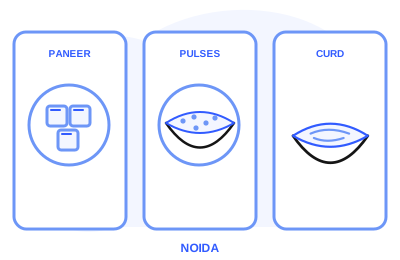
- At home: keep eggs, dahi, paneer and soya chunks in the fridge. A 30 g handful of dry soya chunks gives about 15 g of protein for under 100 kcal.
- At work: choose the thali with dal and raita, toasted chicken or paneer sandwiches, or a tandoori dish with roti.
- On delivery apps: filter by grilled and tandoor dishes and use the declared calories to compare, remembering the 25% tolerance.
- For breakfast: moong dal cheela, besan cheela or egg bhurji instead of parathas on weekdays. See our high-protein Indian breakfast list.
Food works best with regular training. If your society has no gym, Personal Home Training in Noida works with a mat and a pair of dumbbells, and Group Classes in Noida let neighbours from one tower train together for ₹499 a session each. To compare costs, read our guides to gym fees in Noida and personal trainer fees in Noida, or start at online personal training in Noida.
Sources
- Indian Food Composition Tables 2017 (Longvah, Ananthan, Bhaskarachary, Venkaiah), ICMR-National Institute of Nutrition
- Dietary Guidelines for Indians (2024), ICMR-National Institute of Nutrition
- Indian Nutrient Databank (INDB): recipe nutrient dataset, Jaacks Lab, University of Edinburgh (GitHub)
- FoodData Central datasets (FNDDS survey foods and SR Legacy), U.S. Department of Agriculture
- Guidance note on menu labelling (23 February 2022), Food Safety and Standards Authority of India
- Unhealthy fat in street and snack foods in low-socioeconomic settings in India (Gupta et al., 2016), Journal of Nutrition Education and Behavior (via PubMed Central)
- Greater Noida: education, Wikipedia
Written by the MakeMyFitness team from the sources above. First published , last updated . Spotted something out of date? Tell us at hello@makemyfitness.com.