Healthy food in Dehradun starts in the Garhwali kitchen
Dehradun eats like any busy city, with momos, bun tikki, Rajpur Road cafés and north Indian thalis. But the food that came down from the Garhwal hills is some of the most useful in India for someone trying to lose fat or build muscle. The Garhwali staples are finger millet (mandua or koda), horse gram (gahat or kulath), black soybeans (bhatt), whole black urad, rajma and leafy greens, and as a Uttarakhand food guide by 30 Stades puts it, gahat, soybeans, black soybeans, rajma and other lentils are part of almost every meal. This page puts numbers on them.
Where the numbers come from: raw foods are from IFCT 2017, the food composition tables published by ICMR’s National Institute of Nutrition in Hyderabad. Cooked dishes come from INDB, a free databank that works out more than 1,000 Indian recipes from those values, or are marked “IFCT calc”, meaning we added up IFCT figures for the stated ingredients ourselves, with every teaspoon (5 g) of ghee or mustard oil counted as 45 kcal.
| Food | Calories | Protein | Fibre | Worth knowing |
|---|---|---|---|---|
| Mandua (ragi, finger millet) | 321 kcal | 7.2 g | 11.2 g | 364 mg of calcium, against 31 mg in wheat atta |
| Gahat (horse gram, whole) | 330 kcal | 21.7 g | 7.9 g | Almost no fat: 0.6 g |
| Bhatt (soybean, brown) | 381 kcal | 35.6 g | 21.6 g | The most protein, but 19.8 g of fat |
| Black urad, whole (for chainsoo) | 291 kcal | 22.0 g | 20.4 g | Roasted and ground for chainsoo |
| Rajma, red | 299 kcal | 19.9 g | 16.6 g | Hill rajma is a Garhwal staple |
| Wheat atta, for comparison | 320 kcal | 10.6 g | 11.4 g | More protein than ragi, far less calcium |
One gap: jhangora (barnyard millet), the grain behind Garhwal’s jhangora kheer, is not in IFCT 2017, so we give no number for it rather than borrow one from a less reliable table.
Calories and protein in Garhwali dishes you can get in Dehradun
Servings are as stated. Dehradun homes and restaurants differ widely in how much ghee goes into a dish, so read these as the lighter versions. Our national calories in Indian food guide covers dishes from the rest of the country.
| Dish | Serving | Calories | Protein | Source |
|---|---|---|---|---|
| Mandua roti, plain | One roti, 40 g ragi flour | about 128 kcal | 2.9 g | IFCT calc |
| Mandua roti with ghee | The same, with 1 tsp ghee | about 173 kcal | 2.9 g | IFCT calc |
| Gahat (kulthi) dal | 1 bowl | about 201 kcal | 10.5 g | INDB |
| Bhatt ki churkani | 30 g dry bhatt, 10 g rice flour, 1 tsp mustard oil | about 195 kcal | 11.5 g | IFCT calc |
| Chainsoo | 30 g whole black urad, 1 tsp ghee | about 132 kcal | 6.6 g | IFCT calc |
| Kafuli | 150 g spinach, 50 g methi leaves, 10 g rice flour, 1 tsp mustard oil | about 134 kcal | 5.8 g | IFCT calc |
| Rajma curry | 1 bowl | about 172 kcal | 7.1 g | INDB |
| Aloo ke gutke (closest recipe: dry spiced potatoes) | 1 bowl | about 109 kcal | 1.7 g | INDB |
| Boiled rice | 1 plate | about 352 kcal | 7.8 g | INDB |
| Phulka (wheat roti) | One | about 73 kcal | 2.1 g | INDB |
| Chaas | A tall glass, salted | about 80 kcal | 5.7 g | INDB |
| Paneer, for comparison | 50 g | about 153 kcal | 9.4 g | IFCT |
The pattern is clear. Kafuli, chainsoo and gahat dal are light dishes with real protein, as long as the fat stays at a teaspoon. The 30 Stades guide describes kafuli as a saag of spinach and methi leaves, chainsoo as whole black urad roasted, ground and cooked, and phaanu as soaked dals ground to a paste and cooked. Aloo ke gutke, slow-roasted parboiled potatoes with spices, is the dish to watch: mostly starch, little protein, and easy to over-oil.
Bhatt and gahat: the high-protein food Dehradun already has
If you want high-protein food in Dehradun without supplements, start with the two pulses the hills are known for. Bhatt, the black soybean, has more protein than any other pulse on this page: 35.6 g per 100 g raw in IFCT, so 30 g of dry beans gives 10.7 g, more than 50 g of paneer (9.4 g). It also carries 19.8 g of fat per 100 g, so it is a filling food, not a free one. A handful of dry-roasted bhatt is a far better partner for evening chai than namkeen.
Gahat is the leaner option: 21.7 g of protein and only 0.6 g of fat per 100 g raw, and about 10.5 g of protein in an INDB bowl of kulthi dal at about 201 kcal. Have a full bowl at lunch rather than a ladle, and add gahat-stuffed parathas only on days when you need the extra energy, such as before a trek.
Mandua and jhangora: Garhwal’s millets for weight loss
Mandua is the millet most Dehradun families know, and it earns its place. Per 100 g, IFCT gives ragi 321 kcal, 11.2 g of fibre and 364 mg of calcium, more than eleven times the calcium of wheat atta. Its protein is lower than wheat’s, 7.2 g against 10.6 g, so a mandua roti needs dal or curd beside it. A 40 g mandua roti is about 128 kcal; the 30 Stades guide notes that koda rotis are traditionally served with ghee and jaggery, which is fine in a cold Dehradun January but adds up fast as a daily habit.
India’s 2024 national dietary guidelines from ICMR-NIN want 20–30% of an adult’s cereal, weighed raw, to be millet. In Dehradun that takes little effort: a mandua roti with lunch every day, or jhangora cooked like rice once or twice a week. Wikipedia’s list of Uttarakhand dishes also includes a jhangora rabri cooked with chaas and radish leaves, a savoury way to eat the grain. Keep jhangora kheer for festivals; made with milk and sugar, it is a dessert whatever the grain.
Bal mithai, singori and Dehradun’s sweet tooth
Uttarakhand’s best-known sweets are built on khoa. The 30 Stades guide describes bal mithai as khoa cooked into a chocolate-like fudge and coated in sugar balls, and singori as thickened, flavoured khoa wrapped in a maalu leaf. IFCT puts khoa itself at 316 kcal and 20.6 g of fat per 100 g, before any sugar. The ICMR-NIN guidelines advise keeping added sugar to 20–25 g a day. So treat a piece of bal mithai as that day’s sweet, buy the smallest box, and share it.
Healthy food options in Dehradun when you eat out
We don’t review restaurants, but the same order works almost anywhere in the city. At a Garhwali or pahadi restaurant, ask for gahat dal or chainsoo, kafuli, mandua roti without the ghee on top, and rice in a half portion. At a north Indian place, choose rajma or dal with one roti and a raita. Momos are common across Dehradun; we found no analysed value for them, and INDB’s fried recipes count all the frying oil, so we haven’t guessed. Pick steamed over fried, and make a plate of them the meal rather than a snack between meals.
High-protein food in Dehradun: how much you need
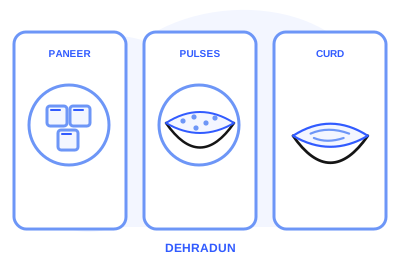
How much protein? The 2024 ICMR-NIN guidelines put the recommended allowance at 0.83 g for every kilogram you weigh, which is 54 g a day for someone of 65 kg, and say 10–15% of calories should come from protein. During a weight-loss diet with a deficit of 500–750 kcal a day, they suggest about 15% of calories from protein to protect muscle, and advise against a deficit larger than 40% of your daily needs. Our protein intake calculator gives your own number.
- Morning: a mandua roti with two boiled eggs (roughly 13 g of protein), or with 50 g paneer (roughly 9 g).
- Lunch: gahat dal, a whole bowl (10.5 g), and kafuli (nearly 6 g).
- Evening: 30 g of roasted bhatt (about 11 g) instead of biscuits or namkeen.
- Dinner: rajma (about 7 g) with cucumber raita (about 6 g).
- Between meals: chaas, nearly 6 g a glass, and warm milk before bed.
A whole week planned on these lines is in our high-protein vegetarian Indian diet guide, and protein in Indian food ranks many more foods gram for gram.
A 1,780 kcal day of Garhwali food in Dehradun
Built only from the figures on this page and from food any Dehradun kitchen keeps, this day totals roughly 1,780 kcal and 81 g of protein. The chai is INDB’s milky cup, and the apple is 150 g of IFCT’s large apple. Vegetarians can swap the eggs for 50 g of paneer, which gives about 1,796 kcal and 77 g of protein.
| When | On the plate | Energy | Protein |
|---|---|---|---|
| Breakfast | 2 boiled eggs, 1 mandua roti, chai | about 299 kcal | 17.1 g |
| Mid-morning | Chaas, one glass | about 80 kcal | 5.7 g |
| Lunch | Gahat dal, half a plate of rice, 1 mandua roti, kafuli | about 639 kcal | 23.1 g |
| Evening | 30 g roasted bhatt, 1 apple | about 208 kcal | 11.1 g |
| Dinner | Rajma curry, 2 phulka, cucumber raita | about 408 kcal | 17.5 g |
| Bedtime | Warm cow’s milk, 200 ml | about 146 kcal | 6.5 g |
Losing fat: whether 1,780 kcal is a deficit for you depends on your size and how active you are; the guidelines’ 500–750 kcal a day below your needs is the gap to aim for. Set your own target with the calorie deficit calculator rather than assuming 1,780 is right. Gaining muscle: have gahat or rajma twice, one more mandua roti and an extra handful of bhatt, and lift three times a week.
On trek weekends the numbers change. A day climbing Nag Tibba or walking the Mussoorie ridge burns far more than a desk day, so add rice, rotis and roasted bhatt rather than cutting back; see treks near Dehradun for the routes.
If you already pay for a gym, Personal Gym Training in Dehradun brings a coach to it by video. To see what a membership costs first, read gym fees in Dehradun, and for outdoor training try running tracks in Dehradun. Everything else is on online personal training in Dehradun.
Sources
- Dietary Guidelines for Indians (2024), ICMR-National Institute of Nutrition
- Indian Food Composition Tables 2017 (Longvah et al.), ICMR-National Institute of Nutrition
- Indian Nutrient Databank (INDB): recipe nutrient dataset, Jaacks Lab, University of Edinburgh (GitHub)
- Development of an Indian Food Composition Database (Vijayakumar et al., 2024), Current Developments in Nutrition
- Uttarakhand: Garhwali and Kumaoni food in pictures (May 2021), 30 Stades
- Cuisine of Uttarakhand, Wikipedia
Written by the MakeMyFitness team from the sources above. First published , last updated . Spotted something out of date? Tell us at hello@makemyfitness.com.