Is Gujarati food healthy? The Vadodara answer
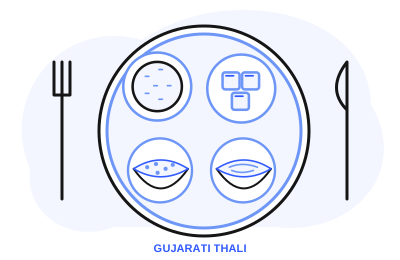
People in Vadodara often ask whether Gujarati food is healthy, and the honest answer is: the base is, the habits around it often aren’t. A home meal of rotli, dal, shaak, rice and chaas matches what the ICMR-NIN Dietary Guidelines for Indians (2024) recommend in outline: cereals, pulses, vegetables and dairy at most meals. The trouble starts with three habits common in Gujarati kitchens: sweet dal and kadhi, a daily handful of farsan, and the sev that tops street food from Raopura to Fatehgunj.
The guidelines put numbers on each. Added sugar should stay under 5% of the day’s energy. A sedentary woman needs only about 20 g of visible fat (oil and ghee) a day, a sedentary man about 30 g, and more only with heavier activity. Salt should be about 5 g a day, a single teaspoon, which a plate of farsan with chutney and pickle can use up quickly.
Sev usal, Vadodara’s signature, counted part by part
Ask anyone for famous Gujarati food in Vadodara and sev usal comes up first. Baroda food blogger Devangi Raval traces usal itself to Maharashtrian cooking and suggests the city’s Gaekwad history explains why it took root here; it is a spicy pea curry, made with dried green or white peas, served with pav, raw onion, lemon and tamarind chutney, with crunchy sev added at the table.
We found no analysed value for a plate of sev usal, but every part of it has one, and that shows exactly where the energy comes from:
| Part of the plate | Calories | Protein | Source |
|---|---|---|---|
| Dried peas, boiled (the usal) | 109 kcal | 6.9 g | CoFID |
| Sev | 478 kcal | 18.8 g | CoFID (homemade sev/ganthia) |
| Pav (white bread, average) | 236 kcal | 8.7 g | CoFID |
| Onion, lemon, coriander | Very little | Very little | Vegetables |
The peas are the healthy heart of the dish: filling, high in fibre and a decent source of protein. The gravy’s oil, the sev and the second pav are what turn it into a heavy meal. Weight for weight, sev carries more than four times the energy of the boiled peas.
- Ask for sev on the side and add one spoonful; about 20 g of sev is roughly 96 kcal.
- Skim the red oil off the top of the bowl before you eat.
- One pav, not two, or swap the pav for extra onion and lemon.
- Make it lunch, not a snack. A bowl of usal is a meal; eaten at 5 PM on top of lunch and dinner, it is what quietly adds up.
Farsan, chevdo and Duliram’s pedas
Vadodara’s farsan shops are a daily stop for many families. Fried mixtures are the hardest food in the city to eat in moderation: the UK’s CoFID tables measure a homemade chevda at 487 kcal and 31.8 g of fat per 100 g, so a 50 g bowl with tea is about 244 kcal, roughly a small meal. Plain peanuts are no lighter by weight, but they are easier to portion: 30 g of raw groundnut is about 156 kcal with 7 g of protein by IFCT 2017 values.
Then there are pedas. Pendawala Duliram Ratanlal Sharma, founded in 1862 according to the History of Vadodara site, still sells its Mathura peda, made from fresh mava coated in castor sugar, from its original Raopura shop. We found no analysed value for a peda, but its main ingredient tells the story: IFCT 2017 lists khoa (mava) at about 316 kcal and 16.3 g of protein per 100 g before any sugar goes in. One peda after dinner on a festival day is fine; a box on the table all week is not.
Calories and protein in everyday Vadodara meals
Most Vadodara meals are home-style Gujarati food or a thali. These values are from the Indian Nutrient Databank (INDB), 1,014 Indian recipes calculated from ICMR-NIN’s food composition tables, and from IFCT 2017 for raw foods. Restaurant versions with more oil will be higher.
| Dish | Serving | Calories | Protein |
|---|---|---|---|
| Vegetable poha | 1 bowl | about 177 kcal | 4.8 g |
| Chana dal | 1 bowl | about 291 kcal | 12.1 g |
| Whole masoor dal | 1 bowl | about 185 kcal | 7.8 g |
| Kala chana curry | 1 bowl | about 169 kcal | 6.8 g |
| Boiled rice | 1 plate | about 352 kcal | 7.8 g |
| Rotli | 1 rotli | about 73 kcal | 2.1 g |
| Matar paneer | 1 bowl | about 374 kcal | 18.3 g |
| Handvo | 100 g | about 207 kcal | 8.2 g |
| Bottle gourd raita | 1 bowl | about 86 kcal | 6.1 g |
| Groundnut, raw (IFCT 2017) | 30 g | about 156 kcal | 7.1 g |
Two quick lessons. A full plate of rice carries almost five rotlis’ worth of energy, so most people losing weight do better with half a plate and an extra bowl of dal. And chana dal is one of the best-value pulses on the table at about 12 g of protein a bowl.
Navratri in Vadodara: eating for nine nights of garba
Navratri in Vadodara means garba late into the night, nine nights running, and many people fast during the day. That combination of a long fast, then hours of dancing, then a late heavy snack is hard on energy levels and sleep. Fasting food is not automatically light: INDB puts a bowl of sabudana khichdi at about 508 kcal with only 7.4 g of protein, while CoFID measures raw sago at 355 kcal per 100 g with almost no protein.
- 1
Eat before you dance
A proper meal two to three hours before garba beats a big plate at midnight.
- 2
Add protein to fasting food
Curd, milk, paneer and peanuts are usually allowed during fasts; pair sabudana with a bowl of curd.
- 3
Drink water between rounds
Hours of dancing in a crowd mean steady sweating; sip, don’t gulp, and add a glass of chaas.
- 4
Go easy on fried fasting snacks
Sabudana vada and fried potato chips are fried, so treat them as the treat, not the meal.
Training for Navratri? A few weeks of leg strength and conditioning make the last nights as enjoyable as the first. See our guide to high-protein vegetarian Indian food for fast-friendly protein ideas.
A Baroda day of food at about 1,730 kcal
This vegetarian day uses the INDB and IFCT figures above and comes to about 1,730 kcal and 71 g of protein. Dal and shaak are cooked without sugar, and plain salad is extra.
| Meal | Food | Calories | Protein |
|---|---|---|---|
| Breakfast | A bowl of vegetable poha, 200 ml cow’s milk | about 322 kcal | 11.3 g |
| Mid-morning | A bowl of sprouted moong salad | about 77 kcal | 4.7 g |
| Lunch | 2 rotli, a bowl of chana dal, half a plate of rice, bottle gourd raita | about 699 kcal | 26.3 g |
| Evening | 30 g groundnuts, a cup of tea with milk | about 190 kcal | 7.9 g |
| Dinner | 1 rotli, a bowl of matar paneer | about 447 kcal | 20.4 g |
Losing weight? ICMR-NIN describes about half a kilogram a week as a safe pace and warns against diets under 1,000 kcal a day; find your own target with the calorie deficit calculator. Building muscle? The guidelines’ allowance is 0.83 g of protein per kg of body weight, and they note that more than about 1.6 g per kg brings no extra gain from strength training. Check your number with the protein intake calculator, and see protein in Indian food for more sources.
Want a full week of Gujarati home meals? Our Gujarati diet plan for weight loss has one, and calories in Indian food lists many more dishes.
Healthy restaurants and food places in Vadodara: what to ask
There are plenty of healthy restaurants, cafes and tiffin services in Vadodara, from Alkapuri to the student areas around MS University. We don’t rate them, but five questions sort a genuinely healthy meal from a marketing one:
- Where’s the protein? Aim for 20 g or more at lunch and dinner: dal plus curd, paneer, sprouts, eggs or chicken.
- Is the dal or kadhi sweetened? In many Gujarati kitchens it is, so ask for it without.
- What is it cooked in, and how much? A thali can carry more oil than the guidelines allow for a whole day.
- Is farsan included? A “diet thali” with fried farsan on the side is not one.
- Is it real food? ICMR-NIN advises against relying on protein powders to build muscle; a bowl of chana dal does the job.
Burn some of it off with cycling in Vadodara, the Vadodara marathon on 7 February 2027, or the steps of Pavagadh in treks near Vadodara. Train at home with Personal Home Training in Vadodara or at your gym with Personal Gym Training in Vadodara. For everything else, start at online personal training in Vadodara.
Sources
- Dietary Guidelines for Indians (2024), ICMR-National Institute of Nutrition
- Indian Food Composition Tables 2017 (Longvah et al.), ICMR-National Institute of Nutrition
- Indian Nutrient Databank (INDB): recipe nutrient dataset, Jaacks Lab, University of Edinburgh (GitHub)
- Development of an Indian Food Composition Database (Vijayakumar et al., 2024), Current Developments in Nutrition
- Composition of foods integrated dataset (CoFID), 2021, Public Health England, GOV.UK
- Sev usal, green peas (15 December 2022), Pistachio Doughnut (Devangi Raval)
- Pendawala Duliram Ratanlal Sharma, History of Vadodara
Written by the MakeMyFitness team from the sources above. First published , last updated . Spotted something out of date? Tell us at hello@makemyfitness.com.