Healthy food in Chennai: what eating well here looks like
Chennai runs on two food rituals: tiffin (idli, pongal, dosa and vada, morning and evening) and meals (rice served with sambar, rasam, kootu, poriyal and curd, often on a banana leaf). Add Chettinad curries, Marina beach sundal and four filter coffees, and you have the city’s diet. Almost all of it can fit a fat-loss or muscle-gain plan. The trouble is rarely a single dish; it is the second and third helping of rice, the ghee in the pongal and the sweet at the end.
The numbers on this page come from published food databases. Cooked dishes use the Indian Nutrient Databank (INDB), a peer-reviewed set of 1,014 Indian recipes calculated from ICMR-NIN’s food tables, and USDA FoodData Central for idli, dosa and vada. Rice, dals, milk and peanuts use the Indian Food Composition Tables 2017 (IFCT). Where no database has the dish, we either built the value from IFCT ingredients and show the recipe, or left the dish out.
Calories and protein in Chennai tiffin, meals and Chettinad food
| Dish | Serving | Calories | Protein | Source |
|---|---|---|---|---|
| Idli | 1 idli, 38 g | 49 kcal | 2.4 g | USDA |
| Ven pongal, home-style | 40 g raw rice, 15 g moong dal, 1 tsp ghee | about 230 kcal | 6.8 g | Built from IFCT, USDA |
| Medu vada | 1 vada, 30 g | 80 kcal | 3.8 g | USDA |
| Plain dosa | 1 medium, 80 g | 168 kcal | 4.6 g | USDA |
| Rava dosa | 1 dosa, 73 g | 167 kcal | 5.4 g | INDB |
| Sambar | 1 bowl, 257 g | 249 kcal | 8.6 g | INDB |
| Rasam (tamarind) | 1 bowl, 390 g | 104 kcal | 4.4 g | INDB |
| Cooked white rice | 1 cup, 158 g | 204 kcal | 4.2 g | USDA |
| Curd rice (thayir sadam) | 1 plate, 216 g | 423 kcal | 12.4 g | INDB |
| Puliyodarai (tamarind rice) | 1 plate (80 g raw rice) | 477 kcal | 9.5 g | INDB |
| Rava kesari | 1 bowl, 177 g | 432 kcal | 4.2 g | INDB |
| Chicken curry (stand-in for chicken Chettinad) | 1 bowl, 248 g | 320 kcal | 29.2 g | INDB |
| Fish curry | 1 bowl, 254 g | 282 kcal | 22.3 g | INDB |
| Chana sundal | 30 g dry chana, 1 tsp oil | about 130 kcal | 5.6 g | Built from IFCT |
| Peanut sundal | 30 g raw peanuts | 156 kcal | 7.1 g | IFCT |
Pongal, idli and the mini tiffin: ordering breakfast in Chennai
Ven pongal is Chennai’s comfort breakfast, and its calories depend almost entirely on the ghee. A home-style serving made from 40 g of raw rice and 15 g of moong dal works out at about 190 kcal before fat (IFCT); one teaspoon of ghee brings it to about 230 kcal with 6.8 g of protein. Every extra teaspoon of ghee, or the cashews fried in it, adds about 41 kcal more. Ask for less ghee on top and have it with sambar rather than coconut chutney.
Idli is the lighter base: about 49 kcal and 2.4 g of protein each. Three idlis with half a bowl of sambar is roughly 270 kcal and 11.5 g of protein. A plain dosa is about 168 kcal, and a rava dosa about the same in the INDB recipe, so neither is a bad choice on its own.
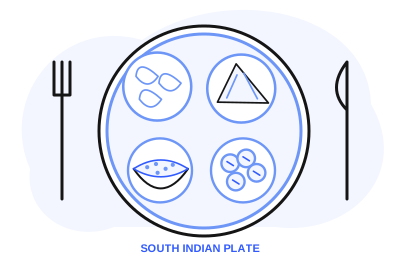
The mini tiffin is where breakfast quietly doubles. It is a sampler on one plate, usually some mix of mini idlis, a small dosa, pongal, a vada and a spoon of rava kesari, and every hotel builds it differently. The sweet is the item to watch: INDB’s kesari is 432 kcal for a 177 g bowl, so even a third of a bowl is about 145 kcal with almost no protein. Eat the savoury parts, share or skip the kesari, and you have a reasonable meal.
Reading a Chennai meals plate: sambar, rasam, kootu and curd
A Chennai meals plate is built in courses: rice with sambar first, then rasam, then curd, with poriyal and kootu on the side. The structure is healthy. What decides the total is how many times the server refills your rice and whether the last course is curd or a full plate of curd rice. Here is the same meal four ways, using the values in the table above:
| How you eat it | What’s on the plate | Calories | Protein |
|---|---|---|---|
| Two helpings of rice | 2 cups rice, sambar, rasam, cabbage and peas poriyal, 150 g curd | about 960 kcal | 32 g |
| Ending with curd rice | As above, but a plate of curd rice instead of plain curd | about 1,290 kcal | 39 g |
| One helping, extra poriyal | 1 cup rice, sambar, rasam, 2 bowls poriyal, 150 g curd | about 860 kcal | 33 g |
| One helping, with fish | 1 cup rice, rasam, poriyal, fish curry, 150 g curd | about 790 kcal | 42 g |
So the lightest change is also the simplest: one helping of rice, then ask for more poriyal or kootu instead. Rasam is the bargain of the meal at about 104 kcal for a 390 g bowl, and sambar is the main vegetarian protein at 8.6 g a bowl. Kootu, made from dal and vegetables, is a good extra too, though we couldn’t find a published figure for it. The poriyal value here is INDB’s cabbage and peas (106 kcal and 5.4 g of protein a bowl); coconut-heavy poriyals carry more fat. For the general rules of a South Indian plate, see the South Indian diet plan for weight loss.
Chettinad food: pepper, kalpasi and how heavy it really is
Chettinad cooking, from the Chettiar community, is defined by its spice blend (kalpasi, dried red chillies and black peppercorns) and, historically, by sun-dried meats and salted vegetables suited to a dry climate. Chicken Chettinad is its best-known dish. Spice adds almost no calories; the oil, coconut and portion size are what count.
There is no published nutrient figure for chicken Chettinad, so we use INDB’s chicken curry as a stand-in: about 320 kcal and 29.2 g of protein for a 248 g bowl. Fish curry is about 282 kcal and 22.3 g. Either makes a Chettinad lunch a high-protein meal, provided the rest of the plate stays sensible: one serving of rice or two dosas, not parotta and biryani on the side. The vegetarian Chettinad dishes worth knowing are idiyappam and kavuni arisi (black rice) rather than the fried snacks.
Sundal on the Marina and Besant Nagar beaches
The beach walk with a paper cone of sundal is one of Chennai’s healthiest food habits. Chana sundal from 30 g of dry chickpeas plus a teaspoon of oil for the tempering is about 130 kcal with 5.6 g of protein, built from IFCT values. Peanut sundal is richer: 30 g of raw peanuts carry 156 kcal and 7.1 g of protein.
Compare that with the other beach-stall staples: bajji and murukku have no reliable published figures, but both are deep-fried. If you want something on the walk, sundal and a tender coconut are the picks; IFCT puts coconut water at about 15 kcal per 100 g.
High protein meals in Chennai from the local menu
ICMR-NIN’s allowance for healthy adults is 0.83 g of protein per kg of body weight a day, about 54 g for a 65 kg person, and people who strength train usually need more. Our protein intake calculator gives your own target. In Chennai food, these are the most protein per serving:
- Chicken or fish curry: 22–29 g a bowl. The easiest high-protein meal in the city, from any non-veg meals hotel.
- Eggs: a boiled egg gives about 6.7 g of protein for 72 kcal. Egg dosa and egg podimas are easy orders.
- Curd rice: 12.4 g of protein a plate, but 423 kcal, so it suits a muscle-gain day more than a fat-loss one.
- Sambar and sundal: 8.6 g a bowl and 5.6–7.1 g a serving, the vegetarian staples.
- Paneer: 9.4 g per 50 g (IFCT 2017), if your canteen has a North Indian counter.
- Buttermilk (neer mor): about 5.7 g of protein in a 423 g glass of salted buttermilk for 80 kcal, and it helps in the heat.
If you order high-protein meal subscriptions in Chennai, check that the box states its protein in grams. Our protein in Indian food chart has 80+ foods to compare against.
A 1,800 kcal day of Chennai food
This sample day keeps the city’s rhythm (tiffin, meals, beach snack, light dinner) and lands at about 1,820 kcal and 82 g of protein, using only the values above. Set your own calorie number with the calorie deficit calculator and adjust the rice first.
| Meal | What to eat | Calories | Protein |
|---|---|---|---|
| Breakfast | Ven pongal (home-style, 1 tsp ghee), half bowl sambar, 1 tbsp mint chutney | 365 kcal | 11.4 g |
| Mid-morning | 1 filter coffee, 100 ml milk, 1 tsp sugar | 89 kcal | 3.3 g |
| Lunch (meals) | Half plate rice (50 g raw), rasam, cabbage and peas poriyal, fish curry, 100 g curd | 729 kcal | 39.5 g |
| Evening | Chana sundal, 1 glass neer mor | 211 kcal | 11.3 g |
| Dinner | 2 plain dosas, 1 boiled egg, 2 tbsp mint chutney | 424 kcal | 16.5 g |
Vegetarian? Swap the fish curry for a full bowl of sambar and another 100 g of curd: the day stays at about 1,850 kcal and drops to about 72 g of protein. Replace the egg with 50 g of paneer to win back about 3 g.
OMR offices, Tidel Park canteens and eating out in Chennai
If you work on OMR, in Guindy or around Tidel Park, weekday lunch is a canteen counter, a meals hotel or a delivery app. The same rules from the meals plate apply, with a few office-specific ones:
- 1
Take one helping of rice and refuse the refill
The difference between one cup and two is about 204 kcal, every working day.
- 2
Put the protein on the plate first
Pick the fish, chicken, egg or paneer item, or a double sambar on vegetarian days, before the rice.
- 3
Choose curd over curd rice on fat-loss days
150 g of curd is about 92 kcal; a plate of curd rice is 423 kcal.
- 4
Swap the 4 PM bajji for sundal or buttermilk
Office tea stalls are fried-snack territory; a packet of sundal from home costs about 130 kcal.
- 5
Order variety rice once a week, not daily
Puliyodarai is about 477 kcal a plate in INDB, and lemon rice even more because of the peanuts and oil.
Koyambedu, Amma Unavagam and cheap healthy staples in Chennai
The healthiest food options in Chennai are often the cheapest. Koyambedu Wholesale Market Complex, opened in 1996 and spread over 295 acres with about 3,100 shops, is one of Asia’s largest markets for perishables. Stock keerai, drumstick, gourds and beans for poriyal and kootu; whole chana, moong and peanuts for sundal; curd and eggs for protein; and horse gram (kollu) for rasam.
For a simple subsidised meal, Tamil Nadu’s Amma Unavagam canteens, launched in 2013, list idli at ₹1, pongal and sambar rice at ₹5 a plate and curd rice at ₹3. These are filling, low-cost plates of rice and dal, but light on protein, so add curd, eggs or sundal elsewhere in the day.
Pair the food with training that protects muscle. Personal Gym Training in Chennai coaches you live at your apartment or office gym, and Rehab & Recovery in Chennai is there if a doctor or physio has cleared you after an injury. Walkers and runners can use the running tracks in Chennai guide and the marathons in Chennai calendar, and personal trainer fees in Chennai compares coaching costs. For 100+ more dishes see calories in Indian food, and for everything else, online personal training in Chennai.
Sources
- Indian Food Composition Tables 2017 (Longvah, Ananthan, Bhaskarachary, Venkaiah), ICMR-National Institute of Nutrition, Hyderabad
- Indian Nutrient Databank (INDB): an open-access database of Indian foods and recipes (Vijayakumar et al., 2024), Current Developments in Nutrition
- Indian Nutrient Databank: recipe data files, Jaacks Lab, GitHub
- FoodData Central datasets (FNDDS and SR Legacy), U.S. Department of Agriculture
- Nutrient Requirements for Indians 2020: brief note (protein RDA 0.83 g/kg/day), ICMR-National Institute of Nutrition
- Chettinad cuisine, Wikipedia
- Koyambedu Wholesale Market Complex, Wikipedia
- Amma Unavagam, Wikipedia
Written by the MakeMyFitness team from the sources above. First published , last updated . Spotted something out of date? Tell us at hello@makemyfitness.com.