Healthy food in Guwahati: why an Assamese plate is lighter than it looks
Assamese cooking is unusual in India for how little it fries. Wikipedia’s summary of the cuisine notes that it uses very few spices, that meat and fish dishes use little oil and lean on ginger, lemon, herbs and fermented bamboo shoot for flavour, and that the bhuna technique of frying spices first is absent. Mustard oil is the cooking fat, and rice is part of every meal. For anyone in Guwahati trying to lose fat or build muscle, that is a good starting point: the dishes are often lean, and the calories sit mainly in how much rice goes on the plate and how fatty the pork is.
Values on this page come from the Indian Food Composition Tables 2017 (IFCT) of ICMR’s National Institute of Nutrition and, for cooked dishes, the Indian Nutrient Databank (INDB), a peer-reviewed set of 1,014 Indian recipes. INDB has no Assamese recipes, so where we give a figure for a dish such as masor tenga, we have added up its main ingredients from IFCT and said so. Oil is counted at about 9 kcal a gram, so a 5 g teaspoon adds about 45 kcal.
Fish, duck, pork and eggs: protein per 100 g in Guwahati’s staples
| Food | IFCT entry | Calories (kcal) | Protein (g) |
|---|---|---|---|
| Rohu | Rohu, Labeo rohita | 102 | 19.7 |
| Catla | Catla, Catla catla | 94 | 17.9 |
| Catfish | Cat fish, Tandanus tandanus | 124 | 15.9 |
| Ilish (hilsa) | Hilsa | 259 | 21.8 |
| Small prawns | Prawns, small | 71 | 13.1 |
| Duck meat | Duck, meat, with skin | 131 | 19.1 |
| Pork, leaner cut | Pork, chops | 179 | 19.4 |
| Pork, fattier cut | Pork, shoulder | 237 | 17.4 |
| Duck egg | Egg, duck, whole, boiled | 176 | 13.8 |
| Hen’s egg | Egg, poultry, whole, boiled | 148 | 13.4 |
River fish such as rohu and catla are the leanest protein in Guwahati’s markets: about 100 kcal for 18–20 g of protein. Duck, so popular in Assam, is leaner than many people assume at 131 kcal per 100 g with skin in IFCT’s sample. Pork varies most by cut. A shoulder cut carries about 19 g of fat per 100 g against 11 g in chops, so the same weight of pork can differ by almost 60 kcal before any oil. Ilish (hilsa) is the oily fish of the region, with more energy from fat than any other fish here, and that fat is the omega-3 kind ICMR-NIN recommends.
Masor tenga, khar and pitika: the lean side of the thali
Masor tenga, Assam’s sour fish curry, is made sour with tomato, a thick-skinned lemon, dried mangosteen (thekera) or roselle leaves, according to Wikipedia. We found no analysed value for it, so here is the arithmetic: a 120 g piece of rohu (about 123 kcal and 24 g protein in IFCT) and one teaspoon of mustard oil (about 45 kcal) give roughly 170 kcal and 24 g protein, with the tomato and lemon adding little. Cooked with two or three teaspoons of oil, it is closer to 215–260 kcal. Either way it is one of the best protein-for-calories dishes in Indian cooking.
Khar is an alkaline dish made with water filtered through the ash of sun-dried banana peel, cooked with raw papaya, pulses, greens or fish. It is mostly vegetables and water, and we found no published figure; keep it as the vegetable side that it is. Pitika, the mashes dressed with raw mustard oil, is where oil goes unnoticed: the mustard oil is most of the calorie, so a teaspoon rather than a generous pour keeps a pitika light. Greens are worth eating every day. IFCT lists mustard leaves at 30 kcal with 3.5 g protein per 100 g, colocasia leaves at 43 kcal and tender pumpkin leaves at 44 kcal.
Rice in Guwahati: joha, boiled rice and the size of the plate
Rice is the centre of the Assamese meal, including the scented joha rice for special occasions. IFCT puts raw milled rice at about 356 kcal and 7.9 g protein per 100 g; INDB’s plate of boiled rice, cooked from 100 g raw, is about 352 kcal. IFCT doesn’t list joha separately. Since the dishes around it are often lean, the rice portion decides whether lunch is 600 or 1,000 kcal.
| Portion | Calories (kcal) | Protein (g) | Who it suits |
|---|---|---|---|
| Half a plate | 176 | 3.9 | Fat loss, lighter days |
| Three-quarters of a plate | 264 | 5.9 | Fat loss for most men, maintenance for many women |
| Full plate | 352 | 7.8 | Active days, muscle gain |
| Full plate plus a refill | About 530 | About 11.7 | Training days for very active people only |
Duck and pork in Guwahati: how to eat them well
Duck cooked with white gourd (ash gourd) is a classic Assamese pairing, and a good one for anyone counting. Our estimate from IFCT values: 150 g of duck meat (about 196 kcal and 29 g protein) with 150 g of ash gourd (about 26 kcal) and two teaspoons of mustard oil (about 90 kcal) comes to roughly 310 kcal and 30 g protein a serving. Pork with bamboo shoot works the same way, since fresh bamboo shoot is only 16 kcal per 100 g in IFCT. The calories in a pork curry come from the cut and the rendered fat: ask for leaner pieces, skim visible fat from the gravy, and take more of the bamboo shoot or greens.
- Choose leaner pork cuts where you can: IFCT’s chops are 179 kcal per 100 g raw, the shoulder 237 kcal.
- Eat duck at home more than out: you control the oil, and the meat itself is lean.
- Pair meat with a vegetable, such as ash gourd, bamboo shoot or greens, and less rice.
- Count the fat you can see: a spoon of rendered fat from a pork gravy is mostly oil.
Jolpan and pitha: breakfast and Bihu food in numbers
Jolpan, the traditional Assamese light meal, is flattened rice (chira) or puffed rice eaten with curd or milk, jaggery and fruit. IFCT gives raw rice flakes 354 kcal and 7.4 g protein per 100 g, and cane jaggery 354 kcal per 100 g. So a 50 g bowl of chira with 200 ml cow’s milk and a banana is about 430 kcal with 11 g protein; adding two boiled eggs on the side lifts it to about 565 kcal and 25 g protein, a strong breakfast for a training day. Keep the jaggery to a spoonful: 20 g adds about 71 kcal.
Pitha, the rice cakes made for Bihu, come in many forms: til pitha with sesame filling, ghila pitha, sunga pitha cooked in bamboo, and fried ones. We found no analysed values, but the fillings tell you where the energy is: IFCT lists brown sesame seeds at 516 kcal per 100 g and fresh coconut at 409 kcal. During Magh Bihu, when pitha, laru and feasts fill January, enjoy them as festival food, keep the other meals of those days protein-led, and go back to normal afterwards.
A 1,860 kcal day of Assamese food in Guwahati
This day uses food you can buy and cook in Guwahati, with IFCT and INDB values and the dish estimates above. It suits many men losing fat and many active women at maintenance, with over 100 g of protein. Find your own target with the calorie deficit calculator and scale the rice and chapatis to it.
| Meal | What to eat | Calories (kcal) | Protein (g) |
|---|---|---|---|
| Breakfast | Jolpan: 50 g chira, 200 ml milk, 1 banana; 2 boiled eggs | 565 | 25 |
| Lunch | Three-quarters plate rice, masoor dal, rohu masor tenga, mustard greens with 1 tsp oil | 692 | 41 |
| Evening | Tea with milk, 30 g puffed rice | 143 | 3 |
| Dinner | 2 chapatis, duck with ash gourd | 458 | 34 |
| Day total | About 1,860 | About 103 |
For muscle gain, add a full plate of rice at lunch (about 88 kcal more) and a bowl of curd or a third egg at breakfast. For a bigger deficit, use half a plate of rice and one chapati. Our protein in Indian food and calories in Indian food guides list values for dishes beyond Assamese food.
Vegetarian protein in Assamese food
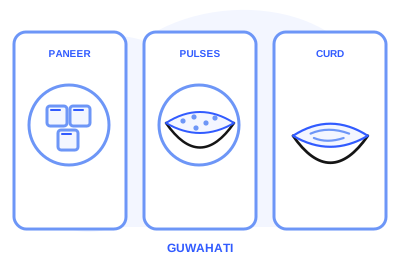
Vegetarians in Guwahati have to work harder for protein, because Assamese meals lean on fish and meat. The dals do most of it. IFCT lists masoor dal at about 24 g protein per 100 g dry and black gram dal (mati mah) at 23 g; INDB’s bowl of whole masoor dal is about 185 kcal with 7.8 g protein. Two bowls of dal a day, curd with jolpan, and paneer or soya a few times a week can take you past ICMR-NIN’s baseline of 0.83 g per kg of body weight, about 54 g a day for a 65 kg adult. Our guide to a high-protein vegetarian Indian diet has full day plans.
Healthy restaurants and cafes in Guwahati: what to order
We don’t review restaurants, but the same rules work at an Assamese thali place, a cafe or a delivery app across Guwahati:
- Pick the fish or duck first, then decide on rice. A tenga or a light fish curry is almost always the leanest protein on an Assamese menu.
- Ask for rice once. Thali refills are where most lunches go over.
- Steamed over fried: steamed momos over fried, boiled or curried meat over fried pork.
- Watch the pitika and chutneys, which carry raw mustard oil.
- Drink water or plain tea rather than sweet lassi or soft drinks with meals.
Training around Guwahati food
Food decides the direction; strength training decides whether the weight you lose is fat or muscle. Two or three sessions a week are enough to start, and Guwahati’s long monsoon makes home or gym training more reliable than outdoor plans, though the dry winter suits cycling in Guwahati and treks near Guwahati. If you already use a gym, Personal Gym Training in Guwahati puts a coach on your phone there, and Personal Home Training in Guwahati works in your living room. To compare costs, see gym fees in Guwahati. Everything else is on our page for online personal training in Guwahati.
Sources
- Indian Food Composition Tables 2017, ICMR-National Institute of Nutrition
- Development of an Indian Food Composition Database (Vijayakumar et al., 2024), Current Developments in Nutrition
- Indian Nutrient Databank (INDB): recipe data and code, Jaacks Lab, University of Edinburgh (GitHub)
- Dietary Guidelines for Indians (2024), ICMR-National Institute of Nutrition (PDF hosted by Nutrition Connect)
- Assamese cuisine, Wikipedia
Written by the MakeMyFitness team from the sources above. First published , last updated . Spotted something out of date? Tell us at hello@makemyfitness.com.