Healthy food in Goa: protein from the sea, calories from the coconut
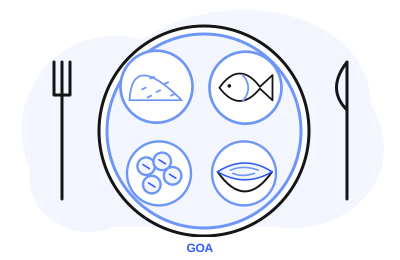
Goan food is better suited to a fitness goal than its reputation suggests. Most of the protein on a Goan plate comes from fish and shellfish, which are lean, and most of the extra energy comes from three places: grated or roasted coconut in the masala, the oil a dish is fried or finished in, and the bread and rice it is eaten with. Fresh coconut kernel is about 409 kcal per 100 g and dry coconut about 624 kcal, according to the Indian Food Composition Tables (IFCT 2017) from ICMR-National Institute of Nutrition. A Goan curry can be a lean meal or a heavy one depending on how much of it goes in.
The numbers on this page come from three places. Raw foods are from IFCT 2017. Cooked dishes are from the Indian Nutrient Databank (INDB), an open set of 1,014 Indian recipes built mainly on IFCT data (Vijayakumar and colleagues, 2024); we haven’t used its deep-fried recipes, which count all the frying oil as eaten. Where neither has a match, as with chorizo and bread, we used the USDA FoodData Central tables and say so. Few Goan dishes have been analysed under their own names, so where we use the closest analysed dish we say that too.
Bangdo, visvon, paplet: protein in Goan fish and seafood
The fish you see at Panaji, Mapusa or Margao market are some of the best-value protein foods in India. Per 100 g of raw edible portion, IFCT gives these values:
| Food (Goan name) | Calories (kcal) | Protein (g) | Fat (g) |
|---|---|---|---|
| Mackerel (bangdo) | 101 | 21.5 | 1.5 |
| Seer fish, kingfish (visvon; IFCT: vanjaram) | 136 | 22.3 | 5.2 |
| White pomfret (paplet) | 123 | 19.0 | 5.1 |
| Oil sardine (tarlo) | 152 | 17.9 | 9.0 |
| Prawns, marine tiger, brown (sungtam) | 65 | 14.9 | 0.6 |
| Prawns, big, freshwater | 91 | 19.2 | 0.5 |
| Squid, small white | 84 | 17.4 | 1.2 |
| Crab, sea | 68 | 15.4 | 0.6 |
| Chicken breast, skinless (for comparison) | 168 | 21.8 | 9.0 |
| Pork chops | 179 | 19.4 | 11.3 |
| Pork shoulder | 237 | 17.4 | 18.8 |
Mackerel stands out: it has the same protein as chicken breast for about 60% of the calories. Sardine is higher in energy because it is an oily fish, and that oil is the healthy, omega-3 kind the ICMR-NIN Dietary Guidelines for Indians (2024) encourage. Prawns, squid and crab are the leanest of all. For a fat-loss plan in Goa, fish is not something to limit but something to build meals around.
Xitt kodi: fish curry-rice, sized for your goal
Fish curry and rice is the everyday Goan lunch, at home and in small hotels across the state. The coconut-based curry is the protein; the rice is where portion size matters. INDB has no recipe called Goan fish curry, but its prawn curry with coconut is close in method, and so are its general fish curry and its fish in coconut milk:
| Plate | Calories (kcal) | Protein (g) |
|---|---|---|
| Full plate of rice + 1 bowl prawn curry with coconut (286 g) | 665 | 32.2 |
| Full plate of rice + 1 bowl fish curry (254 g) | 634 | 30.1 |
| Half plate of rice + 1 bowl prawn curry with coconut | 489 | 28.3 |
| Half plate of rice + fish in coconut milk (326 g) | 456 | 32.1 |
| Rice on its own, full plate | 352 | 7.8 |
Halving the rice saves about 176 kcal and costs only 4 g of protein, which is why the simplest fat-loss change in Goa is “less rice, same curry”. Whether your rice is red or white, parboiled or raw, the calories barely move: IFCT puts parboiled milled rice at 352 kcal per 100 g raw and raw milled rice at 356, so the type of rice changes its texture and fibre more than its energy. Add a fried fish to the plate and you add a lot of oil: we haven’t given a number for rava-fried fish because no reliable published value exists, and INDB’s fried-fish recipe counts all the frying oil.
Xacuti and cafreal: two chicken dishes, very different plates
Xacuti is a curry of chicken or lamb in a masala of roasted grated coconut and spices. We found no analysed value for it, but INDB’s chicken curry is the closest measured dish: about 320 kcal, 29.2 g protein and 18.8 g fat a bowl (248 g). Xacuti’s roasted coconut sits on top of that. Each 20 g of fresh coconut adds about 82 kcal and 8 g of fat, and if the coconut is roasted dry, 20 g of dry coconut adds about 125 kcal and 13 g of fat (IFCT).
Cafreal is a green marinade of coriander, chillies and spices, used mainly on chicken or fish. Cooked on a grill, it is one of the leanest meat dishes in Goa: the closest INDB match, tandoori chicken, is 145 kcal and 16.3 g protein per 100 g. If it is pan-fried instead, add about 45 kcal for every teaspoon (5 g) of oil left on the plate. For fish cafreal, INDB’s hariyali fish tikka, fish in a green herb marinade, is about 268 kcal and 25 g protein a portion (178 g).
- Order cafreal over xacuti on most days, and ask for it grilled if the kitchen will.
- Share the xacuti, and eat it with one poi or a small portion of rice, not both.
- Leave the oil in the pan: lift the chicken out rather than spooning the masala over.
Pork in Goa: chorizo, vindaloo and sorpotel
Pork is central to Goan Catholic cooking: vindaloo, sorpotel and the spicy pork sausage called choris or chorizo. The meat itself varies a lot by cut. IFCT puts pork chops at 179 kcal and 19.4 g protein per 100 g, but pork shoulder at 237 kcal with 18.8 g fat, so a curry made from fatty cuts is a different meal from one made from lean ones. We found no analysed figures for vindaloo or sorpotel themselves.
Chorizo is where calories climb fastest. No analysed value exists for Goan choris, so the nearest figure is USDA’s fresh pork chorizo: 296 kcal, 13.6 g protein and 25.1 g fat per 100 g. A 50 g portion in a chorizo pão therefore adds about 148 kcal and 13 g of fat before you count the bread. Goan choris is its own recipe and may differ from the USDA sample, so treat this as a guide, not a label.
Poi, pão and the morning bakery run
Bread is part of daily life in Goa: the poder’s bicycle horn in the morning, pão with bhaji or ros omelette, poi with a curry. Pão is the soft, brioche-like roll; poi is a farmhouse bread with an airy crumb. Neither has been analysed by IFCT or INDB. The closest USDA matches are a plain dinner roll at 310 kcal and 10.9 g protein per 100 g for pão, and a whole-wheat pita at 262 kcal and 9.8 g protein per 100 g for poi. Breads vary by bakery, so weigh one at home once and you’ll know your number for good.
Ros omelette, an omelette in spicy chicken or chickpea gravy with pão, is better than it sounds. IFCT’s omelette is about 170 kcal and 16.5 g protein per 100 g, and INDB’s chicken curry adds 29 g protein a bowl. The gravy’s oil and the second pão are what tip it over; one pão and half the gravy keep it a solid high-protein breakfast.
Beach-shack eating: what to order by the sea
Shack menus in North and South Goa are long, but the choice that matters is how the fish is cooked. Grilled or tandoori fish is excellent: INDB’s tandoori fish is about 224 kcal and 26.1 g protein a portion (233 g). Rava fry, butter-garlic prawns and calamari rings are where the oil and butter go, and none of them has a reliable published value.
| Order | What we know | Source |
|---|---|---|
| Grilled or tandoori fish | About 224 kcal and 26.1 g protein a 233 g portion | INDB |
| Rava-fried fish, butter-garlic prawns, calamari rings | No reliable value; frying and butter add a lot | None found |
| Beer, 650 ml bottle | About 280 kcal (43 kcal per 100 g) | USDA |
| A 60 ml measure of a 40% spirit | About 19 g alcohol, so about 133 kcal before any mixer | ICMR-NIN (7 kcal per g of alcohol) |
| Cashew nuts, 30 g handful | About 175 kcal, 5.6 g protein, 13.6 g fat | IFCT |
| Tender coconut water, 250 ml | About 38 kcal | IFCT |
The ICMR-NIN guidelines point out that alcohol carries 7 kcal per gram, more than carbohydrate or protein, and advise avoiding it; a long evening at a shack with three or four beers is often more energy than the meal. If you drink, alternate with water or tender coconut water, order the grill, and treat the fried platters as something to share.
Vegetarian food in Goa
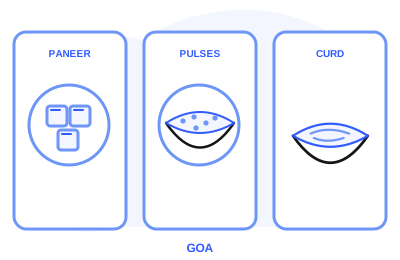
Goan Hindu cooking is largely pescetarian or lacto-vegetarian, built on coconut, kokum and tamarind, with dishes such as tondak (beans with cashews) and khatkhate. The protein in these comes mainly from beans and pulses: INDB’s chickpea curry is about 196 kcal and 7.3 g protein a bowl and its whole moong dal about 184 kcal and 7.7 g. Paneer, at 305 kcal and 18.9 g protein per 100 g in IFCT, and curd raise the protein of a vegetarian thali quickly. Our guide to a high-protein vegetarian Indian diet shows how to reach your target without fish or eggs.
A 1,800 kcal day of Goan food
Here is how a day built from everyday Goan food comes out, using the values above. It suits many adults aiming to lose fat steadily, and it reaches about 103 g of protein without a supplement.
| Meal | What’s on the plate | Calories (kcal) | Protein (g) |
|---|---|---|---|
| Breakfast | 2 boiled eggs and 1 poi (60 g) | 294 | 19.3 |
| Lunch | Three-quarters of a plate of rice, fish in coconut milk, beans with coconut | 741 | 38.0 |
| Afternoon | 30 g cashews and a tender coconut (250 ml water) | 213 | 6.3 |
| Dinner | 200 g grilled cafreal-style chicken (INDB tandoori chicken values), 2 chapatis, green salad | 545 | 39.7 |
| Total | About 1,793 | About 103 |
To make it a muscle-gain day, add a full plate of rice at lunch and a second fish dish at dinner; to make it lighter, swap the cashews for fruit. The protein intake calculator gives your own daily target. ICMR-NIN’s requirement for healthy adults is 0.83 g of protein per kg of body weight a day, and people who strength-train usually aim higher.
Finding healthy food places in Goa
People often search for healthy restaurants and healthy food cafés in Goa, especially in North Goa. A “healthy” label on a menu tells you little, though. Whether you are in a café in Assagao or a family hotel in Margao, the same rules work:
- Pick the protein first: grilled fish, cafreal, tandoori or a fish curry, then add the rice or bread.
- Count the coconut and the oil, not the dish name. Ask whether a curry is made with fresh coconut or coconut milk, and whether a dish is fried or grilled.
- One starch per meal: rice or poi or pão, not all three.
- Smoothie bowls and juices can carry as much sugar as a dessert; have them as the meal, not beside it.
- Keep cured sausages and fried platters for a weekly meal, not a daily one.
For more numbers, our national guides on calories in Indian food and protein in Indian food cover dishes from the rest of the country.
Training and eating well in Goa with a coach
MakeMyFitness has no centre in Goa; every session is live on video with a certified coach who also guides your eating. Most clients start with personal home training in Goa or personal gym training in Goa. See online personal training in Goa for how it works, and compare costs with personal trainer fees in Goa and gym fees in Goa.
To burn off a feast-day lunch, Goa has plenty to offer outdoors: running tracks in Goa, cycling in Goa on the ferry islands, treks near Goa in the dry season, and the December marathons in Goa.
Sources
- Indian Food Composition Tables 2017 (Longvah, Ananthan, Bhaskarachary, Venkaiah), ICMR-National Institute of Nutrition
- Indian Nutrient Databank (INDB): an open-access database of Indian foods and recipes (Vijayakumar et al., 2024), Current Developments in Nutrition (via PubMed Central)
- Indian Nutrient Databank (INDB): recipe nutrient dataset, Jaacks Lab, University of Edinburgh (GitHub)
- Dietary Guidelines for Indians (2024), ICMR-National Institute of Nutrition
- Nutrient Requirements for Indians 2020: brief note, ICMR-National Institute of Nutrition
- FoodData Central download datasets (SR Legacy: pork chorizo, dinner rolls, whole-wheat pita, beer), U.S. Department of Agriculture
- Goan cuisine, Wikipedia
Written by the MakeMyFitness team from the sources above. First published , last updated . Spotted something out of date? Tell us at hello@makemyfitness.com.