Eating well in Vijayawada: the bhojanam plate comes first
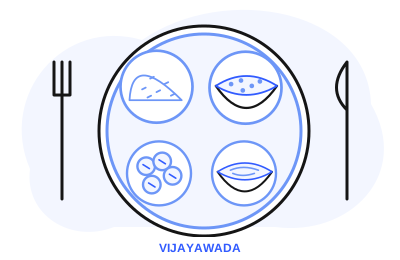
Food in Vijayawada follows the coastal Andhra pattern: the Krishna delta grows rice, so rice is at the centre of the plate, with pappu (dal), one or two kooralu (vegetable curries), rasam or sambar, and curd or majjiga to finish. Food writers describe the Vijayawada–Guntur style of bhojanam as hotter and more heavily spiced than food elsewhere in Andhra Pradesh, which grows more red chilli than any other state. Chilli has almost no calories. The rice, the oil and the extras are what decide whether a Vijayawada lunch suits a fat-loss plan.
This guide puts numbers on the city's everyday food so you can see where your calories go. For a full week of South Indian home meals, use our South Indian diet plan for weight loss; here we deal with Vijayawada itself: the meals hotel, the tiffin centre, the pickle jar and the Sunday biryani.
Calories in an Andhra meals plate in Vijayawada
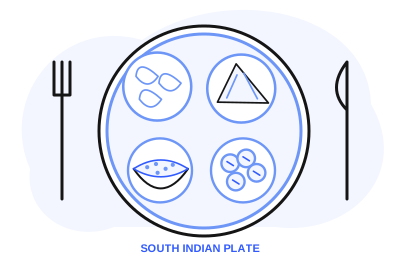
A meals hotel in Vijayawada serves unlimited rice, and that's where most of the energy comes from. INDB puts one plate of boiled rice (100 g raw) at about 352 kcal; the pappu, sambar and rasam that go on it are modest by comparison. Here is the same plate three ways:
| How you eat it | What's on the leaf | Calories (kcal) | Protein (g) |
|---|---|---|---|
| As served, with a second helping of rice | 2 plates rice, moong pappu, sambar, okra fry, a glass of majjiga | About 1,355 | About 40 |
| One helping of rice | 1 plate rice, moong pappu, sambar, okra fry, majjiga | About 1,004 | About 33 |
| Fat-loss version | Three-quarters plate rice, moong pappu, rasam, fish curry, majjiga; no fry | About 868 | About 46 |
The third version has fewer calories than the second and more protein, because the fish curry replaces part of the rice and the fry. That is the main idea of healthy eating in Vijayawada: keep the Andhra plate, change the proportions. If you're vegetarian, a bowl of sambar in place of the rasam and an extra katori of pappu does the same job with less protein.
| Dish | Serving | Calories (kcal) | Protein (g) |
|---|---|---|---|
| Boiled rice (annam) | 1 plate, 100 g raw rice | 352 | 7.8 |
| Moong dal (pesara pappu style) | 1 bowl | 139 | 7.4 |
| Toor dal with spinach (closest to palakura pappu) | 1 bowl | 213 | 8.3 |
| Sambar | 1 bowl | 249 | 8.6 |
| Tamarind rasam (charu) | 1 bowl | 104 | 4.4 |
| Okra fry (bendakaya vepudu style) | 1 bowl | 184 | 3.0 |
| Fish curry (closest to chepala pulusu) | 1 bowl | 282 | 22.3 |
| Chicken curry | 1 bowl | 320 | 29.2 |
| Egg curry | 1 bowl, 1 egg | 178 | 8.2 |
| Salted buttermilk (majjiga) | 1 tall glass | 80 | 5.7 |
| Curd rice (perugu annam) | 1 plate | 423 | 12.4 |
Pesarattu, upma and the Vijayawada tiffin
Breakfast in Vijayawada is a tiffin-centre affair: idli, dosa, upma, puri and pesarattu, the green-gram crepe served with ginger chutney. When it comes stuffed with upma, it's sold as upma pesarattu. Pesarattu is the healthiest choice on the board, because its batter is whole moong rather than rice and urad. IFCT gives whole green gram 22.5 g protein per 100 g raw, against 7.9 g for raw rice.
| Item | Serving | Calories (kcal) | Protein (g) |
|---|---|---|---|
| Pesarattu | 1 small | 76 | 3.3 |
| Idli | 1 piece | 35 | 1.2 |
| Plain dosa | 1 | 138 | 3.7 |
| Rava upma | 1 bowl | 157 | 3.5 |
| Peanut chutney | 1 tablespoon | 54 | 2.5 |
| Coconut chutney | 1 tablespoon | 67 | 0.9 |
| Boiled egg | 1 | 69 | 6.7 |
- Order pesarattu over plain dosa and ask for it without the upma filling if you're cutting: three small pesarattu are about 228 kcal and 10 g protein.
- Take peanut chutney over coconut chutney. It has nearly three times the protein for fewer calories per spoon.
- Add two boiled eggs to any tiffin plate for about 13 g protein and 137 kcal. Many tiffin centres sell them.
- Treat puri and vada as the weekend order. They're deep-fried, and recipe databases that count all the frying oil overstate them, so we haven't printed a figure.
Gongura, avakaya and the salt in Vijayawada's pickle jar
Gongura is the leaf Andhra Pradesh is proudest of, and it appears in pachadi (a ground chutney), pickles, gongura pappu and gongura mutton. IFCT lists it as gogu leaves: 36 kcal, 1.9 g protein and 4.6 g fibre per 100 g of fresh green leaves, so the leaf itself is a light, sour green. Gongura pappu, made with toor dal, is a good everyday dish. Gongura pachadi and pickle are different: they're preserved with oil, salt and chilli, so the leaf's lightness doesn't carry over.
The same goes for avakaya, the mango pickle coated in mustard powder, chilli powder and salt and stored in oil, and for the podis and pachadis that sit on the left of every Andhra leaf. The ICMR-NIN Dietary Guidelines for Indians (2024) name home-made pickles and papads among the main sources of salt in Indian diets, and recommend no more than 5 g of salt a day. They also note that about 45% of Indians already eat more than that. A spoon of pickle with each meal can use up a large share of that allowance before any curry, so keep it to one meal a day and use the pickle for flavour, not volume.
High-protein food in Vijayawada: fish, chicken, eggs and pappu
Coastal Andhra's food is built on rice, lentils and seafood from the Krishna and Godavari deltas, and fish, prawns, chicken and eggs are the easiest way to reach a good protein intake in Vijayawada. These are IFCT values per 100 g raw:
| Food | Calories (kcal) | Protein (g) |
|---|---|---|
| Tilapia | 83 | 18.5 |
| Freshwater prawns, big (scampi) | 91 | 19.2 |
| Rohu | 102 | 19.7 |
| Whole egg | 135 | 13.3 |
| Chicken breast, skinless | 168 | 21.8 |
| Pangas | 204 | 17.1 |
| Green gram (moong), whole | 294 | 22.5 |
| Paneer | 305 | 18.9 |
| Toor dal (red gram, split) | 331 | 21.7 |
| Groundnut | 520 | 23.7 |
Two things stand out. Pangas has twice the calories of rohu or tilapia for less protein, because it is a fattier fish; enjoy it, but choose rohu or prawns more often if you're losing fat. And groundnuts, which go into Andhra chutneys and podis, are high in protein but even higher in calories: 30 g is about 156 kcal. For vegetarians, pappu twice a day plus curd and some paneer gets most people to a reasonable intake. Our guide to protein in Indian food lists many more foods, and the protein intake calculator gives you a daily target.
How much is enough? ICMR-NIN sets the recommended allowance at 0.83 g of protein per kg of body weight a day for healthy adults, about 54 g for a 65 kg person. If you strength train, the International Society of Sports Nutrition suggests 1.4–2.0 g per kg, which is roughly 90–130 g for the same person.
A 1,720 kcal day of Vijayawada food
This sample day uses food you can buy at any tiffin centre or meals hotel in Vijayawada, or cook at home, with the values from the tables above. It suits many men losing fat and many women at maintenance. Work out your own target with the calorie deficit calculator, then scale the rice and chapatis.
| Meal | What to eat | Calories (kcal) | Protein (g) |
|---|---|---|---|
| Tiffin | 3 small pesarattu, 1 tbsp peanut chutney, 1 boiled egg | 350 | 19 |
| Lunch | Three-quarters plate rice, toor dal with spinach, fish curry, majjiga | 839 | 42 |
| Evening | 200 g guava with salt and chilli | 64 | 3 |
| Dinner | 2 chapatis, chicken curry | 466 | 33 |
| Day total | About 1,720 | About 97 |
For a vegetarian day, swap the egg for a second spoon of peanut chutney, the fish curry for a bowl of sambar, and the chicken curry for 100 g of paneer cooked with vegetables. That comes to about 1,660 kcal plus the oil for the paneer, with about 69 g protein, so add a glass of milk or curd if you strength train. For muscle gain, add a full plate of rice at lunch instead of three-quarters and a banana in the evening. For the calories in dishes from other parts of India, see our guide to calories in Indian food.
Healthy meals in Vijayawada when you eat out or order in
People searching for healthy restaurants or healthy food delivery in Vijayawada usually want salads and bowls, but the city's ordinary menus already work if you order with a plan:
- Meals hotels: one helping of rice, both pappu and rasam, the curry with fish or chicken, and majjiga. Skip the second rice and the fried appadam.
- Biryani: INDB's mutton biryani is about 396 kcal and 15 g protein for a 208 g plate, but restaurant portions are often much larger. Share one, or eat half and keep the rest, and add a salad or raita.
- Curd rice to finish: a full plate is about 423 kcal. Order curd or majjiga on the side instead if you've already had rice.
- Delivery apps: search for grilled or tandoori chicken, fish curry with rice, or pesarattu combos, and add boiled eggs where offered. Avoid fried starters as your main protein.
- Drinks: majjiga at about 80 kcal a glass beats a cold drink or a sweet lassi in the Vijayawada heat.
For cheap, simple meals, Andhra Pradesh's Anna Canteens, relaunched on 15 August 2024, charge ₹5 a meal. Breakfast is South Indian tiffin such as idli, upma or pongal, and lunch and dinner are white rice, a vegetable curry, dal or sambar, chutney and curd: a balanced plate, if a light one on protein. Add eggs or curd at home to round it out.
Training around Vijayawada food and the heat
Vijayawada summers push people towards cold drinks, curd rice and a long rest after lunch, and that's sensible in May. Keep training anyway, indoors and early. Eat a light tiffin with protein before a morning session, keep the biggest rice meal for after it, and drink majjiga or water through the afternoon. ICMR-NIN suggests cereals make up no more than 45% of daily energy, while most Indian diets get 50–70% from them; in Vijayawada, cutting back on rice and adding pappu, fish, eggs or paneer is how you close that gap.
If you want help putting this into practice, Personal Gym Training in Vijayawada puts a coach on your phone at your own gym, Personal Home Training in Vijayawada needs only a mat and some floor, and online personal training in Vijayawada explains all four programs. Our guides to treks near Vijayawada, gym fees in Vijayawada and personal trainer fees in Vijayawada cover the rest of a fitness routine in the city.
Sources
- Indian Food Composition Tables 2017, ICMR-National Institute of Nutrition
- Indian Nutrient Databank (INDB): recipe data and code, Jaacks Lab, University of Edinburgh (GitHub)
- Development of an Indian Food Composition Database (Vijayakumar et al., 2024), Current Developments in Nutrition
- Dietary Guidelines for Indians (2024), ICMR-National Institute of Nutrition (PDF hosted by Nutrition Connect)
- International Society of Sports Nutrition position stand: protein and exercise (Jäger et al., 2017), Journal of the International Society of Sports Nutrition
- Andhra cuisine, Wikipedia
- Anna Canteen, Wikipedia
Written by the MakeMyFitness team from the sources above. First published , last updated . Spotted something out of date? Tell us at hello@makemyfitness.com.