Healthy food in Kanpur starts with the samosa
When Uttar Pradesh launched its One District, One Cuisine scheme in January 2026, the dish chosen for Kanpur was the samosa, as News on AIR reported on launch day. It is a fair choice: samosas sit on tea-stall counters everywhere from the factory gates of Panki to the coaching lanes of Kakadeo. It is also the clearest example of why a Kanpur diet goes off track. The samosa itself is not the problem. Two of them, every day, with sweet tea, is.
No Indian lab analysis of a samosa that handles the frying oil properly turned up in our search, so the best available figure is the US Department of Agriculture’s survey food data (FNDDS 2021–2023): about 310 kcal and 5.1 g protein per 100 g, with a regular samosa weighing about 100 g and a small cocktail samosa about 25 g. So a pair of regular samosas at the 4 PM chai break is roughly 620 kcal with only about 10 g of protein.
Kanpur street food calories: Bada Chauraha, Naveen Market and the chaat stalls
Incredible India names Bada Chauraha and Naveen Market as the places for Kanpur’s chaat, with stalls selling pani puri, aloo tikki and swal papdi. The table below gives what we could source for Kanpur’s everyday street and breakfast food. Puri is the closest analysed dish to luchi, the maida puri in Kanpur’s favourite breakfast of luchi-sabzi.
| Food | Serving | Calories (kcal) | Protein (g) |
|---|---|---|---|
| Samosa, regular (USDA) | 1 samosa, about 100 g | 310 | 5.1 |
| Samosa, small (USDA) | 1 samosa, about 25 g | 78 | 1.3 |
| Puri, closest match to luchi (USDA) | 1 puri, 36 g | 147 | 2.5 |
| Aloo ki sabzi (INDB) | 1 bowl | 181 | 3.1 |
| Safed chana curry (INDB) | 1 bowl | 196 | 7.3 |
| Safed matar (dried peas) for chaat (IFCT) | 50 g raw | 152 | 10.2 |
| Moong sprouts chaat (INDB recipe) | 1 plate | 83 | 3.5 |
| Chai with milk and sugar (INDB) | 1 cup | 34 | 0.8 |
| Salted lassi (INDB) | 1 tall glass | 80 | 5.7 |
Two patterns stand out. The fried foods give lots of energy and little protein: a regular samosa has about 5 g of protein for 310 kcal. The pulse-based foods do the opposite: 50 g of safed matar in a chaat gives about 10 g of protein for 152 kcal. There is a health reason as well as a calorie one. The 2024 ICMR-NIN guidelines single out reused frying oil: when vegetable oil is heated repeatedly, its fats oxidise into compounds that may raise the risk of heart disease and cancer. A street karahi in use from morning to night is a textbook example.
Luchi-sabzi, the Kanpur breakfast, and three lighter ones
Incredible India calls luchi and sabzi Kanpur’s favourite breakfast. It is hard to beat on a Sunday, and expensive in calories on a weekday. Four puris of 36 g each with a bowl of aloo sabzi come to about 769 kcal with 13 g protein. Here is how that compares with three other breakfasts that are just as easy to get in Kanpur:
| Breakfast | What it includes | Calories (kcal) | Protein (g) |
|---|---|---|---|
| Luchi-sabzi | Four puris and a bowl of aloo sabzi | 769 | 13.0 |
| Chana and two rotis | Bowl of safed chana curry and two chapatis | 342 | 11.5 |
| Egg bhurji and a roti | Two-egg bhurji with one chapati | 291 | 16.5 |
| Moong cheela and lassi | One moong dal cheela and a salted lassi | 432 | 21.6 |
If luchi-sabzi is the breakfast you look forward to, keep it for one or two mornings a week, have two luchis instead of four (about 475 kcal with the sabzi), and add a boiled egg or a glass of salted lassi for protein. On the other days, the cheela or the bhurji will keep you full until lunch far better.
Eating around a shift in Kanpur
Kanpur’s factories in Panki and Fazalganj, its tanneries in Jajmau and its defence units run on shifts, and shift work changes when you can eat, not just what. The common trap is grazing: tea and biscuits through the night, a fried snack at the break, and a large meal at home after the shift ends. A simpler approach is three proper meals and one planned snack, timed to the shift rather than the clock.
- 1
Eat a real meal before the shift
Dal, roti and a sabzi, or rice with rajma, an hour or two before you start. A bowl of rajma is about 172 kcal with 7 g protein; three chapatis add about 218 kcal and 6 g protein.
- 2
Pack the break snack yourself
Two boiled eggs (about 137 kcal and 13 g protein), roasted chana or a box of sprouted moong chaat give far more protein than the canteen samosa.
- 3
Count the chai
INDB puts a cup of milky, sweet chai at about 34 kcal. Six cups across a night shift is about 200 kcal before a single biscuit, and most of it is sugar.
- 4
Make the post-shift meal smaller, not skipped
After a night shift, have a light plate such as dal-chawal with curd before you sleep, and the bigger meal when you wake.
High-protein food for Kakadeo students and hostel kitchens
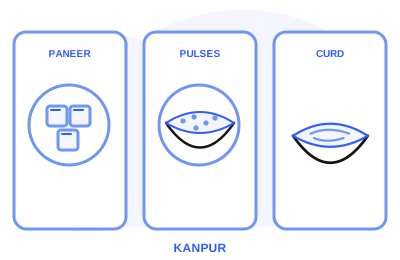
Kakadeo’s lanes are full of students preparing for entrance exams, many of them living in hostels and PGs on mess food and a tight budget. A mess thali is often rice, roti, a thin dal and a potato sabzi: plenty of carbohydrate and not much protein. ICMR-NIN sets the protein requirement for healthy adults at 0.83 g per kg of body weight a day, about 50 g for a 60 kg student, and more is useful if you train. These are the cheapest protein sources to keep in a hostel room or buy on the way back from class, with values from IFCT 2017 per 100 g raw:
| Food | Calories (kcal) | Protein (g) | How to use it in a hostel |
|---|---|---|---|
| Soybean, white | 377 | 37.8 | Soak and pressure-cook, or buy soya chunks |
| Green gram (moong), whole | 294 | 22.5 | Sprout in a steel box; eat as chaat |
| Dried peas (safed matar) | 303 | 20.4 | Boil for chaat with onion and lemon |
| Rajma, red | 299 | 19.9 | Mess rajma-chawal day, or cooked at home |
| Bengal gram (kala chana), whole | 287 | 18.8 | Roasted chana as a desk snack |
| Paneer | 305 | 18.9 | Raw with salt and pepper, or in a roll |
| Hen’s egg, whole | 135 | 13.3 | Boiled eggs from the anda stall |
| Buffalo milk | 107 | 3.7 | A glass before bed |
A realistic hostel day might be two boiled eggs and milk in the morning, the mess lunch with a second bowl of dal, a box of sprouted moong or roasted chana in the afternoon, and the mess dinner with a little paneer or a few more eggs. Those additions alone add about 50 g of protein to the mess food: two eggs (13 g), a 250 g glass of buffalo milk (about 9 g), an extra bowl of moong dal (about 7 g) and 100 g of whole moong, sprouted (22.5 g raw weight). Students who don’t eat eggs will find more options in the high-protein vegetarian Indian diet.
Thaggu ke Laddoo, badnaam kulfi and Kanpur’s sweets
Thaggu ke Laddoo is the Kanpur sweet shop visitors ask for by name, and Incredible India lists its dry fruit laddoos and “badnaam kulfi” among the city’s must-tries. The shop’s recipes aren’t published, so the figures below are INDB’s standard versions of similar sweets: a sense of scale, not the shop’s own values.
| Sweet | Serving | Calories (kcal) | Protein (g) |
|---|---|---|---|
| Suji and khoya laddoo | 1 laddoo | 126 | 2.0 |
| Besan laddoo | 1 laddoo | 168 | 3.1 |
| Kulfi | 1 kulfi | 266 | 8.7 |
ICMR-NIN’s guidelines put the line for ‘high’ added sugar at 25 g a day for an adult eating 2,000 kcal. One laddoo after dinner fits a fat-loss plan; a box shared over an evening does not. If you’re bringing a box home, put two in a bowl and the rest away.
Biryani and dal when eating out in Kanpur
Incredible India also lists biryani, shami kebabs and Sultani dal on Kanpur’s table, and Mall Road, Civil Lines, Swaroop Nagar and Sarvodaya Nagar for sit-down meals. INDB’s mutton biryani comes to 396 kcal and 15.3 g of protein for a 208 g plate: a sensible main meal if you have it with raita and salad rather than with a korma on the side. Rich dals are the hidden cost of eating out: INDB’s moti mahal dal, a rich urad and rajma dal, is about 296 kcal a bowl, more than twice its plain dhuli moong dal at about 139 kcal. If a restaurant’s dal arrives glossy with ghee or cream, have half and fill up on roti and salad.
If you look for healthy restaurants in Kanpur, read the menu before you order. Under FSSAI’s menu-labelling rules, any restaurant chain with ten or more outlets, or with a central licence, has to print the calories in each dish next to it. Grilled tikka, tandoori chicken (about 145 kcal and 16 g protein per 100 g in INDB) and dal-roti are reliable orders almost anywhere.
A day of Kanpur food for a morning-shift worker, about 1,870 kcal
Here is one example built for someone on a 6 AM to 2 PM shift who wants to lose fat while staying strong enough for physical work. Whether 1,870 kcal is the right total for you depends on your size and how physical your job is; use the calorie deficit calculator to set your own and scale the portions.
| When | What | Calories (kcal) | Protein (g) |
|---|---|---|---|
| 5:30 AM, before the shift | Chai and two boiled eggs | 171 | 14.2 |
| 10 AM break | Vegetable poha and a salted lassi | 256 | 10.5 |
| 2:30 PM, after the shift | Three chapatis, rajma, aloo gobhi, cucumber raita | 668 | 22.9 |
| 5 PM | Chai and one small samosa | 112 | 2.1 |
| 8 PM dinner | Chicken curry, three-quarters of a plate of rice, sprouted moong salad | 661 | 39.8 |
| Day total | 1,868 | 89.5 |
- Vegetarian: replace the chicken curry with matar paneer (about 374 kcal and 18 g protein) and add a bowl of moong dal (about 139 kcal and 7 g protein).
- Building muscle: add a glass of milk at night and a third egg in the morning, and see the protein intake calculator for your target.
- The samosa stays. One small samosa a day costs about 78 kcal. Keeping a favourite in the plan is what makes it last.
Two national guides go further than Kanpur’s own dishes: protein in Indian food ranks everyday foods by protein, and calories in Indian food covers the wider Indian plate.
Before you join a gym, see what gym fees in Kanpur and personal trainer fees in Kanpur look like. If you train at home, personal home training in Kanpur needs no equipment to start; if you already have a membership, personal gym training in Kanpur coaches you on your own gym floor. Friends on the same shift can share live group classes in Kanpur, or start with online personal training in Kanpur.
Sources
- UP govt launches ODOC scheme to popularise desi delicacies of each district (25 January 2026), News on AIR, All India Radio
- Kanpur, Incredible India, Ministry of Tourism
- Indian Food Composition Tables 2017 (Longvah, Ananthan, Bhaskarachary, Venkaiah), ICMR-National Institute of Nutrition
- Indian Nutrient Databank (INDB): recipe nutrient dataset, Jaacks Lab, University of Edinburgh (GitHub)
- Development of an Indian Food Composition Database (Vijayakumar et al., 2024), Current Developments in Nutrition
- FoodData Central datasets: FNDDS 2021–2023 (samosa, puri), U.S. Department of Agriculture
- Dietary Guidelines for Indians (2024), ICMR-National Institute of Nutrition
- Guidance note on menu labelling (23 February 2022), Food Safety and Standards Authority of India
Written by the MakeMyFitness team from the sources above. First published , last updated . Spotted something out of date? Tell us at hello@makemyfitness.com.