How a South Indian diet plan for weight loss works
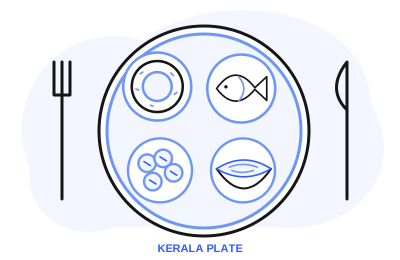
You don't need to give up South Indian food to lose fat. Idli, dosa, sambar, rasam, poriyal, curd and rice can all stay. What changes is the amount on the plate and what goes with it. Fat loss comes from eating a little less energy than you use, day after day, so this guide gives you real numbers for the dishes you already eat and a 7-day chart at about 1,500 kcal. It covers Tamil, Karnataka, Andhra and Telangana home food. Kerala food, with its heavier use of coconut, has its own Kerala diet plan for weight loss.
Every calorie and protein figure here comes from a published database: the Indian Nutrient Databank (INDB), a peer-reviewed set of 1,014 Indian recipes built mainly on the ICMR-NIN Indian Food Composition Tables (Vijayakumar et al., 2024), the Indian Food Composition Tables 2017 (IFCT) for raw ingredients, and USDA FoodData Central where IFCT has no entry. Targets come from the ICMR-NIN Dietary Guidelines for Indians (2024). Our lead coach, Kumar Abhishek, is a certified Human Performance Nutritionist (K11), and this is food guidance for healthy adults, not medical advice.
What the traditional South Indian plate gets right, and where it adds up
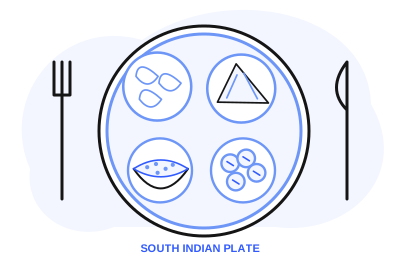
A South Indian home meal has several things going for it. Idli and dosa are steamed or griddled rather than deep-fried. Sambar and rasam bring pulses, tamarind and vegetables into almost every meal. Curd comes at the end of lunch. Poriyal and kootu put a vegetable on the plate every day. Breakfast is often eaten at home rather than bought.
The problems are about proportion. Rice tends to fill most of the plate, often twice at lunch. The ICMR-NIN guidelines suggest getting no more than 45% of calories from cereals and millets, with vegetables, fruit and greens filling about half of what you eat in a day. Rice-heavy South Indian meals rarely come close to that. Protein is low in many vegetarian breakfasts: four small idlis give about 4.6 g. Coconut, oil and ghee go into chutneys, tempering and podi. Then there are vada, bajji, murukku and mixture with evening coffee. The same guidelines suggest limiting cooking oil and other visible fat to about 20 g a day for sedentary women and 30 g for sedentary men, and added sugar to 25 g a day or less. Two sweetened filter coffees and a festival sweet can use up most of that sugar.
Calories and protein in 24 South Indian dishes
This table uses the serving each recipe defines (one idli, one bowl, one plate). The notes in brackets say what's in it, so you can compare it with your own plate. Your mother's sambar or your canteen's dosa will differ, so treat these as a starting point. For more dishes from across India, see calories in Indian food and protein in Indian food.
| Dish | Serving (what's in it) | Calories (kcal) | Protein (g) |
|---|---|---|---|
| Idli | 4 small idlis (40 g dry rice and urad dal) | 138 | 4.6 |
| Plain dosa | 1 dosa (about 33 g dry batter grains, a little butter) | 138 | 3.7 |
| Masala dosa | 1 dosa with potato filling | 345 | 6.9 |
| Rava dosa | 1 dosa | 167 | 5.4 |
| Pesarattu | 1 small (12.5 g moong dal) | 76 | 3.3 |
| Uttapam with vegetables | 1 uttapam | 174 | 4.2 |
| Rava upma | 1 bowl (20 g semolina) | 157 | 3.5 |
| Vegetable upma | 1 plate | 345 | 11.1 |
| Sambar | 1 bowl (25 g toor dal, 15 g coconut) | 249 | 8.6 |
| Rasam (tamarind) | 1 bowl | 104 | 4.4 |
| Coconut chutney | 1 tablespoon | 67 | 0.9 |
| Plain rice | 1 plate (100 g raw parboiled rice) | 352 | 7.8 |
| Curd rice (thayir sadam) | 1 plate (80 g raw rice) | 423 | 12.4 |
| Lemon rice (chitranna) | 1 plate (80 g rice, 25 g peanuts) | 563 | 13.6 |
| Tamarind rice (puliyodarai) | 1 plate (80 g rice) | 477 | 9.5 |
| Vangi bath | 1 plate | 538 | 15.4 |
| Beans poriyal with coconut | 1 bowl (100 g beans) | 197 | 3.9 |
| Avial | 1 bowl (40 g dry coconut) | 417 | 8.2 |
| Chicken curry | 1 bowl (125 g chicken) | 320 | 29.2 |
| Fish curry | 1 bowl (100 g fish) | 282 | 22.3 |
| Egg curry | 1 bowl (1 egg) | 178 | 8.2 |
| Mutton biryani | 1 plate (50 g rice, 50 g mutton) | 396 | 15.3 |
| Vegetable biryani | 1 plate | 527 | 9.5 |
| Ragi flour (for mudde or porridge) | 100 g, raw (IFCT) | 321 | 7.2 |
South Indian swaps that keep the food recognisable
- Masala dosa to plain dosa with sambar. One masala dosa is about 345 kcal with 6.9 g protein. A plain dosa with half a bowl of sambar is about 262 kcal with 8 g protein.
- Chutney by the spoon, not the ladle. Coconut chutney is about 67 kcal a tablespoon, so three spoons add about 200 kcal. Use one spoon of coconut chutney and as much tomato or mint chutney as you like.
- Half a plate of rice, the other half vegetables. A full plate cooked from 100 g of raw rice is about 352 kcal. A half plate with a bowl of poriyal fills the same space for less, and follows the ICMR-NIN advice to fill half the plate with vegetables.
- Flavoured rice once, not twice. Lemon rice is about 563 kcal a plate because of the peanuts and oil. Have half a plate (about 280 kcal) with a vegetable and curd, or keep it for a packed lunch once a week.
- Don't assume vegetable means lighter. In the INDB recipes, a plate of vegetable biryani (527 kcal) carries more energy than mutton biryani (396 kcal) because of the oil. What matters is the portion and the oil.
- Ragi for fibre, not for protein. IFCT lists ragi with 11.2 g fibre per 100 g against 2.8 g in milled rice, but slightly less protein (7.2 g against 7.9 g). Ragi mudde or porridge is filling. It doesn't replace dal, curd or eggs.
- Sundal instead of mixture. A bowl of chana or moong sundal made from 30 g of dry pulses gives about 5.6 to 6.8 g of protein (IFCT) for under 135 kcal, including a teaspoon of oil for tempering.
- Measure the oil. Cooking oils carry 884 to 892 kcal per 100 g (USDA), so every teaspoon is about 45 kcal. Keep a teaspoon in the oil jar.
- Filter coffee without sugar, or with less. Milk is fine: 100 ml of cow's milk is about 73 kcal and 3.3 g protein (IFCT). Cut the sugar a little each week.
How many calories and how much protein you need
The 1,500 kcal in this plan is an example, not a prescription. Work out your own maintenance and target with the calorie deficit calculator. The ICMR-NIN guidelines describe typical weight-loss diets as running a 500 to 750 kcal a day deficit, advise against cutting more than 40% of your daily energy needs, and say a weight-reduction diet should not go below 1,000 kcal a day.
For protein, ICMR-NIN sets the RDA at 0.83 g per kg of body weight a day, which is about 54 g for a 65 kg adult. It adds that while you're in a calorie deficit, getting about 15% of calories from protein helps preserve muscle. At 1,500 kcal that's about 56 g. If you strength train, the International Society of Sports Nutrition suggests 1.4 to 2.0 g per kg for most people who exercise. Get your own number from the protein intake calculator. In South Indian food the easy protein sources are dal and sambar, curd and buttermilk, pesarattu, sundal, eggs, fish and chicken. Vegetarians usually need to add curd, paneer or extra pulses on purpose.
7-day South Indian diet chart for weight loss (vegetarian)
| Day | Breakfast | Lunch | Evening and dinner | Day total |
|---|---|---|---|---|
| Day 1 | 4 small idlis, 1 bowl sambar, 1 tbsp coconut chutney | Half plate rice, rasam, beans poriyal, 200 g curd | Chana sundal (30 g dry chana, 1 tsp oil), 2 pesarattu, moong dal | About 1,550 kcal, 56 g protein |
| Day 2 | 3 pesarattu, 1 tbsp coconut chutney | Half plate rice, 1 bowl sambar, sprouts salad, 150 g curd | 1 guava, 2 chapatis, 75 g paneer, cabbage and peas poriyal | About 1,470 kcal, 62 g protein |
| Day 3 | Rava upma, 150 g curd | Half plate rice, 1 bowl sambar, beans poriyal, neer mor (100 g curd, thinned) | Sprouted moong (30 g dry), 2 plain dosas, moong dal | About 1,530 kcal, 56 g protein |
| Day 4 | 1 plain dosa, 1 bowl sambar | 1 plate curd rice, sprouts salad, rasam | Chana sundal (30 g dry chana, 1 tsp oil), 2 chapatis, masoor dal | About 1,530 kcal, 55 g protein |
| Day 5 | 4 small idlis, 1 bowl sambar | Half plate rice, rasam, half bowl avial, 100 g curd | 150 g papaya, 2 pesarattu, 50 g paneer, cabbage and peas poriyal | About 1,460 kcal, 54 g protein |
| Day 6 | Ragi porridge (40 g ragi, 200 ml milk) | Half plate rice, 1 bowl sambar, beans poriyal, 150 g curd | Sprouted moong (30 g dry), 1 uttapam, moong dal, 100 g curd | About 1,520 kcal, 56 g protein |
| Day 7 | 1 plate vegetable upma, 100 g curd | Half plate rice, 1 bowl sambar, sprouts salad, neer mor (100 g curd, thinned) | 1 guava, 2 chapatis, 50 g paneer, cabbage and peas poriyal | About 1,500 kcal, 61 g protein |
The vegetarian chart gives 54 to 62 g of protein a day, about the RDA for a 65 to 75 kg adult. If you weigh more, or you train hard, add 100 g of curd or 50 g of paneer to any meal. That adds about 3.5 g or 9.4 g of protein.
7-day South Indian diet chart for weight loss (non-vegetarian)
| Day | Breakfast | Lunch | Evening and dinner | Day total |
|---|---|---|---|---|
| Day 1 | 4 small idlis, 1 bowl sambar, 1 boiled egg | Half plate rice, fish curry, beans poriyal, 100 g curd | 1 guava, 2 chapatis, moong dal | About 1,560 kcal, 70 g protein |
| Day 2 | 2 plain dosas, egg curry (1 egg) | Half plate rice, chicken curry, rasam, 100 g curd | Sprouted moong (30 g dry), 4 small idlis, half bowl sambar | About 1,540 kcal, 75 g protein |
| Day 3 | 3 pesarattu, 1 boiled egg | Half plate rice, 1 bowl sambar, sprouts salad, 150 g curd | 1 banana, 2 chapatis, fish curry | About 1,500 kcal, 70 g protein |
| Day 4 | Rava upma, 2 boiled eggs | Half plate rice, chicken curry, beans poriyal | Sprouts salad, 1 plain dosa, 1 bowl sambar | About 1,520 kcal, 74 g protein |
| Day 5 | 4 small idlis, 1 bowl sambar | Half plate rice, mackerel curry with coconut, rasam, 100 g curd | 150 g papaya, 2 chapatis, egg curry (1 egg), cabbage and peas poriyal | About 1,550 kcal, 75 g protein |
| Day 6 | Egg podimas (2 eggs), 1 chapati, 1 banana | 1 plate mutton biryani, 150 g curd | Sprouted moong (30 g dry), 1 plain dosa, 1 bowl sambar | About 1,430 kcal, 61 g protein |
| Day 7 | 1 plain dosa, 1 bowl sambar | Half plate rice, prawn curry with coconut, beans poriyal | 1 guava, 2 chapatis, moong dal | About 1,460 kcal, 61 g protein |
The non-vegetarian chart reaches 61 to 75 g of protein because fish, chicken and eggs pack more protein into fewer calories. A bowl of fish curry gives about 22 g, against 8.6 g from a bowl of sambar.
A South Indian diet plan for weight loss for women
There isn't a separate South Indian diet for women. Calorie needs depend on body size and activity more than gender. For reference, the ICMR-NIN's sample day for a sedentary 55 kg woman of healthy weight comes to about 1,660 kcal and 57 g protein, and the RDA for a 55 kg woman is about 46 g of protein. So 1,500 kcal is a modest deficit for many women, and a larger one for a petite woman who sits most of the day. If you're smaller, shrink the rice and chapati portions first and keep the protein foods. Iron matters too: greens such as keerai and amaranth, pulses and ragi are good everyday sources.
Festivals, weddings and eating out
Pongal week, Ugadi holige, Navaratri sundal, Diwali murukku, a wedding meal on a banana leaf or Hyderabadi biryani and haleem during Ramzan are part of life, not something to avoid. A plan that bans them won't last. On those days, eat the dishes you care about, skip the ones you don't, keep protein in the meal and go back to the chart the next day. A single big meal doesn't undo a week. Tiffin out is easy to keep light: idli or a plain dosa with sambar is one of the more predictable restaurant meals in India. For city-specific options, see the healthy food guides for Bengaluru, Chennai and Hyderabad.
Why strength training matters while you diet
When you lose weight by eating less, part of what you lose is muscle. A review in Advances in Nutrition (Cava et al., 2017) found that in people with overweight or obesity, fat-free mass makes up about 20 to 30% of the weight lost, and more in people of normal weight. It found resistance exercise is an effective way to limit or even prevent that loss. The ICMR-NIN guidelines likewise call regular strength training necessary to maintain muscle mass, and recommend muscle-strengthening work on at least two days a week. Pair this chart with two or three short strength sessions a week, for example our home workout for weight loss, and read how we approach fat loss.
How fast you can expect to lose weight
The NHS advises aiming to lose 0.5 to 1 kg a week. The ICMR-NIN guidelines call half a kilo a week safe and warn against rapid weight-loss approaches. In practice, the first week's drop on the scale is partly water, and some later weeks will show nothing even when you've followed the plan. Weigh yourself a few mornings a week and compare weekly averages, and measure your waist once a month. If the average hasn't moved in three weeks, trim 150 to 200 kcal, usually from rice or oil, rather than cutting whole meals.
Sources
- Dietary Guidelines for Indians (2024), ICMR-National Institute of Nutrition (PDF hosted by Nutrition Connect)
- Indian Food Composition Tables 2017, ICMR-National Institute of Nutrition
- Development of an Indian Food Composition Database (Vijayakumar et al., 2024), Current Developments in Nutrition
- Indian Nutrient Databank (INDB): recipe data and code, Jaacks Lab, University of Edinburgh (GitHub)
- FoodData Central: Yogurt, plain, whole milk (FDC ID 171284), US Department of Agriculture
- FoodData Central: Oil, coconut (FDC ID 171412), US Department of Agriculture
- FoodData Central: Oil, canola (FDC ID 172336), US Department of Agriculture
- Overweight and obesity in adults, NHS
- Preserving Healthy Muscle during Weight Loss (Cava, Yeat and Mittendorfer, 2017), Advances in Nutrition
- International Society of Sports Nutrition position stand: protein and exercise (Jäger et al., 2017), Journal of the International Society of Sports Nutrition
Written by the MakeMyFitness team from the sources above. First published , last updated . Spotted something out of date? Tell us at hello@makemyfitness.com.