Sugar, oil and farsan: what shapes healthy food in Ahmedabad
Ahmedabad eats well by most measures: a mostly vegetarian city with dal at every meal, rotli made from whole wheat, millets in winter and chaas on the table. Three habits work against anyone trying to lose fat or build muscle. Sugar or jaggery goes into dal, kadhi and even shaak. Oil arrives by the spoon, in vaghar, in thepla dough and in winter undhiyu. And farsan, from fafda and gathiya to sev on top of everything, fills the gaps between meals.
The ICMR-NIN Dietary Guidelines for Indians (2024) give numbers for all three. Added sugar should stay under 5% of daily energy, which on 1,800 kcal is about 90 kcal, roughly four to five level teaspoons for the whole day. Visible fat, meaning oil and ghee, should be about 20 g a day for a sedentary woman and 30 g for a sedentary man. Salt should stay at about 5 g a day, and farsan, pickles and papad are all salty. Fix those three and most Ahmedabad food is already a good diet.
This page is about eating in Ahmedabad and Gandhinagar: farsan shops, Manek Chowk, thalis and office lunches. For a full week of home meals at about 1,500 kcal, see our Gujarati diet plan for weight loss.
Calories and protein in Ahmedabad food: dhokla to pav bhaji
Values come from the open Indian Nutrient Databank (INDB), a peer-reviewed set of 1,014 Indian recipes calculated from ICMR-NIN’s food composition tables; from the Indian Food Composition Tables 2017 (IFCT) for raw ingredients; and, for sev and gathiya, from the UK government’s CoFID tables, which include an analysed homemade sev/ganthia. Shop versions with extra oil and sugar will be higher. Where two recipes differ, you get a range.
| Food | Serving | Calories | Protein | Source |
|---|---|---|---|---|
| Khaman dhokla | 100 g (about 2–3 pieces) | 199–216 kcal | 8.5–13.4 g | INDB, two recipes |
| Methi thepla | 1 thepla, about 36 g | about 126 kcal | 3.3 g | INDB |
| Handvo | 100 g slice | about 207 kcal | 8.2 g | INDB |
| Dal dhokli | 1 bowl | about 231 kcal | 10.0 g | INDB |
| Sev or gathiya | 50 g | about 239 kcal | 9.4 g | CoFID (homemade sev/ganthia) |
| Pav bhaji with buttered pav | 1 serving | about 561 kcal | 15.5 g | INDB |
| Rabri | 1 bowl | about 226 kcal | 7.7 g | INDB |
| Chaas | 1 tall glass | about 80 kcal | 5.7 g | INDB (salted lassi) |
| Rotli (phulka) | 1 rotli | about 73 kcal | 2.1 g | INDB |
| Mag (whole moong) with vaghar | 1 bowl | about 143 kcal | 7.3 g | INDB |
| Sprouted moong salad | 1 bowl | about 77 kcal | 4.7 g | INDB |
| Peanuts | 20 g | about 104 kcal | 4.7 g | IFCT 2017 |
| Paneer | 50 g | about 153 kcal | 9.4 g | IFCT 2017 |
Steamed beats fried: khaman, khandvi and handvo against fafda and gathiya
The most useful rule for healthy food in Ahmedabad is that the same besan can go two ways. Steamed, it becomes khaman, about 200–216 kcal per 100 g with 8.5–13.4 g of protein in INDB’s two recipes. Fried, it becomes sev or gathiya, about 478 kcal and 25 g of fat per 100 g in CoFID’s analysis. Weight for weight, the fried version has more than twice the energy, and it is far easier to eat 100 g of it with tea.
- Khaman and dhokla: the best farsan-shop order. Go easy on the oil-and-sugar tempering and the sweet chutney, and the green chutney is fine.
- Khandvi: besan and curd cooked into a thin sheet, rolled and tempered. It isn’t fried, so it sits with khaman rather than fafda, though we found no analysed value to put a number on it.
- Handvo: a baked rice-and-dal cake with bottle gourd. At about 207 kcal and 8 g of protein per 100 g in INDB, a slice with dahi is a solid lunch.
- Fafda and gathiya: deep-fried besan strips. Treat a plate as a meal’s worth of energy, not a snack, and have it on Dussehra rather than every Sunday.
- Sev on top: a 20 g sprinkle of sev on bhel, usal or poha adds about 96 kcal by CoFID’s figure. Roasted chana or sprouts give the crunch with more protein for the calories: 30 g of roasted chana is about 86 kcal with 5.6 g of protein by IFCT values.
The ICMR-NIN guidelines list deep-fried snacks first among foods to swap for salads, sprouts and traditional snacks made with whole grains, and they advise against reheating and reusing frying oil, one more reason to keep fried farsan occasional.
Manek Chowk after dark: ordering at Ahmedabad’s night market
Manek Chowk, in the old city, is the most famous place to eat out in Ahmedabad. The Ahmedabad Municipal Corporation’s heritage site describes it as a vegetable market in the morning and one of India’s largest gold, silver and jewellery markets by day, before eateries, street food stalls and ice-cream counters take over the square in the evening. Gujarat Tourism lists it as open from dusk to midnight and says a full meal costs under ₹200, and singles out its rabri kulfi.
Most of what is sold there is built for indulgence, which is fine once in a while. If you go often, these orders keep the night reasonable:
| Common order | Better order | Why |
|---|---|---|
| Pav bhaji with extra butter, eaten alone | One pav bhaji shared between two, no extra butter | INDB’s pav bhaji is about 561 kcal a serving already |
| Cheese-loaded sandwich or pizza | A plain vegetable sandwich, or skip the cheese | Cheese and butter are where the calories are |
| Rabri kulfi and a second dessert | One kulfi, or a bowl of rabri shared | A bowl of rabri is about 226 kcal on its own |
| Fried snack while you wait | Nothing, or a glass of chaas | Chaas is about 80 kcal with 5.7 g of protein |
Undhiyu, Uttarayan and the winter food season
In winter, and especially around Uttarayan in January, Ahmedabad eats undhiyu: winter beans, purple yam, sweet potato, baby brinjal and fried methi muthia, slow-cooked in plenty of oil, often with puri and jalebi on the side. The vegetables are excellent. The muthia, the oil, the puri and the jalebi are what make it a feast. We found no analysed value for undhiyu, so here is how to enjoy the season without guessing:
- 1
Lift the vegetables, leave the oil
Serve undhiyu with a slotted spoon so the oil stays in the pot. Each tablespoon left behind saves about 135 kcal.
- 2
Swap puri for rotli
CoFID measures a homemade puri at 366 kcal per 100 g; a rotli is about 73 kcal each in INDB.
- 3
Add protein
Undhiyu is low in protein for its calories, so add a bowl of dahi or a glass of chaas, and dal at the next meal.
- 4
One jalebi, not a plate
Treat jalebi and chikki as the festival part of the festival, and go back to normal meals the next day.
High-protein meals in Ahmedabad for vegetarians
The ICMR-NIN 2024 guidelines put the protein requirement for healthy adults at 0.83 g per kg of body weight a day, about 54 g for a 65 kg adult, and suggest about 15% of calories from protein while losing weight to protect muscle. For people building muscle, they note that protein above about 1.6 g per kg adds nothing further to strength-training gains, and they advise against relying on protein powders. Work out your target with the protein intake calculator.
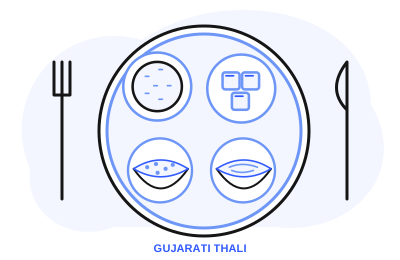
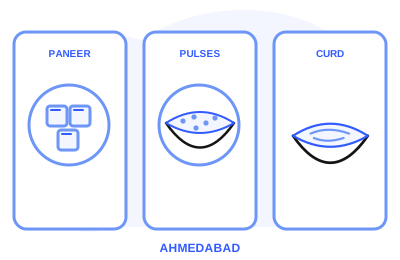
A typical Amdavadi thali is heavy on cereal and light on protein, so most vegetarians need to add protein on purpose. Easy ways to do it with local food:
- Make besan work for you: khaman, besan pudla and handvo carry 8–13 g of protein per 100 g, against about 3 g for a methi thepla.
- Full katori of dal or mag: about 7 g a bowl, so two bowls a day is 14 g.
- Chaas and dahi: about 6 g in a tall glass of chaas or a bowl of raita.
- Paneer three or four times a week: 50 g gives 9.4 g of protein for about 153 kcal by IFCT 2017 values.
- Roasted chana or peanuts, not sev: 30 g of roasted chana gives 5.6 g of protein for about 86 kcal and 20 g of peanuts 4.7 g for about 104 kcal; 20 g of sev gives about 3.8 g for 96 kcal.
Our pillar guide to protein in Indian food ranks more vegetarian sources, and high-protein vegetarian Indian diet builds whole days around them.
An 1,800 kcal Ahmedabad day
This vegetarian day uses the values above and comes to about 1,800 kcal and 78 g of protein. Chai is INDB’s standard cup with milk; dal and shaak are cooked without sugar. Raw salad of cucumber, carrot, tomato and onion is extra and free.
| Meal | What to eat | Calories | Protein |
|---|---|---|---|
| Breakfast | 2 methi thepla, cucumber raita, chai | about 376 kcal | 13.6 g |
| Mid-morning | 1 glass of chaas | about 80 kcal | 5.7 g |
| Lunch | 2 rotli, mag, bharela bhinda, a small katori of rice (30 g raw) | about 500 kcal | 16.2 g |
| Evening | 2 pieces of khaman (about 80 g), 1 guava | about 221 kcal | 13.0 g |
| Dinner | 150 g handvo, cucumber raita, sprouted moong salad | about 478 kcal | 23.2 g |
| Bedtime | 200 ml cow’s milk | about 146 kcal | 6.5 g |
For fat loss: ICMR-NIN considers about half a kilogram a week a safe rate and says diets shouldn’t drop below 1,000 kcal a day. Find your own number with the calorie deficit calculator. For muscle gain: add 50 g of paneer and a second bowl of mag (about 272 kcal and 17 g of protein together), and train with progressively heavier loads. Eat eggs? Two boiled eggs add about 13 g of protein for about 137 kcal in INDB. For more dishes, see calories in Indian food.
Healthy meals and food delivery in Ahmedabad: what to check
Search for healthy food delivery or a high-protein meal subscription in Ahmedabad and you’ll find plenty of options. We don’t review them, but the same checks work for any of them, and for the office canteen on SG Highway:
- Protein per meal: look for at least 20 g in lunch and dinner. A meal with one katori of dal and two rotli has about 11 g, so it needs paneer, dahi, sprouts or a second pulse.
- Oil and sugar: ask whether the dal and kadhi are sweetened and how much oil goes in. A “diet” thali with sweet dal and fried farsan on the side isn’t one.
- Real food over bars and shakes: the ICMR-NIN guidelines prefer food to protein supplements.
- Price per gram of protein: home-set dahi, dal and paneer are hard to beat on cost.
To keep moving between meals, our guides to running tracks in Ahmedabad and the Ahmedabad marathon season cover the riverfront and the city’s races. Training at home? See Personal Home Training in Ahmedabad, or Personal Gym Training in Ahmedabad for your existing gym. For everything else, start at online personal training in Ahmedabad.
Sources
- Dietary Guidelines for Indians (2024), ICMR-National Institute of Nutrition
- Indian Food Composition Tables 2017 (Longvah et al.), ICMR-National Institute of Nutrition
- Indian Nutrient Databank (INDB): recipe nutrient dataset, Jaacks Lab, University of Edinburgh (GitHub)
- Development of an Indian Food Composition Database (Vijayakumar et al., 2024), Current Developments in Nutrition
- Composition of foods integrated dataset (CoFID), 2021, Public Health England, GOV.UK
- Manek Chowk night market, Ahmedabad, Gujarat Tourism
- Manek Chowk heritage site, Ahmedabad Municipal Corporation
Written by the MakeMyFitness team from the sources above. First published , last updated . Spotted something out of date? Tell us at hello@makemyfitness.com.