Dal baati churma by the numbers: where a Jaipur plate gets its calories
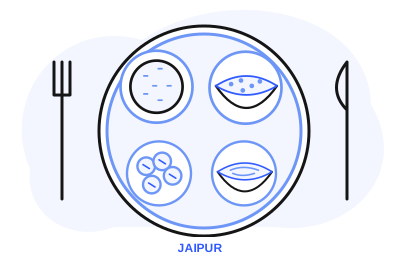
The Ministry of Tourism’s Incredible India guide calls dal baati churma Jaipur’s culinary icon, and any honest page about healthy food in Jaipur has to start there. It is three dishes on one plate: baked wheat baati, a five-lentil panchmel dal, and churma, crushed wheat sweetened and bound with ghee. The dal is a genuinely good food. The baati and churma are where a single lunch turns into most of a day’s energy, almost entirely because of ghee.
We couldn’t find a published analysis of a complete dal baati churma plate, so the table builds one from parts. Baati and churma are “IFCT calc”: worked out from Indian Food Composition Tables 2017 (IFCT, ICMR-National Institute of Nutrition) values for the amounts stated, with 5 g of ghee counted as 45 kcal. The dal is the panchmel dal recipe in the open Indian Nutrient Databank (INDB), which calculates 1,014 Indian recipes from the same tables.
| Component | Amount | Calories | Protein |
|---|---|---|---|
| Baati, not dipped | 1, from 50 g atta and 5 g ghee in the dough | about 205 kcal | 5.3 g |
| Baati, dipped in ghee | The same baati plus 10 g ghee | about 295 kcal | 5.3 g |
| Panchmel dal | 1 bowl (INDB) | about 335 kcal | 13.9 g |
| Churma | 1 small katori: 40 g atta, 10 g ghee, 15 g jaggery | about 271 kcal | 4.5 g |
| Restaurant-style plate | 2 dipped baati, dal, churma | about 1,196 kcal | 29.0 g |
| Lighter plate | 1 undipped baati, dal, raita, half a katori of churma | about 766 kcal | 27.7 g |
The lighter plate keeps every part of the dish and saves about 430 kcal, roughly a quarter of an 1,800 kcal day. Ask for the baati without the ghee bath, have the dal in a full bowl rather than a ladle, and share the churma. If you are making it at home, baking the baati and brushing it with a teaspoon of ghee rather than soaking it gets you most of the taste.
Healthy food in Jaipur: calories and protein in Rajasthani dishes
Servings are as defined by each source. INDB recipes come from standard Indian cookery manuals; home and restaurant versions in Jaipur often use more ghee, so treat these as the lower end. For dishes from other regions, see our list of calories in Indian food.
| Dish | Serving | Calories | Protein | Source |
|---|---|---|---|---|
| Panchmel dal | 1 bowl | about 335 kcal | 13.9 g | INDB |
| Gatte ki sabzi (besan gatte curry) | 1 bowl, about 256 g | about 484 kcal | 19.8 g | INDB |
| Bajra roti, no ghee | 1, from 40 g flour | about 139 kcal | 4.4 g | IFCT calc |
| Bajra roti with 1 tsp ghee | 1, from 40 g flour | about 184 kcal | 4.4 g | IFCT calc |
| Wheat roti (phulka) | 1 roti | about 73 kcal | 2.1 g | INDB |
| Moth dal | 1 bowl | about 188 kcal | 6.9 g | INDB |
| Sprouted moth chaat | 30 g dry moth | about 93 kcal | 5.9 g | IFCT calc |
| Besan chilla | 1 chilla | about 71 kcal | 4.1 g | INDB |
| Bajra ladoo | 1 ladoo | about 152 kcal | 4.6 g | INDB |
| Rabri | 1 bowl | about 226 kcal | 7.7 g | INDB |
| Sweet lassi | 1 tall glass (about 440 ml) | 158–287 kcal | 5.7–11.5 g | INDB recipe to UK CoFID takeaway samples |
| Chaas (salted lassi) | 1 tall glass | about 80 kcal | 5.7 g | INDB |
| Paneer | 50 g | about 153 kcal | 9.4 g | IFCT 2017 |
Gatte ki sabzi surprises people. The Incredible India guide describes it as steamed gram-flour dumplings in a spicy curd gravy, and that besan and curd make it one of the highest-protein vegetarian dishes in Jaipur: about 20 g a bowl in INDB’s recipe. The catch is fat, about 27 g a bowl, so half a bowl alongside dal is a better everyday portion than a full bowl on its own.
Pyaaz kachori, ghewar and laal maas: Jaipur’s richest food
The Incredible India guide notes that Jaipur is very famous for its onion and potato kachoris, and that ghevar, a disc of fried batter, is the traditional Rajasthani dessert. Neither has a published nutrient analysis we trust, and INDB’s deep-fried recipes count all of the frying oil, so we’ve left them out of the tables rather than guess. For scale, the UK government’s CoFID tables measure a homemade puri, a deep-fried wheat bread, at 366 kcal and 22 g of fat per 100 g; a kachori is a thicker, stuffed version of the same idea. Ghewar topped with rabri adds about 226 kcal for a bowl of rabri on its own.
- Pyaaz kachori: have one, not two, and make it the meal rather than a snack between meals. Pair it with chaas rather than a sweet lassi.
- Ghewar: treat it as a festival sweet; a small piece shared at Teej costs far less than a weekly habit.
- Laal maas: the fiery mutton curry the Incredible India guide describes as slow-cooked with red chilli and eaten with bajra roti. There’s no analysed value for it, but INDB’s mutton curries, such as mutton korma, run about 424 kcal and 26 g of protein a bowl. It is a high-protein meal; skim the fat that rises to the top and pair it with one bajra roti.
The ICMR-NIN Dietary Guidelines for Indians (2024) put deep-fried snacks at the top of their list of foods to swap for salads, sprouts and traditional snacks made with whole grains and millets, and advise against reheating and reusing frying oil. Both are good reasons to keep fried street snacks occasional.
Bajra, moth and ker sangri: the desert staples worth keeping
Rajasthani food grew out of a dry climate and long-keeping ingredients, and several of those staples are exactly what a fat-loss or muscle-building diet needs.
- Bajra (pearl millet): IFCT 2017 gives 348 kcal, 11 g of protein and 11.5 g of fibre per 100 g. A 40 g bajra roti is about 139 kcal and very filling. The ICMR-NIN guidelines ask adults to get 20–30% of their cereals from millets, and a bajra roti at one meal a day does that.
- Moth beans: IFCT lists moth at about 309 kcal and 19.8 g of protein per 100 g. Sprouted moth with onion, tomato and lemon is one of the cheapest high-protein snacks in the city.
- Ker sangri: desert berries and dried beans cooked with spices. The Incredible India guide calls it one of the most popular vegetable dishes of Rajasthan and a staple of the thali. We couldn’t find an analysed value for the cooked dish, so the part you can control is the oil in the pan: each tablespoon (15 g) adds about 135 kcal.
- Dahi, chaas and milk: National Dairy Development Board figures put milk availability in Rajasthan at about 1,171 g per person a day in 2023-24, roughly two and a half times the all-India 471 g. Dairy is the vegetarian protein Jaipur already has in the fridge.
High-protein food in Jaipur for vegetarians
The ICMR-NIN 2024 guidelines set the protein requirement for healthy adults at 0.83 g per kg of body weight a day, about 54 g for a 65 kg adult, and suggest around 15% of calories from protein while losing weight to protect muscle. For people building muscle, they note that intakes above about 1.6 g per kg add nothing further to strength-training gains, and they recommend food over protein powders. Find your number with the protein intake calculator.
A vegetarian in Jaipur can get to 70–90 g a day without supplements by stacking dairy and pulses:
- Breakfast: besan chilla with 50 g paneer (about 18 g of protein with chai) instead of kachori or poha alone.
- Lunch: a full bowl of panchmel dal (about 14 g), not a ladle, with bajra roti.
- Snack: sprouted moth (about 6 g per 30 g dry) or roasted chana instead of namkeen.
- Dinner: half a bowl of gatte (about 10 g) with raita (about 6 g).
- Drinks: chaas (about 6 g a glass) through the day, and a glass of milk at night.
If you eat eggs, two boiled eggs add about 13 g of protein for about 137 kcal in INDB. Our guide to a high-protein vegetarian Indian diet builds a full week this way, and protein in Indian food lists more sources by gram.
The Rajasthani thali: how to eat it and still keep your week on track
A Rajasthani thali in Jaipur usually brings baati, dal, gatte, ker sangri, kadhi, bajra roti and churma together, with refills. Add up a typical serving of just five items from the tables above (one dipped baati, a bowl of dal, half a bowl of gatte, one bajra roti with ghee and a katori of churma) and you reach about 1,327 kcal before kadhi, ker sangri, papad or a second round. That’s fine at a wedding. As a weekly office lunch, it is the main reason the scale stays put.
- 1
Start with dal and gatte
Fill the first round with the two highest-protein items, panchmel dal and gatte, plus a bowl of raita or chaas.
- 2
Choose one bread
Either one baati without the extra ghee, or one bajra roti. Not both, and not a refill.
- 3
Take vegetables freely
Ker sangri and the seasonal sabzi are mostly vegetables; ask for a dry serving without a pool of oil.
- 4
Share the sweet
Churma, ghewar or malpua: take a spoonful or two, not a full katori.
An 1,800 kcal day of Jaipur food
This vegetarian day uses the values above and food you can cook in any Jaipur kitchen. It comes to about 1,800 kcal and 82 g of protein. Chai is INDB’s standard cup with milk. A plate of raw onion, cucumber and tomato is extra and free.
| Meal | What to eat | Calories | Protein |
|---|---|---|---|
| Breakfast | 2 besan chilla, 50 g paneer, chai | about 329 kcal | 18.4 g |
| Mid-morning | 1 glass of chaas | about 80 kcal | 5.7 g |
| Lunch | 1 bajra roti, 1 wheat roti, panchmel dal, bharwa bhindi | about 651 kcal | 22.7 g |
| Evening | Sprouted moth chaat (30 g dry), 1 guava | about 141 kcal | 8.1 g |
| Dinner | Half a bowl of gatte ki sabzi, 2 roti, cucumber raita | about 478 kcal | 20.3 g |
| Bedtime | 200 ml cow’s milk | about 146 kcal | 6.5 g |
For fat loss: the ICMR-NIN guidelines consider about half a kilogram a week safe and advise against diets below 1,000 kcal a day. Many women will lose weight on this day as written; many men will need a little more. For muscle gain: add a second bowl of dal or moth and another roti, and keep training hard. Use the calorie deficit calculator to set your own target rather than assuming 1,800 is right.
Summer and winter eating in Jaipur
Jaipur’s food changes with its seasons, and so should the plan. In the hot months, chaas, dahi, lighter dals and moong or moth sprouts are easier to eat than a ghee-heavy lunch, and plenty of water matters more than any supplement. In winter, bajra roti with ghee and jaggery, bajra ladoo (about 152 kcal each in INDB) and gajak are common. They are fine in winter portions: one ladoo, not three, and one teaspoon of ghee on the roti, not a spoonful.
When you eat out in Jaipur, the same order works almost everywhere: dal and a dry sabzi, one bread, raita or chaas, and the sweet shared. Ask for less ghee on the baati and skip the second kachori. That habit matters more than which restaurant you choose.
Prefer to train in your colony gym? Personal Gym Training in Jaipur puts a coach on your phone there, and Personal Home Training in Jaipur needs no gym at all. For the rest of your routine, read about running tracks in Jaipur and what a gym costs in Jaipur, or start at online personal training in Jaipur.
Sources
- Dietary Guidelines for Indians (2024), ICMR-National Institute of Nutrition
- Indian Food Composition Tables 2017 (Longvah et al.), ICMR-National Institute of Nutrition
- Indian Nutrient Databank (INDB): recipe nutrient dataset, Jaacks Lab, University of Edinburgh (GitHub)
- Development of an Indian Food Composition Database (Vijayakumar et al., 2024), Current Developments in Nutrition
- Composition of foods integrated dataset (CoFID), 2021, Public Health England, GOV.UK
- Jaipur: food and cuisine, Incredible India, Ministry of Tourism
- Per capita availability of milk by states, National Dairy Development Board
Written by the MakeMyFitness team from the sources above. First published , last updated . Spotted something out of date? Tell us at hello@makemyfitness.com.