Healthy food in Lucknow, measured: what an Awadhi plate costs
In 2025 UNESCO made Lucknow a Creative City of Gastronomy. UNESCO’s own city page singles out Tunday kebabs, dum biryani and sheermal, and names Hazratganj, Chowk and Aminabad as the markets where the street food lives. In January 2026 the Uttar Pradesh government’s One District, One Cuisine scheme picked malai makhan as Lucknow’s dish, according to All India Radio’s report of the launch. None of that makes the city a hard place to eat well. It means you need numbers, because a Lucknow dinner can be lean or very heavy depending on three or four choices.
The figures on this page come from the Indian Nutrient Databank (INDB), a 2024 peer-reviewed database of 1,014 Indian recipes built mainly on the ICMR-NIN food composition tables, and from the Indian Food Composition Tables 2017 (IFCT) for raw foods. One caution: INDB serving weights are the weights of the raw ingredients, and its authors say they have not yet corrected for water lost or gained in cooking, so use the per-serving calories and protein rather than the grams. Restaurant portions in Aminabad or Gomti Nagar will not match a textbook recipe exactly; treat these as a fair guide, not a lab result.
| Dish | INDB serving | Calories (kcal) | Protein (g) |
|---|---|---|---|
| Mutton seekh kebab | 1 kebab | 60 | 5.1 |
| Boti kebab | 1 kebab | 73 | 5.0 |
| Mutton biryani | 1 plate, 208 g | 396 | 15.3 |
| Mutton korma | 1 bowl | 424 | 26.0 |
| Chicken korma | 1 bowl | 514 | 34.1 |
| Chicken yakhni (clear stew) | 1 bowl | 250 | 26.9 |
| Mutton yakhni (clear stew) | 1 bowl | 242 | 19.2 |
| Naan | 1 naan | 152 | 4.3 |
| Plain paratha | 1 paratha | 166 | 2.8 |
| Chapati | 1 chapati | 73 | 2.1 |
Which Lucknow kebab is the healthiest?
Kebabs are the best news on a Lucknow menu for anyone trying to lose fat or build muscle, as long as you know which ones are grilled. Seekh and boti kebabs are cooked on skewers, over coals or in a tandoor, and INDB puts a mutton seekh kebab at about 60 kcal and 5.1 g protein, a boti kebab at about 73 kcal and 5 g. Four seekh kebabs come to roughly 241 kcal and 20 g of protein, which is as much protein as a bowl of chicken korma at less than half the calories. The kakori kebab, said to have originated in Kakori in Lucknow district, is also a skewered kebab, though its mince is mixed with khoya, so expect it to be richer than a plain seekh.
The galouti is a different animal. Its legend is a contest among Awadh’s cooks to make the softest possible kebab for a nawab, and Tunday Kababi, founded in 1905, still serves it. Galouti mince is very finely ground and fried, generally in ghee. It is not unhealthy food; it is simply richer, so it works best as the main event of a dinner rather than a starter before one.
- For a regular weeknight order, choose seekh, boti or tikka, and ask for onion, mint chutney and lime on the side.
- For galouti night, make it the whole dinner rather than a starter, have one paratha rather than two, and keep breakfast and lunch that day lighter.
- Pick your bread with care. A chapati is about 73 kcal, a naan 152 and a plain paratha 166 (INDB). An ulte tawe ka paratha is closer to the paratha, and often bigger.
- Add something green. A bowl of mixed vegetables with a curd dressing is about 130 kcal and 9 g protein in INDB, and it slows you down between kebabs.
Biryani and korma in Lucknow: the same protein for half the calories
Lucknow’s biryani is cooked in the dum style: rice cooked in ghee, layered with meat, sealed and finished over a slow fire. It is a full meal on its own. INDB’s plate of mutton biryani, 208 g of ingredients, is about 396 kcal with 15.3 g protein. If the plate in front of you is bigger, scale the numbers up in proportion. Korma is the other Awadhi staple, a mild braise thickened with nuts, cream or butter, and that richness shows: a bowl of mutton korma is about 424 kcal, of which more than 31 g is fat, and chicken korma about 514 kcal.
The table below puts two Lucknow dinners side by side. Both give you about 57 g of protein. One costs almost exactly twice the calories of the other.
| Dinner | What’s on the plate | Calories (kcal) | Protein (g) |
|---|---|---|---|
| The feast | Mutton biryani, a bowl of mutton korma, two tandoori parathas, a bowl of phirni | 1,486 | 57.0 |
| The lighter order | Four seekh kebabs, two chapatis, a bowl of chicken yakhni, cucumber raita | 727 | 57.7 |
You don’t have to eat the lighter dinner every time. The point is that the feast is a once-a-week meal, a wedding or an Eid dinner, not a Tuesday. On the other nights, choosing the skewer over the gravy and one bread over three does most of the work. To see what your own daily target looks like, put your numbers into the calorie deficit calculator.
Healthy chaat in Lucknow: what to order from the stall
Chaat began in Uttar Pradesh, and Lucknow’s versions run from matar chaat and aloo tikki to pani puri served with as many as eleven flavoured waters. The healthiest Lucknow chaat is the one built on pulses and puffed rice rather than fried shells. Chana churmura, which Incredible India describes as Lucknow’s name for sukha bhel, is a good example. These are the bases we could source:
| Base | Amount | Calories (kcal) | Protein (g) |
|---|---|---|---|
| Dried peas, the base of matar chaat (IFCT) | 30 g raw | 91 | 6.1 |
| Whole Bengal gram (kala chana) (IFCT) | 30 g raw | 86 | 5.6 |
| Puffed rice (murmura) (IFCT) | 30 g | 109 | 2.2 |
| Potato, the base of aloo tikki (IFCT) | 100 g raw | 70 | 1.5 |
| Sprouted moong chaat (INDB) | 1 plate | 83 | 3.5 |
- Matar chaat is the best protein buy on the chaat lane: the dried peas give about 6 g of protein per 30 g. Ask for less of the sweet saunth chutney and more onion and lemon.
- Chana churmura with extra chana and cucumber is a light evening snack. Thirty grams of murmura is only about 109 kcal.
- Aloo tikki is fried. The potato itself is modest, about 70 kcal per 100 g raw, but the tikki soaks up oil on the tawa. Count it as the evening’s treat.
- Pani puri shells are fried, so one round is a snack and three rounds is a meal.
ICMR-NIN’s Dietary Guidelines for Indians (2024) add one more reason to favour the boiled and roasted options: they warn that oil heated again and again for frying, common in homes and commercial kitchens, produces harmful compounds. A stall that fries all day in one karahi is exactly that case.
Malai makhan, kulfi and phirni: Lucknow’s sweets in a fat-loss week
Lucknow’s winter belongs to malai makhan, also called nimish: a sweet, airy milk foam topped with pistachios, sold from stalls in the winter months, according to Incredible India. It is now Lucknow’s official One District, One Cuisine dish. No reliable calorie figure exists for it, so think of it as a dessert made of cream and sugar and eat it the way it is served: a small cup, slowly, on a cold morning. The other Lucknow sweets do have INDB figures:
| Dessert | Serving | Calories (kcal) | Protein (g) |
|---|---|---|---|
| Kulfi | 1 kulfi | 266 | 8.7 |
| Phirni | 1 bowl | 337 | 10.1 |
| Rabri | 1 bowl | 226 | 7.7 |
| Sweet lassi | 1 tall glass | 158 | 5.7 |
| Salted lassi | 1 tall glass | 80 | 5.7 |
The Dietary Guidelines for Indians treat more than 25 g of added sugar a day (5% of a 2,000 kcal diet) as high, and say less is better. A kulfi or a bowl of phirni can use most of that in one go. In practice: one Lucknow dessert on the days you choose one, not one after every meal; a salted lassi instead of a sweet one with lunch; and plain water or chhaach with kebabs rather than a sweet drink.
Breakfast in Lucknow: kachori, bun maska or a protein start
The old city’s breakfast is generous. Incredible India’s Lucknow food guide describes a Rastogi-style meal of khasta kachori, vada and aloo-chana, finished with badam milk and jalebis, and a tea stall selling bun maska and giant samosas, each stuffed with a whole potato. Most of it is fried or buttered bread, and little of it has much protein. It is a fine Sunday breakfast and a poor daily one.
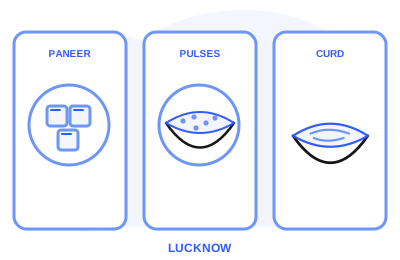
On a weekday, a breakfast that brings 20 g of protein keeps you fuller until lunch and makes the kebab dinner easier to fit. These Lucknow-friendly options come from INDB:
- Moong dal cheela: about 352 kcal and 15.9 g protein for one large cheela.
- Paneer-stuffed cheela: about 436 kcal and 24.3 g protein.
- Egg bhurji: about 109 kcal and 7.2 g protein per egg used; two eggs with a chapati is a solid breakfast.
- Paneer paratha: about 224 kcal and 6.8 g protein, against 191 kcal and 3.5 g for an aloo paratha.
- Chai: about 34 kcal a cup with milk and sugar. Four cups through the day is still under 140 kcal, but the biscuits and rusks beside them add more.
A 1,800 kcal day of Lucknow food for fat loss
This is one example of a Lucknow day at about 1,800 kcal with close to 100 g of protein. Whether 1,800 kcal is right for you depends on your size, age and activity, so work out your own number first; the meals scale up or down. Each line is an INDB serving.
| Meal | Lucknow-style choice | Calories (kcal) | Protein (g) |
|---|---|---|---|
| Breakfast | Moong dal cheela with a glass of salted lassi | 432 | 21.6 |
| Lunch | Two chapatis, whole masoor dal, palak paneer, cucumber raita | 651 | 30.1 |
| Evening | Chai, sprouted moong chaat and one boiled egg | 186 | 11.0 |
| Dinner | Four seekh kebabs, one naan, vegetable salad with curd dressing | 523 | 33.8 |
| Total | 1,792 | 96.5 |
- Vegetarian dinner: swap the seekh kebabs for half a plate of paneer tikka (INDB’s full plate is about 412 kcal and 22 g protein).
- Muscle gain: on training days add a plate of biryani or another chapati and a bowl of dal at lunch. Use the protein intake calculator to set your daily target.
- Biryani or galouti night: keep the breakfast and lunch above, skip the evening snack and let dinner run to 900 kcal.
For more vegetarian protein ideas that work with North Indian home food, see our high-protein vegetarian Indian diet. For values across the whole Indian kitchen, see protein in Indian food and calories in Indian food.
Healthy restaurants and meal deliveries in Lucknow: what to check
People searching for healthy restaurants in Lucknow or a healthy food subscription in Lucknow are usually after one of two things: a lighter meal out, or a weekday lunch they don’t have to cook. We don’t review restaurants, but a few checks work anywhere in the city:
- 1
Look for the calorie column
FSSAI requires restaurants with a central licence or outlets in ten or more locations to show calories per serving and the serving size on the menu, with a tolerance of 25%. If a chain lists them, use them.
- 2
Count the protein in a subscription meal
Our coaches aim for 20–30 g of protein in a main meal, which means a real portion of dal, paneer, chicken, eggs or fish. Check what the box actually contains, not just its name.
- 3
Ask how it’s cooked
Tandoor, grill, steam or a light tadka are good answers. ‘Fried, then cooked in gravy’ is the answer that doubles the calories.
- 4
Keep the old-city meals
Healthy eating in Lucknow doesn’t mean giving up Aminabad or Chowk. Plan one or two of those meals a week and build the rest of the week around them.
If you also want to move more outside the kitchen, our Lucknow guides cover running tracks in Lucknow, cycling in Lucknow and the Lucknow Run half marathon. For the cost of training indoors, see gym fees in Lucknow, or start with online personal training in Lucknow. If you’d rather train with a coach than alone, choose personal home training in Lucknow or personal gym training in Lucknow, and small groups of friends can share live group classes in Lucknow at ₹499 a session each.
Sources
- Lucknow: Creative City of Gastronomy (2025), UNESCO Creative Cities Network
- UP govt launches ODOC scheme to popularise desi delicacies of each district (25 January 2026), News on AIR, All India Radio
- Food guide: what and where to eat in Lucknow, Incredible India, Ministry of Tourism
- Awadhi cuisine, Wikipedia
- Galouti kebab, Wikipedia
- Indian Nutrient Databank (INDB): recipe nutrient dataset, Jaacks Lab, University of Edinburgh (GitHub)
- Development of an Indian Food Composition Database (Vijayakumar et al., 2024), Current Developments in Nutrition
- Indian Food Composition Tables 2017 (Longvah, Ananthan, Bhaskarachary, Venkaiah), ICMR-National Institute of Nutrition
- Dietary Guidelines for Indians (2024), ICMR-National Institute of Nutrition
- Guidance note on menu labelling (23 February 2022), Food Safety and Standards Authority of India
Written by the MakeMyFitness team from the sources above. First published , last updated . Spotted something out of date? Tell us at hello@makemyfitness.com.