Healthy food in Pune: how the Puneri favourites add up
Pune's food is Maharashtrian at its core, with a long list of snacks the city claims as its own. Wikipedia's entry on Pune names Puneri misal as one of its most popular vegetarian dishes and lists poha, upma, vada pav, bhel, sabudana vada and bakarwadi among its favourites. Add mastani, the biscuits of the city's old bakeries and the mess thali that feeds students and IT workers, and you have most of what a Punekar eats in a week.
Here is what those foods cost in calories and give in protein. Values are from the FatSecret India database and the open Indian Nutrient Databank (INDB), with serving sizes stated; where two databases differ, we show both, because recipes and portions really do vary.
| Food | Serving | Calories | Protein | Source |
|---|---|---|---|---|
| Misal pav | 140 g | about 312 kcal | 10.2 g | FatSecret |
| Kanda poha | 1 bowl (98 g) to 1 cup (245 g) | 177–270 kcal | 4.8–5.7 g | INDB, FatSecret |
| Sabudana khichdi | 150 g to 1 bowl (272 g) | 299–508 kcal | 4.1–7.4 g | FatSecret, INDB |
| Sabudana vada | 1 piece | about 99 kcal | 1.4 g | FatSecret |
| Vada pav | 1 (140 g) | about 304 kcal | 9.2 g | FatSecret |
| Bakarwadi (Chitale) | 25 g | about 136 kcal | 2.3 g | FatSecret |
| Nankhatai | 1 biscuit (30 g) | about 138 kcal | 1.9 g | FatSecret |
| Modak | 1 piece | about 153 kcal | 1.6 g | FatSecret |
| Puran poli | 1 piece | 196–284 kcal | 5.1–11.2 g | INDB, FatSecret |
| Mango milkshake with ice cream (closest match to mastani) | 1 tall glass (about 340 ml) | about 232 kcal | 6.6 g | INDB |
Puneri misal: sweeter, with poha, and how to order it
Misal in Pune isn't quite the misal of Kolhapur or Thane. Wikipedia notes that Puneri misal often has a sweet-to-tangy taste and can include pohe, where Kolhapuri misal is known for heat. That matters for the numbers: poha and a little jaggery add starch and sugar to a dish whose real value is the sprouted matki usal underneath. FatSecret's generic misal pav is about 312 kcal and 10.2 g of protein per 140 g; a Pune plate with poha, a mound of farsan and two pav will be well above that.
- Ask for extra usal, not extra poha. Matki has about 19.8 g of protein per 100 g raw (IFCT 2017), so more usal means more protein for the same plate.
- Farsan on the side. FatSecret lists farsan at about 545 kcal per 100 g; a heaped topping is easily 30 g, or about 163 kcal.
- One pav, or one plus a glass of taak. Each pav is about 131 kcal; a tall glass of taak adds about 5.7 g of protein for 80 kcal (INDB).
- Misal for breakfast, light lunch. A full misal plate before a Sinhagad climb is good fuel. On a desk day, make the next meal lighter.
Mastani, bakarwadi and the Pune bakery run
Pune's sweet side is hard to avoid. India's official tourism site, Incredible India, describes mastani as a thick mango milkshake topped with cut fruit, dry fruit and whipped cream, and points visitors to Pune's old bakeries for Shrewsbury biscuits and nankhatai. Bakarwadi, a fried spiral of gram-flour dough with a spiced coconut and sesame filling, is the snack most visitors take home.
No database has an analysed value for a mastani. The closest INDB recipe, a mango milkshake with ice cream, is about 232 kcal per tall glass, and a mastani adds a scoop of ice cream or cream plus dry fruit on top, so treat it as more than that: a dessert, not a drink. Chitale bakarwadi is about 544 kcal per 100 g in FatSecret, with only 9 g of protein, which means a 100 g packet opened at your desk is close to a third of a 1,800 kcal day. A nankhatai is about 138 kcal a biscuit.
- 1
Make mastani the outing
Share one, or order the smaller size, and have it instead of dessert that day, not with it.
- 2
Portion bakarwadi before you eat it
Put 20–25 g (a few pieces, about 110–136 kcal) in a bowl and close the packet.
- 3
Buy bakery biscuits for the week, not the evening
Two Shrewsbury biscuits or nankhatai with tea is a treat; the box is a lunch's worth of calories.
- 4
Pair sweets with protein
A glass of milk or a bowl of dahi with the sweet slows you down and adds protein the sweet lacks.
Sabudana khichdi and upvas days in Pune
Sabudana khichdi is a fixture of Pune breakfasts, office canteens and every upvas. It is mostly tapioca starch with peanuts and ghee or oil, and the numbers show it: FatSecret puts 150 g at about 299 kcal with 4.1 g of protein, and INDB's standard recipe works out to about 508 kcal and 7.4 g for a 272 g bowl. That's a lot of energy for very little protein. One sabudana vada is about 99 kcal with 1.4 g of protein, and two make a fried snack of nearly 200 kcal.
- Keep the bowl small and add protein. A 150 g serving with a bowl of dahi or a glass of milk is a balanced fasting breakfast.
- Use more peanuts, less sabudana. Peanuts are about 23.6 g of protein per 100 g in IFCT 2017; 15 g adds 3.5 g of protein.
- Rotate other upvas foods. Fruit with dahi, rajgira (amaranth) with milk, or roasted peanuts give more protein than a second plate of khichdi.
Mess thalis for students and IT workers in Pune
Pune runs on mess food. It is a city of colleges, and Wikipedia reports that Hinjewadi's Rajiv Gandhi Infotech Park alone houses more than 800 IT companies, with the city's IT sector employing over 300,000 people as of 2017. For many of them, lunch is a thali at a mess or a canteen. Prices are low: from 1 October 2026, Savitribai Phule Pune University raised its limited vegetarian thali to ₹48 for monthly members (from ₹38) and ₹57 for others, as the Free Press Journal reported.
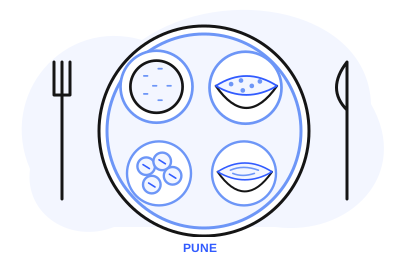
The usual mess pattern is unlimited chapati and rice with a thin dal and one sabzi. It fills you up, but it's low in protein and easy to overeat. The table shows the parts and two ways to fill the plate.
| Item or plate | Serving | Calories | Protein |
|---|---|---|---|
| Chapati | 1 (36 g) | about 73 kcal | 2.1 g |
| Rice, a full plate | 300 g cooked | about 352 kcal | 7.8 g |
| Rice, a small katori | 30 g raw | about 107 kcal | 2.4 g |
| Moong dal | 1 bowl (277 g) | about 139 kcal | 7.4 g |
| Matki usal | 40 g raw matki, 1 tsp oil | about 168 kcal | 7.9 g |
| Cabbage and peas bhaji | 1 bowl (166 g) | about 106 kcal | 5.4 g |
| Cucumber raita | 1 bowl (153 g) | about 90 kcal | 6.2 g |
| Usual plate: 4 chapatis, full rice, dal, bhaji | about 889 kcal | 29.0 g | |
| Better plate: 2 chapatis, small rice, dal, usal, bhaji, raita | about 756 kcal | 33.5 g |
The better plate has less food in it by weight of grain, but more dishes, more protein and fewer calories. If your mess serves usal or a pulse dish on some days, take a full katori of it; if it offers curd or chaas, take that too. Rice and chapati are the parts to set a number on before you start.
High protein meals in Pune on a mess budget
ICMR-NIN's allowance for healthy adults is 0.83 g of protein per kg a day, about 54 g for a 65 kg person, and its 2024 guidelines say protein is unlikely to be used for building muscle unless you're active and do strength exercises. If you lift, you'll likely want more; our protein intake calculator gives your figure. Ways to get there in Pune without a meal subscription:
- Make usal at home. Sprouted matki or moong costs little; 40 g of dry matki gives about 7.9 g of protein.
- Add eggs. Two boiled eggs are about 148 kcal and 13.4 g of protein by IFCT values, and most PGs allow a kettle or a small induction plate.
- Keep dahi and milk in the fridge. A 200 ml glass of cow's milk is about 146 kcal and 6.5 g of protein (IFCT 2017).
- Order paneer or chicken when eating out. IFCT lists paneer at 18.9 g of protein per 100 g; INDB's chicken curry is about 29 g a bowl.
One Pune day at about 1,800 calories, mess lunch included
This sample day keeps a mess lunch and a bakarwadi snack and comes to about 1,815 kcal and 75 g of protein. It suits many men losing weight steadily and many active women. Use the calorie deficit calculator to set your own target.
| Meal | What to eat | Calories | Protein |
|---|---|---|---|
| Breakfast | Home misal without farsan: matki usal, 1 pav, chai | about 333 kcal | 12.8 g |
| Lunch (mess) | 2 chapatis, small katori of rice, moong dal, cabbage and peas, raita | about 588 kcal | 25.6 g |
| Evening | 20 g bakarwadi, chai, 1 guava (about 150 g) | about 191 kcal | 4.8 g |
| Dinner | 1 jowar bhakri, 1 chapati, paneer bhurji (100 g paneer, 1 tsp oil) | about 557 kcal | 25.0 g |
| Bedtime | 200 ml cow's milk | about 146 kcal | 6.5 g |
| Total | about 1,815 kcal | about 75 g |
If you eat chicken, swap the paneer bhurji for a bowl of chicken curry (INDB: 320 kcal, 29.2 g) and the day reaches about 85 g of protein for slightly fewer calories. For muscle gain, add 2 boiled eggs at breakfast and a second bhakri at dinner. More regional dishes, with a 7-day chart, are in our Maharashtrian diet plan for weight loss; for any other food, see protein in Indian food and calories in Indian food.
Eat for the treks, train for the week
Pune's weekends are for the Sahyadris, and a Sinhagad morning is a good reason to eat a proper misal. ICMR-NIN asks adults to do muscle-strengthening exercise on at least two days a week and treats about half a kilogram a week as a safe rate of weight loss. Personal Home Training in Pune fits a PG room or a Baner flat, and Personal Gym Training in Pune puts a coach on your phone in your society gym. Our guides to treks near Pune and running tracks in Pune cover the outdoor side, and online personal training in Pune has the rest.
Sources
- Indian Food Composition Tables 2017 (Longvah et al.), ICMR-National Institute of Nutrition
- Dietary Guidelines for Indians (2024), ICMR-National Institute of Nutrition
- Indian Nutrient Databank (INDB): recipe nutrient dataset, Jaacks Lab, University of Edinburgh (GitHub)
- Misal pav: calories and nutrition (with FatSecret's generic entries for pav, farsan, vada pav, poha, sabudana vada, nankhatai, modak and puran poli), FatSecret India
- Sabudana khichdi: calories and nutrition, FatSecret India
- Chitale bakarwadi: calories and nutrition, FatSecret India
- Pune (Food; Economy), Wikipedia
- Misal pav, Wikipedia
- Pune travel and food guide, Incredible India (Ministry of Tourism)
- Pune University hikes canteen meal prices by ₹10, students oppose move (18 September 2026), Free Press Journal
Written by the MakeMyFitness team from the sources above. First published , last updated . Spotted something out of date? Tell us at hello@makemyfitness.com.