How a Bengali diet chart for weight loss works
Few cuisines give you as much to work with for fat loss as Bengali home food. A meal of machher jhol, dal, a shaak and a torkari is already rich in protein and vegetables. Weight usually creeps up through the extras: a second plate of bhaat, a ladle of mustard oil in every pan, a bhaja with the dal, luchi on Sundays and mishti after dinner. This guide puts real numbers on Bengali dishes and gives a 7-day chart at about 1,500 kcal, in niramish (vegetarian) and non-vegetarian versions, plus how to bring it down to 1,200 kcal.
The cooked-dish values are from the Indian Nutrient Databank (INDB), a peer-reviewed set of 1,014 Indian recipes built mainly on ICMR-NIN data (Vijayakumar et al., 2024). Raw fish, puffed rice, poppy seeds and chhena come from the Indian Food Composition Tables 2017 (IFCT), and plain curd from USDA FoodData Central. Targets follow the ICMR-NIN Dietary Guidelines for Indians (2024). Our lead coach, Kumar Abhishek, is a certified Human Performance Nutritionist (K11). This is guidance for healthy adults, not medical advice.
The Bengali thali, course by course: what helps and what hurts
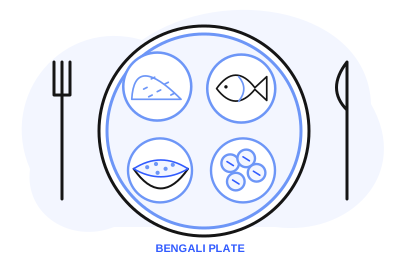
A traditional Bengali lunch comes in courses: something bitter such as shukto, then shaak, then dal with a bhaja, a torkari or dalna, the fish, a sweet-sour chutney and finally doi or mishti. Rice runs underneath the whole meal. Several of these courses help fat loss. Freshwater fish is lean: IFCT lists rohu (rui) at 102 kcal and 19.7 g protein per 100 g raw and katla at 94 kcal and 17.9 g, and notes that fish provide omega-3 fats. Shaak and shukto add greens and bitter vegetables at almost no cost.
What adds up is the oil and the add-ons. The INDB Bengali fish curry uses 15 ml of mustard oil for a single 100 g piece of pomfret. That's about three teaspoons, and every teaspoon of any cooking oil is about 45 kcal (USDA lists oils at 884 to 892 kcal per 100 g). Fish is often fried before it goes into the jhol, and each bhaja (begun, aloo, potol) soaks up more oil. Then there's the chutney and the mishti. ICMR-NIN suggests keeping cooking oil and other visible fat to about 20 g a day for sedentary women and 30 g for sedentary men, added sugar to 25 g a day, and getting no more than 45% of calories from cereals. A plate and a half of bhaat at lunch, cooked from about 150 g of raw rice, is roughly 527 kcal on its own.
Calories and protein in 24 Bengali foods
Cooked dishes use the INDB recipe serving, with the main ingredients in brackets. Fish, puffed rice, poppy seeds and chhena are per stated weight, raw, from IFCT. Home recipes vary, mostly in how much oil goes in, so use these to compare dishes rather than to count to the last calorie. More dishes from across India are in calories in Indian food and protein in Indian food.
| Food | Serving (what's in it) | Calories (kcal) | Protein (g) |
|---|---|---|---|
| Bhaat (boiled rice) | 1 plate (100 g raw parboiled rice) | 352 | 7.8 |
| Rui macher jhol-style fish curry | 1 bowl (100 g rohu, 1 tbsp oil) | 282 | 22.3 |
| Bengali fish curry in mustard oil | 1 bowl (100 g pomfret, 15 ml mustard oil) | 340 | 22.5 |
| Rohu (rui), raw | 100 g (IFCT) | 102 | 19.7 |
| Katla, raw | 100 g (IFCT) | 94 | 17.9 |
| Hilsa (ilish), raw | 100 g (IFCT) | 259 | 21.8 |
| White pomfret, raw | 100 g (IFCT) | 123 | 19.0 |
| Golda chingri (giant river prawn), raw | 100 g (IFCT) | 91 | 19.2 |
| Chingri curry with coconut | 1 bowl (150 g prawns) | 313 | 24.4 |
| Murgir jhol (chicken curry) | 1 bowl (125 g chicken) | 320 | 29.2 |
| Dimer jhol (egg curry) | 1 bowl (1 egg) | 178 | 8.2 |
| Moong dal | 1 bowl (30 g dal, 1 tsp oil) | 139 | 7.4 |
| Masoor (musur) dal, whole | 1 bowl (30 g lentils, 2 tsp oil) | 185 | 7.8 |
| Cholar dal | 1 bowl (50 g chana dal, cooked with ghee) | 291 | 12.1 |
| Khichuri | 1 small bowl (60 g rice, 20 g moong dal, 5 g ghee) | 327 | 9.9 |
| Aloo torkari (potato curry) | 1 bowl (100 g potato) | 181 | 3.1 |
| Bandhakopi with peas | 1 bowl | 106 | 5.4 |
| Palong shaak with potato | 1 bowl | 192 | 5.5 |
| Ruti (chapati) | 1 ruti (20 g atta) | 73 | 2.1 |
| Muri (puffed rice) | 30 g (IFCT) | 109 | 2.2 |
| Posto (poppy seeds) | 10 g (IFCT) | 42 | 2.0 |
| Chhena or paneer | 50 g (IFCT) | 153 | 9.4 |
| Doi (plain curd) | 100 g (USDA) | 61 | 3.5 |
| Sorshe shaak (mustard greens), raw | 100 g (IFCT) | 30 | 3.5 |
Bengali swaps that still taste like home
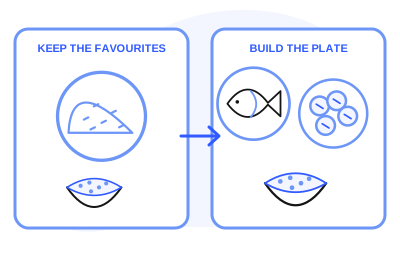
- Measure the mustard oil. Cooking the INDB fish curry with 1 teaspoon of mustard oil instead of 15 ml (about 3 teaspoons) saves about two teaspoons, roughly 90 kcal per bowl. You'll still taste the sorshe.
- Jhol over kalia or fry. A light rui macher jhol is about 282 kcal for 22 g protein. Fry the fish lightly in a measured spoon of oil, or make it bhapa (steamed in mustard paste) instead of deep-frying it first.
- Three-quarters of a plate of bhaat, not one and a half. A three-quarter plate (75 g raw rice) is about 264 kcal. Cutting down from one and a half plates saves about 264 kcal at a single meal.
- One bhaja, not three. Pick one bhaja with the dal, or pan-roast the begun with a teaspoon of oil.
- Ruti on most days, luchi on Sundays. One ruti is about 73 kcal (INDB). Luchi is deep-fried, so keep it for weekends and festivals.
- Muri the plain way. Thirty grams of muri is about 109 kcal (IFCT). Make jhal muri with boiled chana, cucumber, onion and a few drops of mustard oil, and skip the fried chanachur.
- Hilsa in season, in a smaller piece. IFCT puts ilish at 259 kcal per 100 g raw against 102 kcal for rui. It's rich in fish oil and worth eating in season: just take one piece, steamed or in a light jhol.
- Posto is mostly about the potato and oil. Poppy seeds are dense, 423 kcal per 100 g (IFCT), but 10 g is only about 42 kcal. In aloo posto the calories come from the potatoes and the oil.
- Mishti on purpose, not by habit. ICMR-NIN suggests limiting added sugar to 25 g a day. Have plain doi after meals, and keep rasgulla, sandesh and mishti doi for occasions.
Calorie and protein targets for a Bengali diet plan
Work out your own target with the calorie deficit calculator before you follow any chart. ICMR-NIN describes typical weight-loss diets as running a 500 to 750 kcal a day deficit, advises against cutting more than 40% of your daily energy needs, and says weight-reduction diets should not go below 1,000 kcal a day. Its protein RDA is 0.83 g per kg of body weight a day, about 54 g for a 65 kg adult, and it suggests getting about 15% of calories from protein during a deficit to protect muscle (about 56 g at 1,500 kcal). If you strength train, the International Society of Sports Nutrition suggests 1.4 to 2.0 g per kg. Use the protein intake calculator for your number. Bengali food reaches these targets easily with machh or dim at one or two meals. Niramish days need dal, chhena and doi at most meals.
7-day Bengali diet chart for weight loss (niramish)
| Day | Breakfast | Lunch | Evening and dinner | Day total |
|---|---|---|---|---|
| Day 1 | 30 g muri, sprouts salad, 1 banana | Half plate bhaat, musur dal, bandhakopi with peas, 150 g doi (plain curd) | 2 rutis, 75 g chhena or paneer, palong shaak with potato | About 1,490 kcal, 58 g protein |
| Day 2 | 2 rutis, aloo torkari, 100 g doi (plain curd) | Half plate bhaat, moong dal, bandhakopi with peas, 150 g doi (plain curd) | 1 guava, 2 rutis, cholar dal, 100 g doi (plain curd) | About 1,500 kcal, 57 g protein |
| Day 3 | 30 g muri, boiled chana (30 g dry), 150 g papaya, 1 banana | Half plate bhaat, musur dal, palong shaak with potato, 150 g doi (plain curd) | 2 rutis, 50 g chhena or paneer, bandhakopi with peas, 100 g doi (plain curd) | About 1,520 kcal, 58 g protein |
| Day 4 | 2 rutis, aloo torkari, 100 g doi (plain curd) | Small bowl khichuri, bandhakopi with peas, 150 g doi (plain curd) | Sprouts salad, 2 rutis, moong dal, 50 g chhena or paneer | About 1,500 kcal, 60 g protein |
| Day 5 | 30 g muri, sprouts salad, 100 ml milk | Half plate bhaat, cholar dal, bandhakopi with peas | 1 guava, 1 banana, 2 rutis, 50 g chhena or paneer, palong shaak with potato | About 1,530 kcal, 57 g protein |
| Day 6 | 2 rutis, aloo torkari, 100 g doi (plain curd) | Half plate bhaat, musur dal, bandhakopi with peas, 150 g doi (plain curd) | 1 banana, 2 rutis, moong dal, 50 g chhena or paneer | About 1,560 kcal, 59 g protein |
| Day 7 | 30 g muri, boiled chana (30 g dry), 100 g doi (plain curd), 1 banana | Half plate bhaat, moong dal, palong shaak with potato, 150 g doi (plain curd) | 2 rutis, 75 g chhena or paneer, bandhakopi with peas | About 1,510 kcal, 62 g protein |
The niramish chart gives 57 to 62 g of protein a day, mostly from dal, chhena and doi. That's at or above the RDA for adults up to about 68 kg.
7-day Bengali diet chart for weight loss (with machh, dim and mangsho)
| Day | Breakfast | Lunch | Evening and dinner | Day total |
|---|---|---|---|---|
| Day 1 | 30 g muri, 1 boiled egg, 1 banana | Three-quarter plate bhaat, rui macher jhol (100 g rohu), musur dal | 1 guava, 3 rutis, bandhakopi with peas, 100 g doi (plain curd) | About 1,500 kcal, 66 g protein |
| Day 2 | 2 rutis, dimer jhol (1 egg) | Three-quarter plate bhaat, moong dal, pomfret curry in mustard oil | 1 guava, 2 rutis, palong shaak with potato | About 1,510 kcal, 63 g protein |
| Day 3 | 30 g muri, sprouts salad, 1 boiled egg, 1 banana | Three-quarter plate bhaat, murgir jhol (chicken curry), bandhakopi with peas | 150 g papaya, 2 rutis, musur dal | About 1,490 kcal, 71 g protein |
| Day 4 | 2 rutis, aloo torkari, 1 boiled egg | Three-quarter plate bhaat, rui macher jhol (100 g rohu), moong dal, 100 g doi (plain curd) | 1 guava, 2 rutis, bandhakopi with peas | About 1,500 kcal, 67 g protein |
| Day 5 | 30 g muri, boiled chana (30 g dry), 1 boiled egg | Three-quarter plate bhaat, chingri curry with coconut, palong shaak with potato | 1 guava, 2 rutis, moong dal, 100 g doi (plain curd) | About 1,480 kcal, 70 g protein |
| Day 6 | 2 rutis, dimer bhurji (2 eggs) | Three-quarter plate bhaat, rui macher jhol (100 g rohu), bandhakopi with peas, 100 g doi (plain curd) | 2 rutis, musur dal | About 1,480 kcal, 71 g protein |
| Day 7 | 30 g muri, sprouts salad, 1 banana | Small bowl khichuri, dimer jhol (1 egg), 100 g doi (plain curd) | 2 rutis, murgir jhol (chicken curry), bandhakopi with peas | About 1,500 kcal, 72 g protein |
With fish, prawns, chicken and eggs, the non-vegetarian chart gives 63 to 72 g of protein a day and leaves room for three-quarters of a plate of bhaat at lunch.
A Bengali diet plan for weight loss for women
Women don't need a different Bengali diet, just portions that match their size and activity. For comparison, the ICMR-NIN's sample day for a sedentary 55 kg woman of healthy weight is about 1,660 kcal with 57 g protein, and the RDA for a 55 kg woman is about 46 g of protein. A 1,500 kcal chart is a modest cut for many women. If you're shorter or less active, cut bhaat and ruti first, keep the machh, dal, chhena and doi, and keep the oil to about 4 teaspoons for the whole day. Greens such as palong, lal shaak and kalmi, along with pulses, are useful everyday sources of iron.
Durga Puja, Poila Baishakh and wedding feasts
Puja bhog khichuri with labra and beguni, Poila Baishakh lunches, Jamai Shashthi, winter nolen gurer sandesh and the long biyebari menu are part of being Bengali. Plan for them rather than fight them. On the day, choose the dishes you love most, take a normal portion of the khichuri or rice, and skip what you don't care about. Get back to the chart at the next meal. A small bowl of plain khichuri is about 327 kcal (INDB), so the bhog itself is rarely the problem. For eating out in Kolkata, see the Kolkata healthy food guide.
Why strength training matters while you diet
When you cut calories, some of the weight you lose is muscle. A review in Advances in Nutrition (Cava et al., 2017) found that in people with overweight or obesity, 20 to 30% of the weight lost by dieting is fat-free mass, and that resistance exercise is an effective way to limit or even prevent that loss. ICMR-NIN also recommends muscle-strengthening exercise on at least two days a week and says regular strength training is necessary to maintain muscle mass. Start with two or three short sessions a week, such as our home workout for weight loss, and see how we coach fat loss.
How much weight to expect, and when
The NHS advises aiming for 0.5 to 1 kg a week, and ICMR-NIN calls half a kilo a week safe and warns against rapid weight-loss approaches. The first week usually shows a bigger drop because some of it is water, and later weeks are uneven. Weigh yourself a few mornings a week and watch the weekly average, and measure your waist monthly. If the average stalls for three weeks, take 150 to 200 kcal off the day, usually from rice or oil.
Sources
- Dietary Guidelines for Indians (2024), ICMR-National Institute of Nutrition (PDF hosted by Nutrition Connect)
- Indian Food Composition Tables 2017, ICMR-National Institute of Nutrition
- Development of an Indian Food Composition Database (Vijayakumar et al., 2024), Current Developments in Nutrition
- Indian Nutrient Databank (INDB): recipe data and code, Jaacks Lab, University of Edinburgh (GitHub)
- FoodData Central: Yogurt, plain, whole milk (FDC ID 171284), US Department of Agriculture
- FoodData Central: Oil, coconut (FDC ID 171412), US Department of Agriculture
- FoodData Central: Oil, canola (FDC ID 172336), US Department of Agriculture
- Overweight and obesity in adults, NHS
- Preserving Healthy Muscle during Weight Loss (Cava, Yeat and Mittendorfer, 2017), Advances in Nutrition
- International Society of Sports Nutrition position stand: protein and exercise (Jäger et al., 2017), Journal of the International Society of Sports Nutrition
Written by the MakeMyFitness team from the sources above. First published , last updated . Spotted something out of date? Tell us at hello@makemyfitness.com.