Most runners know they should do strength work and most skip it, because running feels like the real training and everything else feels optional. This guide explains what strength training actually does for runners, according to the research, then gives you eight exercises, a plan for two sessions a week and a way to fit them around your runs without wrecking your legs.
Why strength training helps runners: what the research says
The main measured benefit of strength training for runners is running economy: how much energy you use to hold a given pace. Better economy means the same pace costs you less, which shows up late in a long run or race.
- A 2018 systematic review in Sports Medicine (Blagrove and colleagues) looked at 24 studies of middle- and long-distance runners. Running economy was measured in 20 of them and generally improved by 2 to 8% compared with running alone, although not every study found a gain. Time-trial performance over 1.5 to 10 km also tended to improve, and body composition wasn't harmed. The authors suggested two to three strength sessions a week using a mix of methods.
- A 2016 meta-analysis (Balsalobre-Fernández and colleagues) pooled five controlled trials with 93 highly trained runners and found a large improvement in running economy. It recommended combining resistance exercise with plyometrics (jumps and hops) 2 to 3 times a week for 8 to 12 weeks.
- A 2024 meta-analysis in Sports Medicine (Llanos-Lagos and colleagues) compared methods. Heavy loads (at least 80% of the most you can lift once), plyometrics and combinations improved running economy; lighter loads and static holds on their own seemed less effective. Plyometrics helped at speeds up to 12 km/h, which is 5 minutes per km or slower, the pace range of most recreational runners.
The practical message: lift genuinely challenging weights for low reps, add some hops, and do it twice a week for at least two to three months. Light, high-rep circuits feel like work but did less in these studies.
Does strength training prevent running injuries?
Probably, but the evidence is less tidy than the internet suggests. A 2014 meta-analysis in the British Journal of Sports Medicine pooled 25 randomised trials with 26,610 participants across many sports. Strength training programs reduced injuries to less than a third (risk ratio 0.315), while stretching showed no protective effect. That review covered sports in general, not runners specifically.
Running-specific trials are mixed. In a randomised study of 720 first-time New York City Marathon runners, a self-directed 10-minute routine three times a week didn't reduce overuse injuries that stopped people finishing (7.1% vs 7.3%). Runners averaged about two of the three prescribed sessions a week, and the authors noted they couldn't check anyone's technique without in-person instruction. A later analysis of 867 runners from the 2019 race found that those who could hold a single-leg glute bridge on their weaker side for 20 to 29 seconds had a 64% lower risk of overuse injury than those who managed 0 to 9 seconds.
Read together: short, unsupervised routines probably aren't enough, while real strength, especially around the hips, is linked with fewer injuries. How fast you add running distance matters too. A Danish study of 874 new runners found that those who increased weekly distance by more than 30% over two weeks seemed more prone to distance-related injuries, such as runner's knee and shin splints, than those who increased by less than 10%. The finding was exploratory, but it's a sensible ceiling.
The 8 key strength exercises for runners
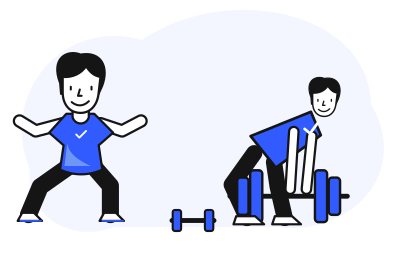
Running is a series of single-leg landings, so most of these work one leg at a time. Each has a no-equipment version, a dumbbell version and a gym version. Pick the level where the last two reps of each set are hard but your form holds.
| Exercise | No equipment | Dumbbells | Gym |
|---|---|---|---|
| Squat | Bodyweight squat, 3-second lowering | Goblet squat | Back or front squat |
| Split squat | Split squat, back foot on the floor | Rear-foot-elevated split squat holding dumbbells | Barbell or Smith-machine split squat |
| Hip hinge | Single-leg reach (balance hinge) | Single-leg Romanian deadlift | Romanian deadlift or trap-bar deadlift |
| Calf raise | Single-leg calf raise off a step | Single-leg calf raise holding a dumbbell | Seated and standing calf-raise machines |
| Glute bridge | Single-leg glute bridge and hold | Hip thrust with a dumbbell on the hips | Barbell hip thrust |
| Step-up | Step-up onto a sturdy chair or stair | Step-up holding dumbbells | Step-up to a box with a barbell or dumbbells |
| Side plank | Side plank, top leg raised | Side plank with a reach-through | Copenhagen side plank on a bench |
| Hops | Pogo hops on the spot | Skipping rope | Box jumps and bounds |
- 1
Squat: 3 sets of 5 to 8
Feet shoulder-width, sit down between your heels, keep your knees tracking over your toes and stand tall. Builds the quadriceps that absorb every landing. Progress to a goblet squat, then a barbell, adding weight when all sets feel smooth.
- 2
Split squat: 3 sets of 6 to 8 per leg
Long stance, lower the back knee towards the floor and push up through the front foot. With the back foot raised on a bench (the Bulgarian version), it's one of the most running-specific lifts you can do.
- 3
Hip hinge: 3 sets of 6 to 8 (per leg if single-leg)
Soft knee, push your hips back with a flat back until you feel your hamstrings, then stand. The single-leg version adds balance. Works the hamstrings and glutes that drive you forward.
- 4
Calf raise: 3 sets of 10 to 15 per leg
Slow up, pause, slow down, with the heel lowering below the step. Do some with the knee straight and some bent to work both calf muscles. Your calves work on every stride, so don't skip these.
- 5
Single-leg glute bridge: 3 sets of 8 to 10 per leg, then a hold
Drive through the heel and lift the hips level. Finish with a hold on each side and build towards 30 seconds; in the New York study, holds of 20 seconds or more were linked with lower injury risk.
- 6
Step-up: 2 to 3 sets of 8 per leg
Use a box or step around knee height. Push through the top foot only, without bouncing off the bottom leg. Lower slowly.
- 7
Side plank: 2 to 3 sets of 20 to 40 seconds per side
Body in a straight line, hips high. Raising the top leg works the hip abductors that keep your pelvis level on landing.
- 8
Hops: 2 to 3 sets of 10 to 20 contacts
Quick, springy hops on the balls of your feet, staying tall. Start on the spot, then progress to skipping, small jumps forward and box jumps. Do them at the start of a session while you're fresh.
Strength training for runners at home, with no equipment
You can do strength training for runners at home with no equipment, with one catch: bodyweight gets easy fast, and the research favours heavy loads. Make bodyweight work harder in this order:
- Go single-leg. A single-leg squat to a chair, a rear-foot-elevated split squat and a single-leg calf raise roughly double the load on each leg.
- Slow down. Take 3 to 4 seconds to lower, and pause at the bottom.
- Add a backpack loaded with books or water bottles.
- Buy one or two dumbbells when you can do 15 clean single-leg reps. Our guide to a dumbbell workout at home shows how far a pair can take you.
If you don't have a gym, Personal Home Training builds these progressions around the space and equipment you have, live on video.
Strength training for runners' knees
Pain around or behind the kneecap (patellofemoral pain, often called runner's knee) affects a large share of people, from teenagers to older adults. A 2018 international consensus statement on patellofemoral pain, published in the British Journal of Sports Medicine, supported exercise therapy, especially combining hip-focused and knee-focused exercises, to improve pain and function. That's one reason good plans for runners include split squats, step-ups, glute bridges and side planks rather than only squats.
Strength training for women runners
The plan and the loads are the same for women runners. The studies above included women, and there's no reason to lift lighter or do more reps. Two points matter more in practice. First, eat enough: the International Olympic Committee's 2023 consensus statement describes Relative Energy Deficiency in Sport (REDs), where eating too little for the training you do harms both health and performance, in women and men. Second, if your periods stop or become irregular while training, or you keep getting bone stress injuries, see a doctor rather than training harder. If you're over 40, our guide to strength training for women over 40 covers what changes.
A 2-day-a-week strength plan across a training cycle
Do two sessions a week, A and B, each 30 to 40 minutes after a 5-minute warm-up. The plan below follows a typical 16-week build to a race. Shorten each phase for a shorter cycle.
| Weeks | Phase | Sessions a week | What changes |
|---|---|---|---|
| 1 to 4 | Foundation | 2 | Learn the moves. 2 to 3 sets of 8 to 12 reps, moderate weight, slow lowering. Hops on the spot only. |
| 5 to 10 | Strength | 2 | Heavier: 3 to 4 sets of 4 to 6 reps on squats, split squats and hinges, leaving 1 to 2 reps in reserve. Add skipping and small jumps. |
| 11 to 14 | Race build | 1 to 2 | Keep the weights heavy but drop to 2 to 3 sets. Short, sharp plyometrics. Skip a session in your biggest running weeks. |
| 15 to 16 | Taper and race | 1, early in the week | One short session at moderate weight, at least 4 to 5 days before the race. Nothing new. |
| After the race | Recovery | 0 to 1 | Rest a week, then restart at Foundation with lighter weights. |
Dropping to one session a week in heavy running blocks is fine. A 2023 review in Sports Medicine found that even one resistance session a week builds strength in people new to lifting, so one good session a week is a reasonable minimum during your biggest running blocks.
| Session A | Session B |
|---|---|
| Pogo hops, 2 x 15 | Skipping or small forward jumps, 2 x 10 |
| Squat, 3 x 5 to 8 | Hip hinge, 3 x 6 to 8 |
| Split squat, 3 x 6 to 8 per leg | Step-up, 3 x 8 per leg |
| Single-leg calf raise, 3 x 12 per leg (knee straight) | Single-leg calf raise, 3 x 12 per leg (knee bent) |
| Side plank with leg raise, 2 x 30 seconds per side | Single-leg glute bridge, 2 x 10 per leg, then a hold |
How to fit strength training around your running
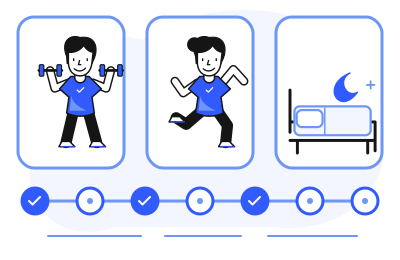
- Keep hard days hard and easy days easy. Lift on the same day as a hard run (intervals or tempo), after the run or later that day. Your easy days stay truly easy.
- Not the day before your long run or key workout. Heavy legs from lifting will spoil the run that matters most.
- Run first if it's the same session. Runners care more about the run, so do it fresh.
- Expect soreness at first. The first two weeks of lifting will make your legs ache. Start light; it settles quickly.
- Track it. Write down weights and reps, like you log kilometres.
| Day | Running | Strength |
|---|---|---|
| Monday | Rest or easy walk | None |
| Tuesday | Intervals or tempo (morning) | Session A (evening) |
| Wednesday | Easy run | None |
| Thursday | Rest | None |
| Friday | Steady or hill run (morning) | Session B (evening) |
| Saturday | Rest or easy 20 minutes | None |
| Sunday | Long run | None |
Strength training for Indian runners: heat, humidity and early starts
In most Indian cities the coolest part of the day is just before sunrise, so serious runners train at 5 or 6 AM for much of the year. That makes it tempting to cram strength work into the same early slot, half asleep. A better pattern for Indian runners is to run early, while it's cooler, and do strength work indoors in the evening, when heat and humidity matter much less for a 35-minute session with rests between sets.
Use the seasons too. In the hottest weeks and the heaviest monsoon weeks, when outdoor running is cut short, keep your two strength sessions and treat them as the anchor of your training. In the cooler months, when many Indian races are held, follow the race-build volume. Our guide to the best time to work out goes further into morning versus evening training, and the half marathon training plan for beginners covers heat and hydration on race day.
Where to run in your city
Pick a route where you can run your easy kilometres without dodging traffic. These city guides cover named parks, lakes, tracks and loop distances, plus the best months and times to run in each city:
- Running tracks in Bengaluru
- Running tracks in Gurugram
- Running tracks in Hyderabad
- Running tracks in Pune
- Running tracks in Mumbai
- Running tracks in Delhi
- Running tracks in Noida
- Running tracks in Chennai
- Running tracks in Thane
- Running tracks in Navi Mumbai
- Running tracks in Ahmedabad
- Running tracks in Chandigarh–Mohali
- Running tracks in Jaipur
- Running tracks in Kolkata
- Running tracks in Kochi
- Running tracks in Ghaziabad
- Running tracks in Lucknow
- Running tracks in Surat
- Running tracks in Nagpur
- Running tracks in Nashik
- Running tracks in Indore
- Running tracks in Goa
- Running tracks in Dehradun
When a coach makes the difference
The New York trial is a useful warning: runners given a routine and left alone did about two-thirds of it, with nobody checking their form. A coach fixes both problems. If you train at a gym, Personal Gym Training puts a certified coach on your phone while you lift, from ₹799 a session or ₹7,070 for 12. You can also learn the basics with our gym workout plan for beginners and keep your fuelling on track with the protein intake calculator.
Sources
- Effects of Strength Training on the Physiological Determinants of Middle- and Long-Distance Running Performance: A Systematic Review (Blagrove et al., 2018), Sports Medicine, via PubMed
- Effects of strength training on running economy in highly trained runners: a systematic review with meta-analysis (Balsalobre-Fernández et al., 2016), Journal of Strength and Conditioning Research, via PubMed
- Effect of Strength Training Programs in Middle- and Long-Distance Runners' Economy at Different Running Speeds (Llanos-Lagos et al., 2024), Sports Medicine, via PubMed
- The effectiveness of exercise interventions to prevent sports injuries: a systematic review and meta-analysis (Lauersen et al., 2014), British Journal of Sports Medicine, via PubMed
- A Randomized Study of a Strength Training Program to Prevent Injuries in Runners of the New York City Marathon (Toresdahl et al., 2020), Sports Health, via PubMed Central
- Strength and Flexibility Self-Assessment and Subsequent Training Injuries Among Runners of the New York City Marathon (Toresdahl et al., 2025), Clinical Journal of Sport Medicine, via PubMed
- Excessive progression in weekly running distance and risk of running-related injuries (Nielsen et al., 2014), Journal of Orthopaedic & Sports Physical Therapy, via PubMed
- 2018 Consensus statement on exercise therapy and physical interventions for patellofemoral pain (Collins et al.), British Journal of Sports Medicine, via PubMed
- 2023 International Olympic Committee's consensus statement on Relative Energy Deficiency in Sport (REDs), British Journal of Sports Medicine, via PubMed
- Minimalist Training: Is Lower Dosage or Intensity Resistance Training Effective to Improve Physical Fitness? A Narrative Review (Behm et al., 2023), Sports Medicine, via PubMed Central
Written by the MakeMyFitness team from the sources above. First published , last updated . Spotted something out of date? Tell us at hello@makemyfitness.com.