Dumbbells are the most useful thing you can buy for training at home. They fit under a bed, they work every muscle group, and unlike bodyweight alone they let you add load in small, measurable steps. This guide covers what to buy, the exercises worth learning, three routines and the rules for making them harder over time.
Can you get a full workout with dumbbells at home?
Yes. The World Health Organization's 2020 guidelines ask adults to do muscle-strengthening activities on 2 or more days a week, and the NHS lists lifting weights as one of the ways to do it. A pair of dumbbells covers every movement pattern: squat, hinge, lunge, push, pull and carry.
You also don't need very heavy weights to build muscle. A 2017 meta-analysis of 21 studies by Schoenfeld and colleagues found that muscle growth was similar with light and heavy loads when sets were taken close to failure, while heavy loads produced bigger gains in maximal strength. Home dumbbells are often lighter than a gym's, so the rule is simple: end every set with only one to three good reps left in you.
Choosing dumbbells: fixed or adjustable, and what weight
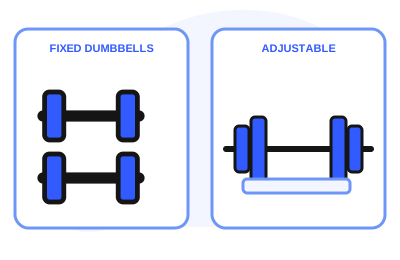
| Type | Good for | Drawbacks |
|---|---|---|
| Fixed pairs (hex or round, rubber or vinyl coated) | Quick to pick up, nothing to come loose, quiet on the floor | You need several pairs as you get stronger, which costs space and money |
| Spinlock adjustable (bar, plates and collars) | One set covers light to heavy, cheapest per kg | Changing plates takes a minute; collars must be checked every set |
| Selector adjustable (dial or pin) | Fast changes, compact | Expensive, bulkier, and you can't drop them |
Prices vary a lot by brand, coating and sale. As one reference point, Decathlon India's dumbbell set listings showed a 10 kg Domyos dumbbell kit at ₹2,599 (MRP ₹3,999), a 20 kg cast-iron dumbbell set at ₹5,999 (MRP ₹8,999) and a 50 kg adjustable dumbbells and bars kit at ₹12,999 (MRP ₹21,999) when we checked in October 2026.
Your legs and back can handle far more weight than your shoulders and arms, which is why an adjustable set suits most people. Pick the weight for each exercise by feel: you should be able to do the target reps with good form and finish with two or three reps left. The ranges below are our coaches' rough starting points for adults who are new to lifting, not a rule.
| Exercise type | Examples | Starting range |
|---|---|---|
| Legs and hips | Goblet squat, Romanian deadlift (one heavier dumbbell or a pair) | 4 to 12 kg |
| Rows | One-arm row, bent-over row | 3 to 10 kg |
| Presses | Floor press, overhead press | 2 to 8 kg |
| Small muscles | Curls, lateral raises, reverse flys | 1 to 5 kg |
18 dumbbell exercises to learn at home
Each exercise has a cue or two that fixes the most common mistake. Move under control: take about 2 to 3 seconds to lower each rep.
Lower body
- 1
Goblet squat
Hold one dumbbell upright against your chest. Sit between your heels, knees tracking over your toes, chest tall, then stand. Keep the dumbbell touching your body the whole time.
- 2
Romanian deadlift
Dumbbells in front of your thighs, knees soft. Push your hips back until you feel your hamstrings stretch, dumbbells sliding down your legs, back flat. Stand by driving your hips forward. It's a hinge, not a squat.
- 3
Reverse lunge
Step back and lower until both knees bend to about a right angle, front heel down, then push through the front foot to stand. Dumbbells by your sides.
- 4
Split squat
Feet in a long stance, back heel up. Drop straight down and up without moving your feet. Harder: back foot on a sofa or bed (Bulgarian split squat).
- 5
Step-up
Use a sturdy step or low bench, never a chair that tips. Press through the top foot to stand up; don't push off the bottom foot.
- 6
Dumbbell hip thrust
Upper back on the sofa edge, dumbbell across your hips on a folded towel. Drive your hips up until your body is straight from shoulders to knees, squeeze, lower.
- 7
Calf raise
One dumbbell in one hand, the other hand on a wall. Rise high on the balls of your feet, pause, lower slowly. Use a step edge for more range.
Push: chest, shoulders and triceps
- 1
Floor press
The home answer to a bench press. Lie on your back, knees bent, dumbbells over your chest. Lower until your upper arms touch the floor at about 45 degrees from your body, pause, press up.
- 2
Overhead press
Standing or seated, dumbbells at shoulder height. Brace your stomach and glutes so your lower back doesn't arch, press straight up, finish with biceps beside your ears.
- 3
Lateral raise
Light dumbbells at your sides, slight bend in the elbows. Raise out to shoulder height, leading with your elbows, and lower slowly. No swinging.
- 4
Overhead triceps extension
Hold one dumbbell overhead with both hands. Lower it behind your head by bending only at the elbows, keeping them pointing forward, then straighten.
Pull: back and biceps
- 1
One-arm row
One hand and knee on a sofa or bench, back flat. Pull the dumbbell towards your hip, not your chest, and lower until your arm is straight.
- 2
Bent-over row
Hinge forward to about 45 degrees with a flat back, dumbbells hanging. Row both towards your lower ribs, squeeze your shoulder blades, lower.
- 3
Reverse fly
Hinged forward with light dumbbells, arms slightly bent. Open your arms out to the sides until level with your body. Great for posture.
- 4
Biceps curl and hammer curl
Elbows pinned to your sides. Curl up without leaning back, lower over 3 seconds. Palms up for a curl, palms facing each other for a hammer curl.
Core and carries
- 1
Farmer carry
Heavy dumbbells at your sides, stand tall and walk for 20 to 40 metres or 30 to 45 seconds. Shoulders down, no leaning.
- 2
Suitcase carry
The same with one dumbbell. Resist leaning towards it: this trains the sides of your trunk. Swap hands each set.
- 3
Dumbbell dead bug
On your back holding one light dumbbell above your chest, knees over hips. Lower one heel to tap the floor while your lower back stays pressed down, then switch.
Full-body dumbbell workout at home: 3 routines
These full-body routines follow the American College of Sports Medicine's position stand on progression, which recommends 2 to 3 sessions a week for novices, with loads they can lift for about 8 to 12 reps. Leave a day between sessions, for example Monday, Wednesday and Friday. Warm up for 5 minutes first: march on the spot, arm circles, hip circles and a few bodyweight squats.
Routine 1: beginner (weeks 1 to 6)
| Exercise | Sets x reps | Rest |
|---|---|---|
| Goblet squat | 2 x 10 to 12 | 90 seconds |
| One-arm row | 2 x 10 to 12 each side | 60 seconds |
| Floor press | 2 x 10 to 12 | 60 seconds |
| Romanian deadlift | 2 x 10 to 12 | 90 seconds |
| Overhead press (seated) | 2 x 10 to 12 | 60 seconds |
| Dead bug | 2 x 8 each side | 45 seconds |
Routine 2: intermediate (A and B, alternate)
| Day A | Day B | Sets x reps | Rest |
|---|---|---|---|
| Goblet squat | Reverse lunge | 3 x 8 to 12 | 90 seconds |
| Bent-over row | One-arm row | 3 x 8 to 12 | 75 seconds |
| Floor press | Overhead press | 3 x 8 to 12 | 75 seconds |
| Romanian deadlift | Dumbbell hip thrust | 3 x 10 to 12 | 90 seconds |
| Lateral raise | Reverse fly | 2 x 12 to 15 | 45 seconds |
| Farmer carry | Suitcase carry | 3 x 30 to 40 seconds | 60 seconds |
Routine 3: advanced (heavier, single-leg focus)
| Exercise | Sets x reps | Rest |
|---|---|---|
| Bulgarian split squat | 4 x 6 to 10 each leg | 2 minutes |
| Romanian deadlift (3-second lowering) | 4 x 8 to 10 | 2 minutes |
| Floor press, then curl (superset) | 3 x 8 to 12 each | 90 seconds after both |
| One-arm row, then overhead triceps extension (superset) | 3 x 8 to 12 each | 90 seconds after both |
| Overhead press | 3 x 6 to 10 | 90 seconds |
| Step-up | 3 x 8 to 10 each leg | 75 seconds |
| Suitcase carry | 3 x 40 seconds each side | 60 seconds |
When your heaviest dumbbells start to feel light, the advanced routine keeps them useful: single-leg work doubles the load on each leg, and slow lowering makes a light weight harder. Our guide to building muscle at home has more on making light loads work.
Dumbbell workout at home for women
A dumbbell workout at home for women uses exactly the same exercises and routines. Women don't need special "toning" moves or tiny pink dumbbells: the goblet squat, Romanian deadlift, row and press work the same way for everyone, and only the weight changes. Lifting won't make you bulky; building large muscles takes years of deliberate training and eating in a surplus. If you're over 40, our guide to strength training for women over 40 explains why it matters even more, and online personal training for women covers training at home with a coach.
Dumbbell workout at home for men: chest, arms and back
The most common dumbbell searches from men are for chest and biceps. Without a bench, the floor press is your chest exercise; add push-ups after it, with a slow lowering, to finish the set. For biceps, curls and hammer curls at the end of the session are enough, because rows already work the biceps hard. The bigger gains, though, come from not skipping the legs and back: they're the largest muscles and the ones a full-body routine trains first. To grow, follow the muscle building goal page and eat enough protein, about 1.4 to 2.0 g per kg of body weight a day according to the International Society of Sports Nutrition. Our protein intake calculator works out your number.
Dumbbell workout at home for belly fat: what actually works
No dumbbell exercise burns belly fat specifically. A 2022 meta-analysis of 13 studies with 1,158 participants compared trained and untrained body parts and concluded that localized muscle training had no effect on the fat over that area. In an earlier randomized trial, adults who did seven abdominal exercises 5 days a week for 6 weeks gained ab endurance but showed no change in belly fat, waist size or body fat percentage.
What does work is lowering your overall body fat: a modest calorie deficit, full-body strength training to keep your muscle, and daily walking. The CDC links a steady loss of about 0.5 to 0.9 kg a week with keeping it off. Set a target with the calorie deficit calculator, and read our home workout for weight loss plan and fat loss goal page. Measure your waist at the navel once a week; it's a better guide than the scale.
How to progress: rules for adding weight
Progressive overload is what turns a routine into results. The ACSM position stand recommends a 2 to 10% increase in load once you can do one or two reps more than your target. With home dumbbells, jumps are often bigger than that, so use these steps in order:
- Add reps within the range: if the target is 8 to 12, work from 8 up to 12 with the same weight.
- Add weight when you hit 12 on every set, and drop back to 8 reps.
- If the next dumbbell is too big a jump, slow the lowering to 3 to 4 seconds, add a pause at the bottom, or add a set.
- Switch to a harder version: goblet squat to split squat, floor press to single-arm floor press.
- Write everything down: date, weight, reps and how hard it felt from 1 to 10.
Safety when lifting dumbbells at home
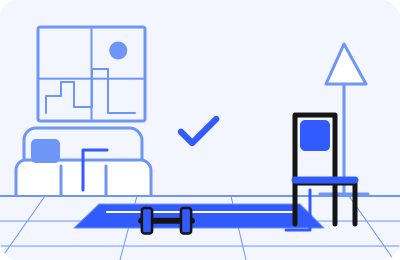
- Check the collars on spinlock dumbbells before every set. A plate that slides off mid-press can land on your face or foot.
- Clear the space: a mat's length plus an arm's reach on each side, no rugs that slide, no glass tables nearby.
- Set dumbbells down, don't drop them. Floors crack and neighbours complain.
- Store them on the floor, not on shelves where a child can pull them down, and keep children and pets out of the room while you train.
- Wear shoes or train barefoot, never in socks on tiles.
- Stop if a joint hurts with a sharp or pinching pain. Muscle burn is normal; joint pain is not.
When a coach makes the difference
Dumbbells are simple, but choosing the right weight for each exercise and spotting a rounding back on your own is hard. Personal Home Training costs ₹899 a session, or ₹8,080 for a 4-week plan of 12: 45 minutes one-to-one on live video, built around whatever dumbbells you own. See all programs on the pricing page, what to expect in your first session, and the strength training goal page. No dumbbells yet? Start with the no-equipment home workout plan for beginners or a resistance band workout at home.
Sources
- World Health Organization 2020 guidelines on physical activity and sedentary behaviour, British Journal of Sports Medicine
- Physical activity guidelines for adults aged 19 to 64, NHS
- Progression models in resistance training for healthy adults (position stand, 2009), American College of Sports Medicine
- Strength and hypertrophy adaptations between low- vs. high-load resistance training: a systematic review and meta-analysis (2017), Journal of Strength and Conditioning Research
- A proposed model to test the hypothesis of exercise-induced localized fat reduction, including a systematic review with meta-analysis (2022), Human Movement
- The effect of abdominal exercise on abdominal fat (2011), Journal of Strength and Conditioning Research
- Steps for losing weight, Centers for Disease Control and Prevention
- International Society of Sports Nutrition position stand: protein and exercise (2017), Journal of the International Society of Sports Nutrition
- Adjustable dumbbell sets (prices checked October 2026), Decathlon India
Written by the MakeMyFitness team from the sources above. First published , last updated . Spotted something out of date? Tell us at hello@makemyfitness.com.