Best time to work out, morning or evening: what the research says
The research on the best time to work out, morning or evening, is more reassuring than the internet suggests: for most goals, the time of day makes a small difference at most. The largest recent review, by Fabienne Bruggisser and colleagues in Sports Medicine Open in 2023, screened 14,125 articles and included 26 studies on strength and endurance training at different times of day, seven of them in the meta-analyses. The authors concluded that the evidence gives little support for or against the idea that training at a particular time leads to bigger improvements in performance or health.
The one pattern they did find was a matching effect: there was some evidence that results are larger when you train at the same time of day you're tested. In plain terms, if you have a 6 AM race, a morning sports trial or a fitness test at a fixed hour, it makes sense to train at that hour in the weeks before. The authors also noted that most of the studies had a high risk of bias, so firm rules aren't justified.
What the guidelines do insist on is the total. The World Health Organization recommends adults get at least 150 minutes of moderate activity (or 75 minutes of vigorous activity) a week, plus muscle-strengthening work on 2 or more days. No guideline specifies a clock time. The best time to exercise is the time that lets you hit those numbers week after week; our guide on how many days a week to work out shows how to arrange them.
Best time to exercise for muscle gain: morning or evening?
For muscle gain, morning and evening training give similar results when everything else is equal. A 2019 systematic review and meta-analysis by Jozo Grgic and colleagues in Chronobiology International pooled 11 studies that compared morning and evening resistance training with the same volume and frequency. Muscle size increased similarly at either time, and strength gains were similar too.
There is one nuance. People in those studies were generally stronger in the evening at the start. Training in the morning brought morning strength up to roughly evening levels, while evening trainers kept their usual evening advantage. So if you lift in the evening you may move slightly heavier weights on the day, but over weeks and months the gains even out.
What does decide muscle gain is the work itself: training each muscle group at least twice a week, adding weight or reps over time, and eating enough protein. The protein intake calculator gives you a daily target, and our muscle building page explains how we coach it. If you're new to lifting, start with our gym workout plan for beginners.
Best time to exercise for weight loss: morning or evening?
For weight loss, one well-known trial hints at an advantage for morning exercise, but it isn't strong enough to override what you can stick to. In the Midwest Exercise Trial 2, published by Erik Willis and colleagues in the International Journal of Obesity in 2020, inactive adults with overweight or obesity did supervised exercise five days a week for 10 months. When the researchers grouped people by when they usually exercised, the early group (most sessions between 7:00 and 11:59 AM) lost 7.2% of body weight on average, and lost about 2.1 percentage points more than the late group (most sessions between 3:00 and 7:00 PM).
Two caveats matter. First, participants chose their own times rather than being randomly assigned, so the morning group may differ in other ways. Second, the researchers found no significant differences between the groups in calories eaten or total energy burned, and said the reasons were unclear. Nothing in the study shows that evening exercise stops weight loss.
What reliably drives fat loss is a moderate calorie deficit plus plenty of activity. Use the calorie deficit calculator to set a starting target and the TDEE calculator to see what you burn in a day. Walking adds up quickly at any hour, which is why our guide to walking for weight loss pairs well with two or three strength sessions a week. More on how we coach it is on the fat loss page.
Best time to exercise for women: morning or evening?
The best time to exercise for women depends on the goal, according to one widely reported trial, though it's too small to be a rule. In a 12-week study by Paul Arciero and colleagues in Frontiers in Physiology in 2022, 30 women and 26 men aged 25 to 55 who were already highly active were randomly assigned to train in the morning (6 to 8 AM) or evening (6:30 to 8:30 PM) on a mixed program of resistance, interval, stretching and endurance sessions, four times a week.
- Women training in the morning lost more total and abdominal fat and had larger drops in blood pressure.
- Women training in the evening gained more upper-body strength and power, such as bench press and push-ups.
- Men improved similarly at either time for performance and body composition; evening training lowered their blood pressure more.
Read this with its limits, which the authors list: only 27 women and 20 men finished, everyone was already fit and lean, most were Caucasian, chronotype wasn't assessed, and the study was funded by a nutrition company that employs one of the authors. The fair takeaway for women is that both times work, and if you have a specific priority (fat loss or upper-body strength) and a free choice of slot, this study offers a mild tie-breaker. Our guide to online personal training for women covers programming in more depth.
Best time to work out, morning or night: will evening exercise ruin your sleep?
Evening exercise generally does not ruin sleep, which matters because many working people in India can only train after 7 PM. A 2019 systematic review and meta-analysis by Jan Stutz, Remo Eiholzer and Christina Spengler in Sports Medicine pooled 23 studies of healthy adults and found no support for the idea that evening exercise disturbs sleep overall. Evening exercise was linked to slightly more deep (slow-wave) sleep.
The exception was vigorous exercise ending within about an hour of bedtime, which may make it harder to fall asleep and reduce sleep time. The practical rule: hard sessions finish at least an hour before bed; gentle stretching, a walk or light mobility work later than that is fine. Morning exercisers have the opposite problem: if a 5:30 AM alarm cuts your sleep short, the trade-off may not be worth it.
Morning, afternoon or evening: pros and cons
| Time | Advantages | Drawbacks |
|---|---|---|
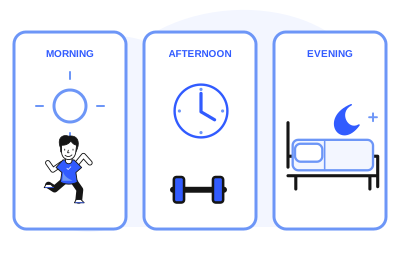
| Early morning (5–8 AM) | Fewest clashes with work and family; coolest hours in summer; easy to make a fixed habit | Short sleep if bedtime doesn't move; stiff first sets; often poor air in north Indian winters |
| Late morning (9 AM–12 PM) | Quiet gyms; warmed up and fed | Rarely possible on office days; heat building outdoors from March to June |
| Afternoon (12–4 PM) | Often the cleanest air on winter days | Hottest hours; health advisories say avoid outdoor exertion from 12 noon to 3 PM in heatwaves |
| Evening (5–8 PM) | Strength tends to be highest; fits after office hours; cooler than afternoons in summer | Busiest gym hours; plans get cancelled by work and traffic |
| Night (after 8 PM) | Flexible and quiet | Vigorous sessions close to bedtime may delay sleep |
The best time to work out in India: heat, smog, office hours and fasting
In India, the best time to work out is shaped as much by the weather, air quality and the working day as by your body clock. These are the factors worth planning around.
Summer heat: avoid midday outdoors
In Indian summers, outdoor training belongs in the early morning or evening. The public health advisory on extreme heat from the National Centre for Disease Control, under the Ministry of Health and Family Welfare, advises avoiding the sun especially between 12 noon and 3 PM, avoiding strenuous activities outside in the afternoon, and limiting outdoor activity to the cooler morning and evening hours. It also notes that people arriving from a cooler climate need a gradual increase in activity over 10 to 15 days to acclimatise. Indoors, with fans or air conditioning, the clock matters less; drink water before you're thirsty either way.
Winter mornings in north India: check the air first
In north Indian cities such as Delhi, Noida, Gurugram and Chandigarh, winter brings the year's worst air, and within the day the early hours are often among the most polluted, which makes the classic early-morning run a poor choice on high-pollution days. A 2021 study by Ruaraidh Dobson and colleagues in the International Journal of Tuberculosis and Lung Disease, analysing monitors in cities across 14 low- and middle-income countries, found outdoor PM2.5 typically peaks in the morning and that overnight concentrations (2 to 8 AM) were higher than late-afternoon concentrations (2 to 8 PM) in 19 of 23 cities, by a median of 26%. The authors link this to the lower atmospheric mixing layer at night, which traps pollution close to the ground.
Practical rule: on winter days with poor air quality, check your city's live AQI before an outdoor session, move hard cardio indoors, or shift outdoor walks to the afternoon. Strength training indoors is unaffected by the time of day, which is one reason many people switch to gym or home sessions from November to January.
Office hours and commutes
For most salaried people in Indian cities, the realistic windows are before work (6 to 8 AM) and after work (7 to 9 PM), and the evening window is the one most often lost to late meetings and traffic. If your evenings are unpredictable, mornings are usually the safer slot to protect. If you can't be sure of either, two 45-minute strength sessions at home on fixed days, plus walking, still meet the WHO's muscle-strengthening recommendation. Our guide for working professionals has schedules built around office days.
Fasting days
On fasting days, such as Navratri, Ekadashi, Karva Chauth or Ramzan, the best time to work out is close to when you can eat and drink, and the session should be lighter than usual. Common approaches: a light session before breaking a fast in the evening so you can eat and rehydrate soon after; a session an hour or two after the evening meal; or simply a walk and mobility work instead of hard training. On a fast without water, avoid hard or hot sessions altogether.
Decision table: the best time to work out by goal and situation
| Your goal or situation | Best time | Why |
|---|---|---|
| General health | Whenever you can repeat it 3+ days a week | No guideline sets a clock time; the weekly total matters |
| Weight loss | Morning if it suits you; any time otherwise | One trial favoured early exercisers, but deficit and total activity matter more |
| Muscle gain | Either; evening if you like lifting heavier on the day | Gains were similar morning and evening when training was matched |
| A race or test at a fixed time | Train at that time in the weeks before | Results tend to be larger when training and testing times match |
| Poor sleeper | Morning or early evening | Avoid vigorous sessions ending within an hour of bedtime |
| Unpredictable evenings | Before work | Morning slots are less often cancelled |
| North Indian winter, outdoor cardio | Afternoon, or indoors | PM2.5 tends to be higher overnight and in the morning than in the late afternoon |
| Summer heatwave, outdoor training | Early morning or after sunset | Health advisories say avoid 12 noon to 3 PM outdoors |
| Fasting day | Near when you can eat and drink | Keep it light; hard sessions on an empty tank add risk |
How to change your workout time without losing progress
If you switch from evening to morning workouts, or the reverse, expect the first sessions at the new time to feel a little harder, and don't judge the change on week one. Lower the weights slightly, extend your warm-up in the mornings, and keep the same exercises so you can compare like with like. Because the 2023 review found some benefit when training and testing times match, the numbers in your log will usually catch up once the new time is routine.
If a fixed slot is what you're missing, that's what a booked session gives you. Our one-to-one coaching runs from 6 AM to 8 PM India time every day, in 45-minute sessions. Personal Gym Training costs ₹799 a session at your own gym; Personal Home Training costs ₹899 a session at home; and Group Classes are ₹499 a session. See the full pricing, or start with a single first session.
Sources
- Best time of day for strength and endurance training to improve health and performance? A systematic review with meta-analysis (2023), Bruggisser F, Knaier R, Roth R, et al., Sports Medicine Open, via PubMed
- The effects of time of day-specific resistance training on adaptations in skeletal muscle hypertrophy and muscle strength: a systematic review and meta-analysis (2019), Grgic J, Lazinica B, Garofolini A, et al., Chronobiology International, via PubMed
- The effects of exercise session timing on weight loss and components of energy balance: Midwest Exercise Trial 2 (2020), Willis EA, et al., International Journal of Obesity, via PubMed
- Morning exercise reduces abdominal fat and blood pressure in women; evening exercise increases muscular performance in women and lowers blood pressure in men (2022), Arciero PJ, et al., Frontiers in Physiology
- Effects of evening exercise on sleep in healthy participants: a systematic review and meta-analysis (2019), Stutz J, Eiholzer R, Spengler CM, Sports Medicine, via PubMed
- Diurnal variability of fine-particulate pollution concentrations: data from 14 low- and middle-income countries (2021), Dobson R, et al., International Journal of Tuberculosis and Lung Disease, via PubMed Central
- Public Health Advisory: Extreme Heat/Heatwave, National Centre for Disease Control, Ministry of Health and Family Welfare, Government of India
- Physical activity (Be He@lthy, Be Mobile), World Health Organization
Written by the MakeMyFitness team from the sources above. First published , last updated . Spotted something out of date? Tell us at hello@makemyfitness.com.