
In short
- Yes, you can be fit at a higher weight, and fitness matters a great deal.
- In pooled studies, people who were fit at higher weights had mortality risk not statistically different from fit people of normal weight, while unfit people had roughly double the risk at any weight.
- But one very large study found that higher weight still carried extra heart risk even with clean blood tests.
- Both findings are real. Neither means you are doomed or in the clear.
If someone has told you "you can't be healthy at that size", or you have wondered it yourself, the research gives a more careful answer than either side of the argument usually admits. Fitness, meaning how well your heart and lungs deliver oxygen during effort, is one of the strongest things measured in these studies. Weight also shows up in the data. This post reports what the main studies found, what they could not show, and what an ordinary person can do with it on a Monday morning.
Can you be overweight and fit at the same time?

Yes. Fitness and weight are two separate measurements, and they do not always move together. Someone in a larger body can walk briskly for an hour, climb stairs without stopping and recover quickly. Someone of lower weight can get breathless after one flight. The studies below measure both, and then ask who lives longer.
What did the research say about fitness versus fatness?

In 2014, Barry and colleagues pooled ten prospective studies in Progress in Cardiovascular Diseases. To be included, a study had to measure fitness objectively, measure body mass index (BMI), and follow people to see who died of any cause. The authors reported that, compared with fit people of normal weight, "unfit individuals had twice the risk of mortality regardless of BMI", and that overweight and obese people who were fit had similar mortality risk to fit people of normal weight.
A larger and newer analysis, by Weeldreyer and colleagues in the British Journal of Sports Medicine in 2025, pooled 20 cohort studies with 398,716 observations. Here "fit" had a precise meaning: fitness was assessed with a maximal exercise test or a VO2peak test, not a questionnaire. Using fit people of normal weight as the comparison, the all-cause mortality hazard ratios were:
| Group | All-cause mortality | Cardiovascular mortality |
|---|---|---|
| Overweight and fit | 0.96 (0.61–1.50) | 1.50 (0.82–2.76) |
| Obese and fit | 1.11 (0.88–1.40) | 1.62 (0.87–3.01) |
| Normal weight and unfit | 1.92 (1.43–2.57) | 2.04 (1.32–3.14) |
| Overweight and unfit | 1.82 (1.47–2.24) | 2.58 (1.48–4.52) |
| Obese and unfit | 2.04 (1.54–2.71) | 3.35 (1.17–9.61) |
The authors describe the fit groups as not having a statistically different risk, and the unfit groups as having two to three times the risk. Read the cardiovascular column with care: the fit-but-heavier estimates are above 1 and their ranges are wide, so the study could not rule out some extra risk there. The authors concluded that fitness is a strong predictor of cardiovascular and all-cause mortality and "attenuates" the risks linked with overweight and obesity. Attenuates means reduces. It does not mean removes.
Does higher weight still carry risk when blood tests look healthy?

This is the other side, and it deserves equal space. In 2017, Caleyachetty and colleagues published a study in the Journal of the American College of Cardiology using UK primary-care health records for 3.5 million adults who started free of cardiovascular disease. They counted three metabolic problems: diabetes, high blood pressure and high blood fats. Over an average follow-up of 5.4 years, obese people with none of the three had a higher risk than normal-weight people with none of the three:
- coronary heart disease: hazard ratio 1.49 (95% CI 1.45–1.54)
- cerebrovascular disease, such as stroke: 1.07 (1.04–1.11)
- heart failure: 1.96 (1.86–2.06)
The same study found that risk rose with the number of metabolic problems at every weight, and that normal-weight people with metabolic problems had similar cardiovascular risks. So a normal BMI is no guarantee either. Its limit is that, from the abstract, it did not report fitness, so it cannot tell us whether the fit would have fared better.
How the two sets of findings fit together
They answer different questions. The fitness studies look at death from any cause and ask whether fitness changes the picture. The health-records study looks at new heart and circulation disease in people whose blood tests were fine. Both can be true: fitness is strongly linked to living longer at any weight, and higher weight is still linked to more heart disease on average. Studies show averages, not what will happen to you.
Does this change for Indians?
It may. In 2004 a World Health Organization expert consultation, published in The Lancet, reviewed evidence that Asian populations have different links between BMI, body fat percentage and health risk than European populations. It concluded that a substantial share of Asian people have a high risk of type 2 diabetes and cardiovascular disease at BMIs below the usual overweight line of 25. Across Asian groups, the BMI where risk starts to show varied from 22 to 25, and where high risk begins from 26 to 31.
The consultation did not set a single new cut-off for all Asians. It kept the international WHO cut-offs and named extra points to watch, at BMI 23.0, 27.5, 32.5 and 37.5, so countries could decide their own definitions. The practical reading: at a given BMI, an Indian body may carry more risk than the chart suggests, which makes the fitness side of the story more useful, not less. Our body fat percentage chart for India and the BMI calculator explain what these numbers can and cannot tell you.
How can you tell if you are fit without a lab?

The studies used maximal exercise tests, which you cannot do at home. We are not aware of a home test with norms we can quote, and we will not invent one. What you can do is notice change in everyday effort. These are our own common-sense markers, not from the studies and not diagnoses:
- You can climb a flight or two of stairs and still talk afterwards, and it feels easier than it did two months ago.
- A walk at a pace that is brisk for you gets easier over weeks, or you can walk longer before you need to stop.
- Your breathing settles back to normal faster after effort.
- You carry bags, lift a child or get up from the floor without dread.
- You can finish a session and are not wiped out for the rest of the day.
If these are improving, fitness is improving, whatever the scale does. If you want a number, ask your doctor what tests suit you.
What should you do at any size?
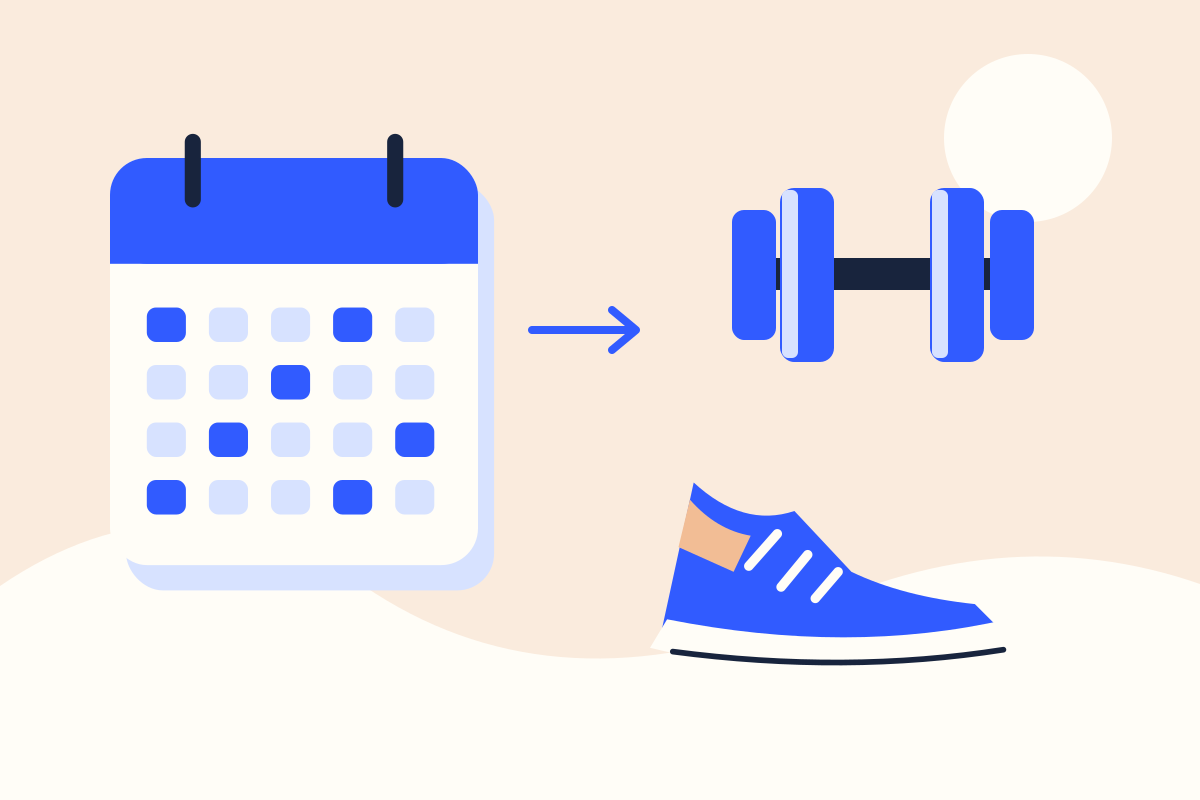
The WHO 2020 guidelines say adults should do at least 150–300 minutes of moderate-intensity aerobic activity, or at least 75–150 minutes of vigorous activity, or an equivalent mix, each week. They add muscle-strengthening work at moderate or greater intensity, involving all major muscle groups, on two or more days a week. They also say some activity is better than none, and that adults should limit time spent sitting. They apply to adults including those with chronic conditions, with the extra caution that going above 300 minutes is only for when it is not contraindicated.
Few people start at 150 minutes, and you do not have to. Here is one gentle starter week, our own suggestion and not taken from the WHO or the studies, written for someone who is new to exercise. Adjust it to your joints, your energy and your doctor's advice.
| Day | What | How long |
|---|---|---|
| Monday | Easy walk, a pace where you can talk | 20 minutes |
| Tuesday | Strength: sit-to-stand from a chair, wall push-ups, glute bridges | 20 minutes |
| Wednesday | Easy walk | 20 minutes |
| Thursday | Rest or a gentle stroll | 10 minutes |
| Friday | Strength: same moves, one more round if it feels fine | 20 minutes |
| Saturday | Longer easy walk, or any activity you enjoy | 30 minutes |
| Sunday | Rest | None |
After two or three weeks, add five minutes to the walks. More ideas are in our guide on walking for weight loss and on zone 2 cardio, which is the easy, talk-while-you-move pace.
This is not a reason to skip check-ups
Being fit does not cancel the need for blood pressure, blood sugar and cholesterol checks. If you have diabetes, high blood pressure, heart disease, chest pain, breathlessness at rest or dizziness, speak to your doctor before changing how much you exercise, and follow their advice over anything in this post.
What can you say if someone tells you that you cannot be healthy at that size?

You could say: "Health is more than one number. Fitness is something I can build, and research shows it matters at every weight." You could also say nothing, which is allowed. Remarks like "Moti ho gayi ho" ("you have become fat") are common, but the evidence does not support the all-or-nothing version of that remark. The studies do not say you are unhealthy because of your size, and they do not say weight is irrelevant. They say fitness is worth building, and that regular check-ups are worth keeping. If you want to know how pressure and teasing tend to work, read does fat-shaming work.
Where can a live coach help?
Training live with a coach on video, at home, means nobody else is watching, and the coach works with the body you have today. If you are starting from a larger body, our guide to online personal training for overweight beginners explains what a first month can look like. You can also read the full list on our blog.
Sources
- Fitness vs. fatness on all-cause mortality: a meta-analysis, Progress in Cardiovascular Diseases (Barry and colleagues, 2014)
- Cardiorespiratory fitness, body mass index and mortality: a systematic review and meta-analysis, British Journal of Sports Medicine (Weeldreyer and colleagues, 2025)
- Metabolically Healthy Obese and Incident Cardiovascular Disease Events Among 3.5 Million Men and Women, Journal of the American College of Cardiology (Caleyachetty and colleagues, 2017)
- Appropriate body-mass index for Asian populations and its implications for policy and intervention strategies, The Lancet (WHO expert consultation, 2004)
- World Health Organization 2020 guidelines on physical activity and sedentary behaviour, British Journal of Sports Medicine (Bull and colleagues, 2020)
- Physical activity fact sheet, World Health Organization
Written by the MakeMyFitness team from the sources above and reviewed by Kumar Abhishek, our lead coach (Diploma in Personal Training, K11 School of Fitness Sciences). First published , last updated . How we write and check our guides: editorial policy. This is general fitness information, not medical advice: see the medical disclaimer.