
Walking is the most underrated weight-loss tool there is. It needs no equipment, almost anyone can do it every day, and it's gentle on your joints. But a step count on its own doesn't guarantee fat loss. This guide explains how many steps a day are worth aiming for, what 10,000 or 15,000 steps actually burn, what the research says about step counts and health, and how to walk safely through Indian summers and smoggy winters.
Walking for weight loss: how many steps a day?
A useful target for most adults is 7,000 to 10,000 steps a day, with at least 3,000 of them taken briskly. That comes from a 2011 review in the International Journal of Behavioral Nutrition and Physical Activity by Tudor-Locke and colleagues, which concluded that about 7,000 to 8,000 steps a day is a reasonable threshold for healthy adults, that 30 minutes of brisk walking is roughly 3,000 to 4,000 steps, and that 100 steps a minute is a reasonable floor for moderate-intensity walking.
| Steps a day | Category |
|---|---|
| Under 5,000 | Sedentary |
| 5,000–7,499 | Low active |
| 7,500–9,999 | Somewhat active |
| 10,000–12,499 | Active |
| 12,500 or more | Highly active |
For weight loss specifically, more walking helps because every step burns energy. But the right number for you starts from where you are. If your phone shows 3,000 steps a day, jumping straight to 15,000 is a recipe for sore shins and a plan you abandon. Add about 1,000 to 2,000 steps a day each week, as in the 6-week plan below.
What the research says about step counts and health
The famous 10,000 figure didn't come from a study. Two large reviews now give a much better picture:
- Paluch and colleagues, The Lancet Public Health, 2022: a meta-analysis of 15 international cohorts with 47,471 adults. Compared with the lowest group (a median of 3,553 steps a day), people in the higher groups had a lower risk of dying during follow-up: 40% lower at about 5,800 steps, 45% lower at about 7,800 and 53% lower at about 10,900. The benefit levelled off at 6,000 to 8,000 steps a day for adults 60 and over and 8,000 to 10,000 for adults under 60. The authors note there is little evidence behind the 10,000 recommendation itself.
- Ding and colleagues, The Lancet Public Health, 2025: a review of 57 studies. As the University of Sydney summarised it, 7,000 steps a day was linked with a 47% lower risk of death than 2,000 steps, almost the same as 10,000, and a 38% lower risk of dementia. One of the authors said that beyond 7,000 steps the extra benefits for most outcomes were modest.
These are studies of health and lifespan, not weight. They tell you that 7,000 to 10,000 steps is a strong goal for health. For weight loss, the number of calories you burn keeps rising with every extra step, so going beyond 10,000 can still help, as long as your body and your schedule can handle it.
Steps to km and steps to calories
How far is 10,000 steps? It depends on your stride. In one study cited in the Tudor-Locke review, adults walking at a brisk 6.4 km/h took an average of 1,936 steps per mile, which works out to about 1,200 steps per km. Slower walking and shorter legs mean shorter steps, so you may take more. To find your own number, walk a known distance, such as a 400 m track lap, and count.
| Steps | Distance (approx.) | Time at a brisk pace |
|---|---|---|
| 3,000–4,000 | 2.5–3.3 km | About 30 minutes |
| 7,000 | 5.8 km | About 55–70 minutes |
| 10,000 | 8.3 km | About 75–100 minutes |
| 15,000 | 12.5 km | About 2 to 2.5 hours |
| 20,000 | 16.7 km | About 2.5 to 3.3 hours |
Calories come from the 2024 Adult Compendium of Physical Activities, which rates walking in METs, multiples of your resting rate. One MET is about 1 kcal per kg of body weight per hour, as the Compendium paper explains, so calories ≈ METs × weight in kg × hours. The Compendium lists speeds in mph; they're converted to km/h here.
| Pace | METs | 60 kg | 70 kg | 80 kg |
|---|---|---|---|---|
| Moderate, 4.5–5.5 km/h | 3.8 | 114 kcal | 133 kcal | 152 kcal |
| Brisk, 5.6–6.3 km/h | 4.8 | 144 kcal | 168 kcal | 192 kcal |
| Very brisk, 6.4–7.1 km/h | 5.5 | 165 kcal | 193 kcal | 220 kcal |
| Uphill, 6–10% grade, moderate to brisk | 7.0 | 210 kcal | 245 kcal | 280 kcal |
Putting those together: if every one of 10,000 steps were taken at a very brisk 6.4 km/h, a 70 kg person would burn roughly 400 to 500 kcal, depending on whether you count the energy you'd have used anyway at rest. That's about 40 to 50 kcal per 1,000 brisk steps. Real days include plenty of slow, pottering steps around the house and office, so the true figure is usually lower. The Compendium also notes its values aren't precise for any one person.
10,000 steps a day: how much weight will you lose?
It depends on how many steps you were taking before and on what you eat. Going from 5,000 to 10,000 brisk steps a day adds roughly 200 kcal of extra burn a day for a 70 kg person, using the figures above. That helps, but it's easily cancelled by one extra snack. The clearest evidence is a 2024 meta-analysis in JAMA Network Open of 116 trials: each extra 30 minutes a week of aerobic exercise was linked with about 0.52 kg more weight loss, and more than 150 minutes a week may be needed for meaningful cuts in waist size and body fat.
So walking works best as part of a plan: a modest calorie deficit does most of the work, walking adds to it and keeps your appetite and mood in check. Find your maintenance calories with the TDEE calculator, then set a daily target with the calorie deficit calculator. The CDC notes that people who lose weight at a gradual 1 to 2 pounds (about 0.5 to 1 kg) a week are more likely to keep it off, so a realistic month of 10,000 steps a day plus a sensible diet is roughly 2 to 4 kg, not 10.
Walking 15k steps for weight loss: is more better?
Walking 15,000 steps a day burns more, roughly half as much again as 10,000, but it costs about two to two and a half hours of walking. For most people with a job, that only works if much of it is built into the day: walking calls, walking to the metro or market, and a longer walk at the weekend. Build up to it over several weeks, wear proper walking shoes, and back off if your shins, heels or knees start to hurt. If 15,000 steps is costing you sleep or strength sessions, it's the wrong trade: 8,000 to 10,000 steps plus two strength sessions usually beats 15,000 steps and none.
Why adding strength training matters
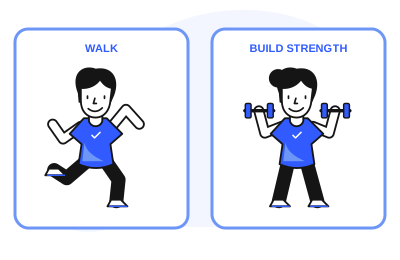
When you lose weight, some of it can come from muscle unless you give your body a reason to keep it. Strength training is that reason. A 2022 meta-analysis in Obesity Reviews of 114 randomised trials in people with overweight or obesity found that resistance training combined with calorie restriction cut fat mass by about 5.3 kg and body fat by 3.8 percentage points compared with control groups, while lean mass was maintained. Resistance training on its own added about 0.8 kg of lean mass.
Two 30 to 45-minute sessions a week are enough to start: squats, lunges or step-ups, push-ups, rows, hip hinges and a plank. You can do them at home with a dumbbell workout at home or a home workout plan for beginners, or in a gym. Our fat loss goal page shows how walking, strength and food fit together.
Walking in Indian heat and air pollution

Walking for weight loss in India means planning around two things: summer heat and winter smog. For heat, the World Health Organization advises avoiding strenuous activity during the hottest part of the day, drinking water regularly and wearing light clothing, and warns that heatstroke is a medical emergency. In practice, walk before about 8 AM or after sunset in April to June, carry water, and stop to cool down if you feel dizzy, sick or confused.
For air quality, check the AQI before an outdoor walk. The Central Pollution Control Board uses six bands, set by measured pollutant levels and their likely health effects:
| AQI | CPCB category | Our suggestion for walking |
|---|---|---|
| 0–50 | Good | Walk outdoors as planned |
| 51–100 | Satisfactory | Walk outdoors as planned |
| 101–200 | Moderately polluted | Keep it easy; go indoors if you have asthma or heart or lung disease |
| 201–300 | Poor | Move the walk indoors |
| 301–400 | Very poor | Indoors only |
| 401–500 | Severe | Indoors only |
Indoor options keep the habit alive: a treadmill, mall walking early in the day, stair climbing in your building, or a brisk walking workout at home, marching and stepping in place for 20 to 30 minutes. Even a few hundred steps after each meal adds up over a smoggy week.
A 6-week walking plan for weight loss
Start from your current average (check the last week on your phone) and follow the right-hand column, not the step numbers, if your starting point is very different. Brisk means you can talk in short sentences but not sing, about 100 or more steps a minute.
| Week | Daily steps target | Brisk walk | Also do |
|---|---|---|---|
| 1 | 6,000 | 20 min, 5 days | Note your starting average; 2 short strength sessions |
| 2 | 7,000 | 25 min, 5 days | 2 strength sessions; a 5-min walk after dinner |
| 3 | 8,000 | 30 min, 5 days | 2 strength sessions; one walk with hills or stairs |
| 4 | 9,000 | 30 min, 6 days, last 5 min faster | 2 strength sessions; weekend walk of 60 min |
| 5 | 10,000 | 35–40 min, 6 days | 2 strength sessions; 4 × 2 min very brisk in one walk |
| 6 | 10,000–12,000 | 40–45 min, 6 days | 2 strength sessions; weekend walk of 75–90 min |
After week 6, keep the step count steady and progress the quality instead: more hills, more stairs, a few faster minutes, or a weighted backpack on part of the walk. If you enjoy it, the same base leads naturally to a trek: see how to prepare for a trek. If you'd rather mix it up, cycling for weight loss gives you another low-impact option.
Walking for weight loss tips
- Walk after meals. A 10 to 15-minute walk after lunch and dinner adds 2,000 to 3,000 steps without a separate workout.
- Make some of it brisk. Aim for at least 30 minutes a day at 100 or more steps a minute.
- Use hills and stairs. The Compendium rates uphill walking at a 6–10% grade at 7.0 METs, against 4.8 for brisk walking on the flat.
- Don't eat back the steps. A walk rarely earns a samosa and chai; count your food, not your watch's calorie number.
- Get good shoes with cushioning that fits, and replace them when the soles wear unevenly.
- Keep protein up. Use the protein intake calculator to find your daily number.
- Track the weekly average, not one day. A busy Monday at 4,000 steps is fine if the week averages 9,000.
When a coach helps
Walking is easy to start and easy to drift away from. A coach keeps the plan honest, adds the strength work and adjusts things when the weather or your schedule turns. Personal Home Training is ₹899 a session or ₹8,080 for a 4-week plan of 12, live on video. If you already have a gym, Personal Gym Training is ₹799 a session or ₹7,070 for 12, and group classes start at ₹499 per person. See everything on our pricing page.
Sources
- How many steps/day are enough? for adults (2011), International Journal of Behavioral Nutrition and Physical Activity
- Daily steps and all-cause mortality: a meta-analysis of 15 international cohorts (2022), The Lancet Public Health
- Rethink the 10,000-a-day step goal, study suggests (24 July 2025), The University of Sydney
- 2024 Adult Compendium of Physical Activities: walking, Adult Compendium of Physical Activities
- 2024 Adult Compendium of Physical Activities: a third update of the energy costs of human activities, Journal of Sport and Health Science
- Aerobic exercise and weight loss in adults: a systematic review and dose-response meta-analysis (2024), JAMA Network Open
- Steps for losing weight, Centers for Disease Control and Prevention
- Resistance training effectiveness on body composition and body weight outcomes in individuals with overweight and obesity across the lifespan (2022), Obesity Reviews
- Climate change, heat and health (fact sheet), World Health Organization
- About National Air Quality Index, Central Pollution Control Board
Written by the MakeMyFitness team from the sources above. First published , last updated . Spotted something out of date? Tell us at hello@makemyfitness.com.