What fat loss training is, and what it isn't
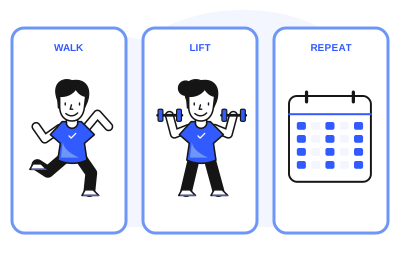
Any training burns calories. Fat loss training is the narrower idea of arranging your week so that, while you eat a little less than you burn, the weight that comes off is fat and the muscle underneath stays. In practice that means strength work comes first, cardio is dosed rather than endless, and daily movement fills the gaps. It is a program, not a single sweaty workout.
It isn't a "fat-burning" class, a belly routine or a heart-rate zone. Those are pieces, and we've written about each: fat burn training covers steady cardio and intervals, fat loss exercises lists the movements, and belly fat training explains why crunches don't choose where fat comes off. This page is about putting the pieces into a coached program and running it live on video.
The three parts of a fat loss training program
| Part | What it does | How much | At MakeMyFitness |
|---|---|---|---|
| Strength training | Signals the body to keep muscle while you lose fat; shapes the result | 3 full-body sessions a week, made gradually harder | Every live session, coached rep by rep |
| Cardio | Adds to the calorie deficit; improves fitness and waist measurement | 150 to 250 minutes a week of moderate work, or shorter intervals | A short finisher in sessions, plus two or three sessions of your own |
| Daily steps | Keeps energy use up on the days you don't train, without tiring you out | Build towards 7,000 to 10,000 a day | A target set from your own average, raised weekly |
The order matters. If you only have three hours a week, they go to strength work first, because that is the part no amount of walking replaces. Cardio and steps are then added around it, and food sets the deficit. The fat loss goal page covers the food and habit side; the sections below cover the training.
Strength training: the part that decides what you lose
When you eat less, the body can take energy from muscle as well as fat. Lifting gives it a reason not to. A 2022 meta-analysis in Obesity Reviews pooled 114 trials in adults with overweight or obesity. Resistance training on its own cut fat mass by about 1 kg and added about 0.8 kg of lean mass against no training. Resistance training combined with calorie restriction cut fat mass by about 5.3 kg and body fat by 3.8 percentage points, and lean mass was maintained. Combined resistance and aerobic training sat in between, at about 1.4 kg of fat.
A deficit does limit how much muscle you can build. A 2022 meta-analysis and meta-regression of resistance training in an energy deficit found gains in lean mass were held back while strength gains were comparable to training without a deficit, and that a deficit of about 500 kcal a day was the level at which lean mass stopped increasing. So the aim of fat loss training is not to add muscle; it is to keep what you have and get stronger, with a deficit that stays under about 500 kcal a day.
What that looks like in a session: a squat pattern, a hinge, a push, a pull, a lunge and a carry, in that order of priority, for 2 to 4 working sets each. At home the loads are your body, a backpack, bands or dumbbells; at your gym they are barbells and machines. If you want the full list, read fat loss exercises.
Cardio for fat loss: steady, intervals, or both?
Both work, and the difference is time. A 2017 meta-analysis in Obesity Reviews compared high-intensity interval training with moderate continuous training across 13 trials in overweight and obese adults, averaging 10 weeks at three sessions a week. Both reduced whole-body fat mass and waist circumference, there was no significant difference between them on any body composition measure, and the interval training took about 40% less time. Running had large effects on fat mass in both formats; cycling, in those trials, did not.
The dose is what most people get wrong. The American College of Sports Medicine's position stand on physical activity and weight concludes that 150 to 250 minutes a week of moderate activity produces only modest weight loss by itself, that more than 250 minutes a week is associated with clinically significant loss, and that 150 to 250 minutes improves the result of a moderate diet. A 2024 meta-analysis in JAMA Network Open of 116 trials found each 30 minutes a week of aerobic exercise was associated with about 0.52 kg less body weight, 0.56 cm off the waist and 0.37 percentage points less body fat. More cardio helps, up to the point where it wrecks your strength sessions or your knees.
| Option | A session | Picks it when |
|---|---|---|
| Brisk walking | 30 to 45 minutes, able to talk but not sing | You're starting out, carrying extra weight, or live somewhere flat and walkable (walking for weight loss) |
| Stairs | 10 to 20 minutes of climbs with easy descents | You live in a tower block and want a short, hard session (stair climbing for fat loss) |
| Skipping rope | 10 to 15 minutes of short rounds | You have a mat, a metre of ceiling clearance and healthy knees (skipping rope for weight loss) |
| Intervals | 8 to 10 rounds of 1 minute hard, 1 to 2 minutes easy | You're short of time and already fit enough to recover between rounds |
| Steady zone 2 | 45 to 60 minutes at an easy, conversational pace | You enjoy longer sessions or train for a run (zone 2 cardio for fat loss) |
You can't train fat off one spot
Sit-ups for belly fat and inner-thigh machines for thighs are the two most common requests, and the body doesn't work that way. In a 12-week study in the Journal of Strength and Conditioning Research, 11 adults trained only one leg, three times a week, with 960 to 1,200 light leg-press repetitions a session. Fat mass fell by about 5% overall, but the loss came from the trunk and upper body, not the trained leg, which lost no more fat than the untrained one. Fat loss training works the whole body and lets the deficit decide where it comes from. Core work still belongs in the program; it just isn't a fat-loss tool.
A 12-week fat loss training program, coached live
This is the structure a MakeMyFitness coach uses for a client whose main goal is losing fat. Every number is adjusted to the person; the shape stays the same.
| Block | Strength (3 live sessions a week) | Cardio and steps | What's measured |
|---|---|---|---|
| Weeks 1 to 4: foundation | Learn the six patterns; 2 to 3 sets of 10 to 15 reps; add reps each week | 2 walks of 30 minutes; steps raised 1,000 a week from your baseline | Starting waist, weekly average weight, step average, form in each lift |
| Weeks 5 to 8: progression | 3 to 4 sets; load up 2 to 10% once you beat the rep target; one harder variation per session | 150 to 200 minutes a week; one interval session if it suits you | Reps and loads in every lift, waist, weekly averages |
| Weeks 9 to 12: push and review | Heavier main lifts, shorter rests, a timed conditioning finisher | Up to 250 minutes a week if recovery allows; steps held at target | Week 12 against week 1: waist, weight trend, strength, sleep, how clothes fit |
Progression follows the American College of Sports Medicine's progression guidelines: 2 to 3 sessions a week for novices, loads you can lift for about 8 to 12 reps, and a 2 to 10% increase in load once you can do one or two reps beyond your target. Your coach logs every set, so the next session starts from what you actually did, not from a template.
A week of fat loss training at home versus at your gym
| At home ([Personal Home Training](/programs/personal-home-training)) | At your gym ([Personal Gym Training](/programs/personal-gym-training)) | |
|---|---|---|
| Strength days (Mon, Wed, Fri) | Bodyweight progressions, a loaded backpack, bands or dumbbells; slower lowering and pauses to make moves harder | Barbell or dumbbell squats, hinges, presses and rows; machines when a rack is busy |
| Finisher in the session | 4 to 6 minutes, low-impact if you live in a flat: step-ups, carries, mountain climbers | Rower, bike or sled if the gym has one; otherwise the same bodyweight work |
| Cardio days (Tue, Thu, Sat) | Walks, stairs or skipping; a longer walk at the weekend | Treadmill incline walks or intervals after a short strength warm-up |
| Price | ₹899 a session; ₹8,080 for 12 | ₹799 a session; ₹7,070 for 12 |
Food, sleep and recovery while training for fat loss
- Protein protects muscle. The International Society of Sports Nutrition suggests 1.4 to 2.0 g per kg of body weight a day for people who exercise, in servings of about 20 to 40 g. Work yours out with the protein intake calculator.
- Keep the deficit modest. Estimate your maintenance with the TDEE calculator and set a target of 300 to 500 kcal below it with the calorie deficit calculator. Bigger deficits cost strength and muscle.
- Sleep changes what you lose. In a crossover trial in Annals of Internal Medicine, 10 adults on the same calorie-restricted diet lost 1.4 kg of fat with 8.5 hours in bed but 0.6 kg with 5.5 hours, and lost more fat-free mass on short sleep. If a 6 AM slot costs you sleep, train in the evening.
- Rest days are training days. Three hard sessions and three easy cardio days leave one full rest day. Soreness that lasts past 72 hours means the last session was too much, and your coach pulls it back.
How to tell fat loss training is working
The scale measures everything: water, glycogen, food in transit and the menstrual cycle, as well as fat. So fat loss training is judged on four numbers at once: the weekly average weight from three to seven morning weigh-ins, the waist at the navel once a week, the reps and loads in your main lifts, and monthly photos in the same light and clothes. Fat is coming off when the first two trend down while the lifts hold or climb. If all four sit flat for three weeks, the plan changes. Body fat percentage charts for India explains what the numbers mean, and body recomposition covers the case where weight stays still but the waist shrinks.
What online fat loss training costs
Live coaching is priced per session, with no joining fee, no contract and nothing that renews. You pay for one session or one 4-week plan of 12 sessions, which is the first block of the program above.
| Program | One session | 4-week plan (12 sessions) | Per session on the plan |
|---|---|---|---|
| Personal Gym Training1:1, 45 minutes | ₹799 | ₹7,070 | about ₹589 |
| Personal Home Training1:1, 45 minutes | ₹899 | ₹8,080 | about ₹673 |
| Rehab & Recovery1:1, once a doctor or physio has cleared you | ₹1,299 | ₹12,121 | about ₹1,010 |
| Group ClassesPer person, small group | ₹499 | ₹4,040 | about ₹337 |
Twelve coached sessions over four weeks cost ₹7,070 at your gym or ₹8,080 at home, about ₹589 and ₹673 a session. Live group classes are ₹499 a class if you'd rather train with others on the call. Work out a month for your own schedule below, or see the full pricing.
Which program?
How many sessions a week?
Rupees for your month on 4-week plans
- 12 live sessions a month, about ₹673 each on a plan.
- ₹10,788 if you pay ₹899 per session instead.
- No subscription. A plan is 12 sessions to use within 6 weeks of the first, so at two a week it simply lasts longer.
Turn your number into a plan
A good place to start: Personal Home Training
Book one session first and see what a live coach is like before you commit to a plan.
Who fat loss training suits
- People who have lost weight before and gained it back. Strength-first training is the part most crash plans skipped, and it is what makes the result hold.
- Anyone "skinny fat": a normal weight, a soft middle and little strength. The program is the same; the deficit is smaller. See skinny fat: what to do.
- Gym members with no plan. The hardest part of fat loss training at a gym is knowing what to do with the 45 minutes; your coach decides, set by set.
- Beginners at home. Nothing more than a mat is needed for the first block. Home workout for weight loss shows the uncoached version.
- Not a fit for anyone who needs a result in two weeks, who wants cardio only, or whose weight needs medical management first.
Sources
- Resistance training effectiveness on body composition and body weight outcomes in individuals with overweight and obesity across the lifespan: a systematic review and meta-analysis (2022), Lopez P, et al., Obesity Reviews
- Energy deficiency impairs resistance training gains in lean mass but not strength: a meta-analysis and meta-regression (2022), Murphy C and Koehler K, Scandinavian Journal of Medicine and Science in Sports
- The effects of high-intensity interval training vs. moderate-intensity continuous training on body composition in overweight and obese adults: a systematic review and meta-analysis (2017), Wewege M, et al., Obesity Reviews
- Appropriate physical activity intervention strategies for weight loss and prevention of weight regain for adults (position stand, 2009), American College of Sports Medicine, Medicine and Science in Sports and Exercise
- Aerobic exercise and weight loss in adults: a systematic review and dose-response meta-analysis (2024), JAMA Network Open
- Regional fat changes induced by localized muscle endurance resistance training (2013), Ramírez-Campillo R, et al., Journal of Strength and Conditioning Research
- Progression models in resistance training for healthy adults (position stand, 2009), American College of Sports Medicine
- International Society of Sports Nutrition position stand: protein and exercise (2017), Journal of the International Society of Sports Nutrition
- Insufficient sleep undermines dietary efforts to reduce adiposity (2010), Annals of Internal Medicine
- Obesity: treatment, NHS
Written by the MakeMyFitness team from the sources above and reviewed by Kumar Abhishek, our lead coach (Diploma in Personal Training, K11 School of Fitness Sciences). First published , last updated . How we write and check our guides: editorial policy. Spotted something out of date? Tell us at hello@makemyfitness.com.