Starting exercise when you're overweight: the honest version
Most exercise advice is written for people who are already fairly fit. If you are carrying extra weight, a lot of it doesn't fit: jumping jacks hurt your knees, getting down to the floor and back up is a workout in itself, and a gym full of mirrors is the last place you want to be. None of that means exercise isn't for you. It means the starting point has to be yours, not someone else's.
This guide covers when to check with a doctor, how to tell whether you are in the overweight range for Indian adults, exercises with chair and wall versions, low-impact cardio, a realistic rate of weight loss and a 4-week starter plan. Nothing in it involves crash diets, punishment workouts or being weighed on camera.
Before you start: when to see a doctor first
Exercise is safe for most people, and being overweight on its own is not a reason to wait. The American College of Sports Medicine's screening recommendations, updated in 2015, were designed to remove unnecessary barriers to exercise. According to the American Council on Exercise's summary of the ACSM algorithm, if you are not regularly active, you need medical clearance before starting only if you have known cardiovascular, metabolic or kidney disease (for example heart disease or diabetes), or signs or symptoms that suggest one. Without those, the algorithm doesn't call for clearance, though starting gently is still the sensible way in.
- Pain or discomfort in the chest, neck, jaw or arms, at rest or on effort
- Shortness of breath at rest or with mild exertion
- Dizziness or fainting
- Breathlessness when lying flat, or waking at night gasping for air
- Swollen ankles
- Palpitations or a racing heartbeat
- Leg pain or cramping when you walk
- A known heart murmur
- Unusual tiredness or breathlessness during everyday activities
Are you overweight? Asian BMI cut-offs for Indians
The usual BMI categories come from the World Health Organization: 25 to 29.9 is overweight and 30 or more is obese. A 2004 WHO expert consultation in The Lancet found that many Asian people face a high risk of type 2 diabetes and heart disease below a BMI of 25, with the risk point varying from 22 to 25 across Asian populations, and suggested extra action points at 23, 27.5, 32.5 and 37.5. India's 2009 consensus guidelines for Asian Indians, summarised by Misra and Shrivastava in 2013, use lower cut-offs.
| Category | WHO | Indian consensus guidelines |
|---|---|---|
| Normal | 18.5–24.9 | 18.0–22.9 |
| Overweight | 25.0–29.9 | 23.0–24.9 |
| Obese | 30 or more | 25 or more |
| Abdominal obesity (waist) | Over 102 cm men, 88 cm women (NCEP ATP III) | 90 cm or more men, 80 cm or more women |
Work out yours with our BMI calculator, which shows both sets of categories. BMI is a screening number, not a verdict: it can't tell muscle from fat, and your waist measurement adds useful information. Whatever your number, the plan below starts in the same gentle way.
Why strength training matters when you're overweight
Many beginners assume they should only do cardio until they've lost weight. The research says the opposite: strength training belongs in the plan from week one. When you lose weight, some of it can come from muscle unless you give your body a reason to keep it. A 2022 meta-analysis in Obesity Reviews of 114 randomised trials in people with overweight or obesity found that resistance training combined with calorie restriction cut fat mass by about 5.3 kg and body fat by 3.8 percentage points compared with control groups, while lean mass was maintained. Resistance training on its own added about 0.8 kg of lean mass.
Strength also makes daily life easier quickly: standing up from a low sofa, climbing stairs, carrying shopping. The World Health Organization's 2020 guidelines ask adults for 150 to 300 minutes of moderate activity a week plus muscle-strengthening on 2 or more days. You won't start there, and you don't need to. Our strength training page shows how progress usually looks.
Workout for overweight beginners at home: chair and wall versions
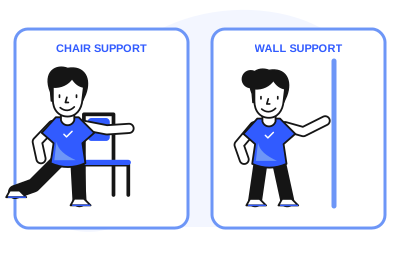
Every movement below has a version that starts from a chair or a wall, so you never need to get down to the floor in the first weeks. Use a solid chair without wheels or arms; the NHS's sitting exercises advise exactly that, and suggest building up repetitions gradually. Move to the next level only when the current one feels comfortable for all your reps.
| Movement | Level 1 | Level 2 | Level 3 |
|---|---|---|---|
| Squat | Sit-to-stand from a chair, hands on thighs | Sit-to-stand, arms crossed | Lower to just touch the chair, then stand |
| Push-up | Wall push-up | Push-up with hands on a kitchen counter | Push-up with hands on a sturdy sofa or bed edge |
| Hip hinge | Seated lean forward with a flat back | Standing hip hinge, hands sliding down thighs | Hip hinge holding a water bottle or bag |
| Row | Seated towel pull, squeezing shoulder blades | Standing door-frame lean-back row | Resistance band row, if you have one |
| Core | Seated tall posture with slow breathing | Wall plank, forearms on the wall | Counter plank, hands on a kitchen counter |
| Legs and balance | Seated knee lifts (hip marching) | Standing march holding a chair | Step-ups on the bottom stair, holding the rail |
Do each movement for 8 to 12 slow reps, rest as long as you need, and stop a couple of reps before you feel you couldn't do another. Mild muscle soreness a day or two later is normal. Sharp pain, joint pain that lasts, or any of the warning symptoms above is a reason to stop. If you have bands or dumbbells later, see our guides to resistance band workouts and dumbbell workouts at home.
Low-impact cardio that's kind to your knees
You don't need to jump, run or do burpees to burn calories or get fitter. Low-impact cardio keeps one foot on the ground or takes your weight off your joints altogether. Good options for overweight beginners include brisk walking, marching in place, stationary cycling, swimming or walking in water, and step-ups on a low stair.
Walking is the easiest place to start: free, joint-friendly and possible almost every day. Our guide to walking for weight loss has step targets and a 6-week walking plan. For the effect on weight, a 2024 meta-analysis in JAMA Network Open of 116 trials found that each extra 30 minutes a week of aerobic exercise was linked with about 0.52 kg more weight loss, and more than 150 minutes a week may be needed for meaningful cuts in waist size and body fat.
Losing weight also takes load off your knees. In a 2005 study of 142 overweight and obese older adults with knee osteoarthritis, each 1 kg of weight lost was linked with about 40 newtons less compressive force on the knee with every step, roughly four times the weight lost. Over thousands of steps a day, that adds up. It's one more reason to start with movements your knees can tolerate and build from there.
How a live online personal trainer adapts for overweight beginners
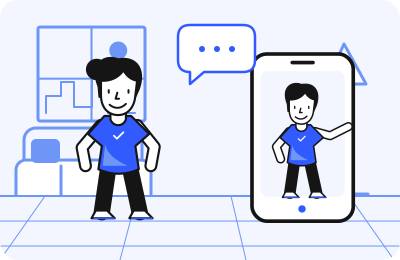
A video plan treats everyone the same. Live online fitness coaching puts a coach on the call who watches you and changes the session as it happens. For a beginner carrying extra weight, that matters more than for almost anyone. Supervision has measurable value: an exploratory meta-analysis by Fisher and colleagues (2022) compared supervised with unsupervised resistance training across 12 studies and found a moderate advantage for supervision on strength.
- Starts where you are. Your first session is an assessment, gentle on purpose. If sit-to-stands from a chair are the right starting point, that's where you start.
- Adjusts range and support. A higher chair, hands on a wall, a shorter step: the coach changes the version when they see a knee wobble or your breathing get too heavy.
- Keeps you off the floor until you're ready. Floor work can wait. When it comes, the coach teaches a safe way down and up first.
- Paces by effort. You should be able to talk in short sentences during most of the session. The coach watches for it.
- Never shames. No weigh-ins on camera, no before photos, no comparisons. Your camera shows what you choose, and you can turn it off for a moment whenever you like. Progress is measured in reps, stairs climbed without stopping and how you feel, as well as the scale if you want it.
- Plans around your life. Sessions run from 6 AM to 8 PM India time, every day, and can be moved with notice.
Personal Home Training is the natural place to start: one-to-one, at home, with whatever kit you have. If you are coming back from a specific injury and a doctor or physiotherapist has cleared you to exercise, Rehab & Recovery is one-to-one coaching built on their advice. It's coaching after clearance, not treatment.
A realistic rate of weight loss
The NHS advises losing weight steadily, at 0.5 to 1 kg a week. For people starting a longer plan, the NIDDK notes that experts recommend beginning with a loss of 5 to 10% of your starting weight over 6 months.
| Starting weight | 5% of starting weight | 10% of starting weight | Weeks at 0.5–1 kg a week to lose 5% |
|---|---|---|---|
| 80 kg | 4 kg | 8 kg | 4 to 8 weeks |
| 100 kg | 5 kg | 10 kg | 5 to 10 weeks |
| 120 kg | 6 kg | 12 kg | 6 to 12 weeks |
Weight rarely drops in a straight line; water and salt move the scale from day to day, so track a weekly average. Most of the deficit comes from food, not exercise. Find your maintenance calories with the TDEE calculator, set a modest daily target with the calorie deficit calculator, and keep protein up with the protein intake calculator. Our fat loss page and home workout for weight loss guide go further.
A 4-week starter plan for overweight beginners
This plan assumes you're starting from little or no exercise and have checked the safety section above. Strength days use the chair and wall progressions; move up a level only when every rep feels controlled. If a week feels too much, repeat it. That's progress too.
| Week | Strength (chair and wall) | Low-impact cardio | Daily movement |
|---|---|---|---|
| 1 | 2 days: 4 moves, Level 1, 1 round of 8 reps | 10 minutes easy walking or marching, 3 days | A 5-minute walk after two meals |
| 2 | 2 days: 5 moves, Level 1, 2 rounds of 8 reps | 15 minutes easy walking, 3 days | Add 1,000 steps a day to last week's average |
| 3 | 3 days: 6 moves, Level 1 or 2, 2 rounds of 10 reps | 15 to 20 minutes, 4 days, with a few brisker minutes | Take the stairs for one floor where you can |
| 4 | 3 days: 6 moves, Level 2 where comfortable, 2 to 3 rounds of 10 to 12 reps | 20 minutes, 4 to 5 days, mostly brisk | Add another 1,000 steps a day |
- 1
Warm up, 5 minutes
Seated or standing marching, arm circles, shoulder rolls and gentle sit-to-stands to get warm.
- 2
Strength block, 15 to 20 minutes
Sit-to-stand, wall push-up, hip hinge, towel row, wall plank and seated knee lifts, one after the other, resting as needed.
- 3
Cardio, optional, 10 to 20 minutes
Walking or marching at a pace where you can still talk in short sentences.
- 4
Cool down, 5 minutes
Slow breathing and gentle stretches for the chest, hips and calves, seated if you prefer.
After four weeks, most beginners can move to a three-day plan with harder versions. Our home workout plan for beginners is the natural next step, and how many days a week to work out helps you set a weekly rhythm.
What online personal training for overweight beginners costs
MakeMyFitness prices are the same in every city, checked against our pricing page in October 2026. A live one-to-one session at home is ₹899 for 45 minutes, or ₹8,080 for a 4-week plan of 12 sessions (about ₹673 each). At your own gym it's ₹799, or ₹7,070 for 12. Once you're comfortable with the basics, live group classes at ₹499 per person add more sessions for less. Start with one session; nothing renews by itself.
Sources
- Updating ACSM's recommendations for exercise preparticipation health screening (2015), Riebe D, et al., Medicine & Science in Sports & Exercise, via PubMed
- New preparticipation guidelines remove barriers to exercise (February 2018), American Council on Exercise
- Obesity: treatment, NHS
- Sitting exercises, NHS
- Appropriate body-mass index for Asian populations and its implications for policy and intervention strategies (2004), WHO Expert Consultation, The Lancet, via PubMed
- Obesity and dyslipidemia in South Asians (2013), Misra A, Shrivastava U, Nutrients, via PMC
- Resistance training effectiveness on body composition and body weight outcomes in individuals with overweight and obesity across the lifespan (2022), Obesity Reviews (Edith Cowan University repository)
- Aerobic exercise and weight loss in adults: a systematic review and dose-response meta-analysis (2024), JAMA Network Open
- Weight loss reduces knee-joint loads in overweight and obese older adults with knee osteoarthritis (2005), Messier SP, et al., Arthritis & Rheumatism, via PubMed
- Dieting and gallstones, National Institute of Diabetes and Digestive and Kidney Diseases
- World Health Organization 2020 guidelines on physical activity and sedentary behaviour, British Journal of Sports Medicine
- The role of supervision in resistance training: an exploratory systematic review and meta-analysis (2022), Fisher J, et al., International Journal of Strength and Conditioning
Written by the MakeMyFitness team from the sources above. First published , last updated . Spotted something out of date? Tell us at hello@makemyfitness.com.