Which fat loss exercises should you choose?
Choose fat loss exercises by asking three questions: can you do the movement comfortably, can you make it gradually harder, and can you fit it into an ordinary week? A brisk walk that happens regularly is more useful to your plan than a difficult circuit you keep putting off. You do not need to earn a place in the weights area by losing weight first. Start at the level you can control today.
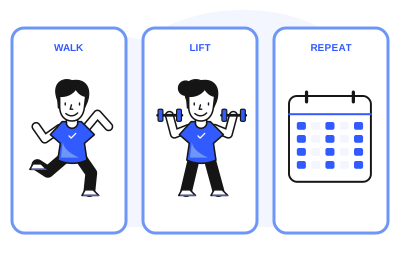
Think of the plan as two jobs. Cardio gives you time moving at a sustained effort. Strength work gives your muscles a challenge to keep adapting to. A review of resistance training supports including it during dietary weight loss to help preserve lean mass. That makes the dumbbell session valuable even when its calorie number looks smaller than the treadmill's.
| Exercise | Its job in the plan | An accessible starting option |
|---|---|---|
| Brisk walking | Repeatable aerobic activity | A short flat route near home |
| Cycling or swimming | Another way to build aerobic time | An easy stationary-bike ride or supervised pool session |
| Squat or sit-to-stand | Train the legs through sitting and standing | A sturdy chair secured against a wall |
| Hip hinge or glute bridge | Train the hips and back of the legs | An unloaded hinge or bridge on a mat |
| Wall or incline push-up | Train pushing with the chest and arms | A wall at a comfortable distance |
| Dumbbell row | Train pulling with the back and arms | A light weight with the free hand supported |
| Carry or controlled core work | Practise trunk control | A light suitcase carry in a clear space |
Learn the strength movements before chasing speed
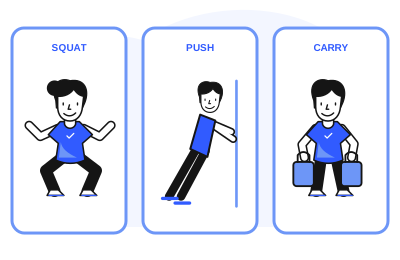
The following is a suggested starting session for generally healthy adults, not a prescription for an injury or medical condition. Warm up with easy walking or marching and a few unloaded practice repetitions. Begin with one set of each movement. If that feels manageable, use two sets in later sessions. A set is a group of repetitions followed by a rest; you can finish all sets of one exercise before moving on.
- 1
Sit-to-stand or squat: 6 to 10 repetitions
Stand in front of a stable chair, feet in a comfortable stance. Send your hips back, bend your knees and sit down under control. Stand by pushing through your feet. Use a higher seat or light hand support if needed. When you no longer need the seat, practise the same movement as a free squat, keeping the depth comfortable.
- 2
Hip hinge: 8 to 12 repetitions
Stand with soft knees and slide your hips backwards while keeping your back in a comfortable, steady position. Return to standing without leaning backwards at the top. Practise without a weight first. Later, hold light dumbbells close to your legs. If learning the hinge feels confusing, use a glute bridge and ask a coach to check your setup.
- 3
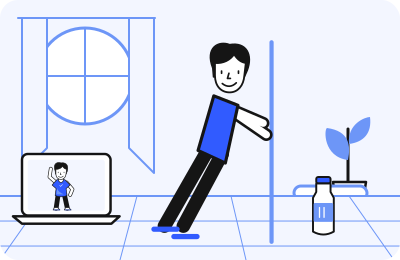
Wall push-up: 6 to 10 repetitions
Place your hands on a wall around chest height and step back until the position feels manageable. Bend your elbows and bring your body towards the wall, then press away. Keep your body moving as one unit. A fixed kitchen counter makes this harder; avoid movable tables, folding furniture and anything that might slide.
- 4
Supported row: 8 to 12 repetitions per side
Support one hand on a secure surface, hinge comfortably and hold a light dumbbell in the other hand. Pull your elbow towards your hip, then lower slowly. Avoid twisting to finish the repetition. Repeat on the other side. If you have no suitable pulling equipment, use the gym alternative below rather than improvising an anchor on a door handle.
- 5
Suitcase carry: a short controlled walk on each side
Hold one light weight beside you, stand comfortably tall and walk through a clear space without leaning sideways. Turn slowly and repeat with the other hand. Choose a load that lets you breathe normally. If space is limited, stand still with the weight for a short hold instead of weaving between furniture.
Rest until you can repeat the next set with similar control; about a minute or two is a useful starting allowance, and longer is fine. Finish each set while you could still perform another couple of controlled repetitions. If the last repetition needs a swing, a held breath or a sudden change in position, reduce the load or stop the set earlier next time.
Home and gym versions of the same plan
A gym gives you more ways to adjust resistance, but the basic jobs stay the same. Choose one option from each row, rather than doing both versions to make the session feel more complete. Ask a trainer to show you the seat adjustments and range of motion on unfamiliar machines. Record the settings so the next visit starts smoothly.
| Pattern | At home | At your gym |
|---|---|---|
| Squat | Chair squat or goblet squat | Leg press or goblet squat |
| Hinge | Unloaded hinge, bridge or dumbbell hinge | Dumbbell Romanian deadlift after learning the movement |
| Push | Wall or counter push-up | Chest-press machine |
| Pull | Supported dumbbell row | Seated cable row |
| Aerobic work | Outdoor walking or indoor marching | Treadmill, bike or cross-trainer |
For a full equipment-based routine, see the gym workout plan for beginners. If you train in a bedroom or living room, the home workout plan gives you more bodyweight options. Pick the environment that removes obstacles: a nearby gym can help if home is crowded, while home training avoids a commute on busy workdays.
Build a week around strength and walking
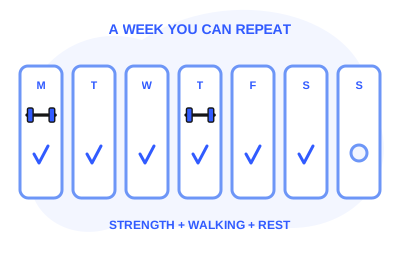
The CDC adult activity recommendations include at least 150 minutes of moderate aerobic activity and two days of muscle strengthening each week. This is a health guideline, not a promise of weight loss. The example below supplies 150 minutes of walking separately from its strength sessions. Build towards it if you currently do much less.
| Day | Strength | Brisk walking |
|---|---|---|
| Monday | Full-body session | 15 minutes |
| Tuesday | None planned | 30 minutes |
| Wednesday | None planned | 20 minutes |
| Thursday | Full-body session | 15 minutes |
| Friday | None planned | 25 minutes |
| Saturday | None planned | 45 minutes, split if preferred |
| Sunday | Rest | Optional easy stroll, not included in the total |
If that looks like too much, shorten the walks and do one set per strength exercise for now. Put the shorter version in your diary and complete it before adding more. You can split a walk between a lunch break and an evening outing. In an Indian summer or during heavy rain, an indoor route or stationary bike may make the same habit easier to maintain.
How hard should fat loss exercise feel?
For cardio, use breathing as a practical check. The CDC talk test describes moderate activity as an effort where you can talk but not sing. You do not need to turn every walk into a race. If you can only get out a few words, slow down when the session is intended to be moderate.
For strength work, watch the movement itself. A challenging set should still look recognisable from the first repetition to the last. When you complete the top of your repetition range comfortably across your sets, try the smallest available weight increase next time. If that makes the movement untidy, return to the previous weight. Increase one thing at a time, rather than adding weight, sets and cardio together.
Food and recovery belong in the plan
The CDC's weight-management guidance explains that physical activity and food intake work together through energy balance. A hard workout does not guarantee a calorie deficit. Keep meals regular enough that you are not arriving at dinner ravenous, and review easy-to-miss extras such as sweetened drinks or repeated snacks before making large cuts to ordinary meals.
An Indian meal can stay familiar: include a protein source such as dal, beans, curd, paneer, tofu, eggs, fish or chicken, alongside vegetables and a portion of rice or roti that fits your needs. Our protein in Indian food guide helps compare choices. If you use the TDEE calculator, treat its output as an estimate to review, not a calorie allowance that is exact for your body.
Leave space between your full-body strength days and keep a realistic bedtime. If training makes the rest of your day unusually exhausting, first reduce the session you cannot recover from. The goal is a routine that works alongside your job, household responsibilities and sleep. A plan that only works during a quiet week needs a smaller version for normal life.
Track progress without chasing a calorie score
- Record the sessions you actually completed, including shortened ones. This shows whether the plan fits your schedule.
- Write down repetitions, loads and how the walk felt. More controlled repetitions or a more comfortable route are useful changes.
- If you track body weight or waist size, compare measurements taken under similar conditions over several weeks. Avoid rewriting the plan after one reading.
- If nothing is changing, review attendance, ordinary meals and recovery before adding punishing workouts. Change one habit and reassess.
You can use the belly fat training guide if waist change is your main concern, or the fat burn training guide to choose between steady cardio and intervals. Neither requires you to abandon these strength basics. They answer different planning questions rather than offering a secret exercise that the rest of your routine is missing.
Sources
- Adult Activity: An Overview, Centers for Disease Control and Prevention
- Physical Activity and Your Weight and Health, Centers for Disease Control and Prevention
- How to Measure Physical Activity Intensity, Centers for Disease Control and Prevention
- Resistance training effectiveness on body composition and body weight outcomes (2022), Obesity Reviews / Edith Cowan University
- Tips for Starting Physical Activity, National Institute of Diabetes and Digestive and Kidney Diseases
Written by the MakeMyFitness team from the sources above. First published , last updated . Spotted something out of date? Tell us at hello@makemyfitness.com.