What an online weight loss personal trainer in India actually does
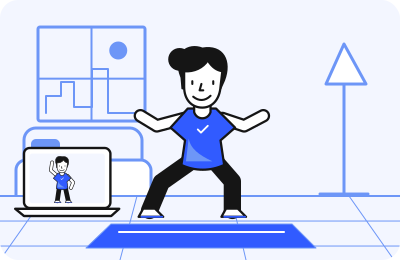
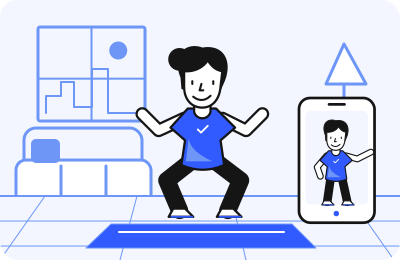
An online personal trainer for weight loss does three jobs. They run your strength sessions live on video, correcting every rep. They set the targets that happen between sessions: steps, protein, a sensible calorie deficit and sleep. And they review the numbers every week and change the plan when progress stalls. The training is the part you see; the weekly adjustments are the part that makes it work.
This guide walks through what the first 12 sessions look like at MakeMyFitness, which is one 4-week plan of 3 sessions a week. If you want the overview of how we approach fat loss, including the longer 12-week picture, start at the fat loss goal page. This page is the close-up of the first month. For how live coaching differs from an app plan or chat check-ins, see online fitness coaching, explained.
| Where you train | One session | 4-week plan (12 sessions) | Per session on the plan |
|---|---|---|---|
| At home (Personal Home Training) | ₹899 | ₹8,080 | about ₹673 |
| At your gym (Personal Gym Training) | ₹799 | ₹7,070 | about ₹589 |
Most people losing weight start at home, because it's the easiest place to stay consistent and needs nothing more than a mat. If you already pay for a gym, training there with your coach on video costs less per session. Prices are the same in every city; see pricing.
The 4-week plan at a glance
| Week | Sessions | Focus | What gets measured |
|---|---|---|---|
| 1 | 1–3 | Assessment and learning the basic movements | Starting weight, waist, step count, how each movement looks |
| 2 | 4–6 | Building the habit: fixed slots, daily steps, protein | Sessions attended, daily steps, protein most days |
| 3 | 7–9 | Progression: more reps, then more load | Reps and weights in each lift, weekly average weight |
| 4 | 10–12 | Review and plan the next block | Waist, weekly averages, strength, how you feel |
Week 1, sessions 1 to 3: the assessment
Your first session is an assessment, and it's gentle on purpose. Your coach asks about your goal, your training history, injuries, health conditions, sleep and work hours, then watches you do a handful of basic movements: a squat to a chair or bench, a hip hinge, a push-up against a wall or the floor, a row and a plank. Nothing is a test you can fail. The point is to see where you start so the plan fits you. What happens in your first session explains it in full.
Sessions 2 and 3 teach the movements that every later session builds on: squat, hinge, push, pull, lunge and carry, at a level you can control with clean form. Your coach also sets your baseline numbers. You weigh yourself on a few mornings that week, measure your waist at the navel, and note your average daily steps from your phone. Those numbers matter more than any single weigh-in.
Week 2, sessions 4 to 6: building the habit
Week 2 is about making three sessions a week feel normal. Pick fixed slots, for example 7 AM on Monday, Wednesday and Friday, and treat them like meetings. Slots run from 6 AM to 8 PM India time every day, and sessions can be moved with 24 hours' notice, which matters when work runs late.
The sessions themselves get a little longer in the working sets and a little shorter in the rests. Your coach adds one or two new exercises, usually a lunge variation and a loaded carry, and starts tracking reps so there's something to beat next week. Outside the sessions, the two targets are a daily step goal set from your baseline and protein at every meal.
Week 3, sessions 7 to 9: progression
By week 3 the movements look steady, so the work gets harder. Progression follows a simple order: first more reps at the same weight, then a harder version or more weight. The American College of Sports Medicine's position stand on progression recommends a 2 to 10% increase in load once you can do one or two reps more than your target, and 2 to 3 sessions a week for novices with loads you can lift for about 8 to 12 reps. At home without weights, harder means slower lowering, pauses, single-leg versions or a backpack loaded with books.
This is also the week many people notice the scale doing something odd, like rising after a hard session or after a salty dinner. Your coach will point you back to the weekly average and the waist measurement.
Week 4, sessions 10 to 12: review and what comes next
The last week of the plan compares the numbers with week 1: waist, weekly average weight, the reps and loads in your main lifts, your average steps and how you feel. If things moved, the next block carries on with more load and volume. If they didn't, your coach goes through food, steps and sleep with you before changing anything drastic. Nothing renews by itself; you choose whether to book another 12.
What a 45-minute weight loss session looks like
| Part | Minutes | What happens |
|---|---|---|
| Check-in | 5 | Sleep, soreness, steps and food since last time; today's plan adjusted |
| Warm-up | 8 | Joint mobility and lighter sets of the day's main movements |
| Main work | 25 | Full-body strength: squat, hinge, push, pull, lunge and carry, coached rep by rep |
| Finisher or core | 4 | A short conditioning or core block, low-impact if you live in a flat |
| Cool-down and recap | 3 | Stretch, then the targets until next session |
Notice what's missing: an hour of jumping. Weight loss sessions are built around strength, because the calorie deficit does most of the losing and the training decides what you lose. Conditioning is there, but it's a finisher, not the whole session.
How much weight can you lose in 12 sessions?
A realistic pace is 0.5 to 1 kg a week. The NHS advises aiming to lose 1 to 2 lb, or 0.5 to 1 kg, a week, and the CDC notes that people who lose weight at a gradual, steady pace of about 1 to 2 pounds a week are more likely to keep it off. Over a 4-week plan that's about 2 to 4 kg at most, and less if you have less to lose.
| Pace | Over 4 weeks | Who it usually suits |
|---|---|---|
| 0.5 kg a week | About 2 kg | Most people, especially if you have less to lose |
| 0.75 kg a week | About 3 kg | People with more to lose who are sleeping and eating well |
| 1 kg a week | About 4 kg | The upper limit of the NHS range; hard to sustain |
Faster isn't better. A 2022 review of 13 studies in Current Obesity Reports found that faster weight loss may take off more fat-free mass (muscle and water) and less fat while you're losing, with bigger drops in the energy your body burns at rest. The first week can also show a bigger drop than later weeks as water shifts, so judge the month, not the first weigh-in.
Why strength training matters when you're losing weight
When you eat less, your body can lose muscle along with fat unless it has a reason to keep it. Strength training is that reason. A 2022 meta-analysis of 114 trials in Obesity Reviews in people with overweight or obesity found that resistance training combined with calorie restriction cut fat mass by about 5.3 kg and body fat by 3.8 percentage points compared with control groups, while lean mass was maintained. In plain terms: lift while you eat a little less, and more of what you lose is fat.
That's why every session in the plan is strength-first, and why the clearest sign the plan is working is lifting the same or more while your weight trends down. If you want the at-home version of this approach without a coach, read home workout for weight loss.
What gets measured, and why the scale isn't the only number
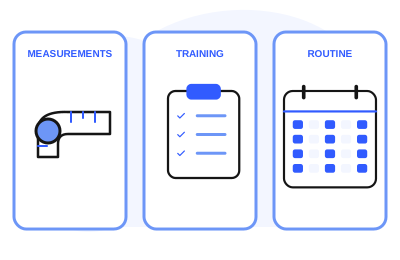
- Weekly average weight. Weigh on waking, after the toilet, on 3 to 7 mornings a week, and compare averages. Daily weight swings with water, salt and, for women, the menstrual cycle.
- Waist at the navel, once a week. It often moves when the scale doesn't.
- Reps and loads in each main lift, logged by your coach every session.
- Average daily steps from your phone or watch.
- Sessions attended. Twelve out of twelve beats any clever program done half the time.
- Sleep and energy, asked at every check-in.
How food fits into the plan
Food does most of the losing, so it's part of every check-in. Our lead coach, Kumar Abhishek, is a certified Human Performance Nutritionist (K11 School of Fitness Sciences), and the guidance is practical: a protein target, portion ideas and simple swaps for the meals you already eat. It isn't a written diet chart, and if you have a medical condition we'll suggest you also see your doctor or a registered dietitian.
- 1
Find your maintenance calories
Use the TDEE calculator for an estimate of what you burn on a normal day.
- 2
Set a modest deficit
The calorie deficit calculator turns that into a daily target for a pace of about 0.5 kg a week.
- 3
Put protein in every meal
The International Society of Sports Nutrition suggests 1.4 to 2.0 g per kg of body weight a day for people who exercise, in servings of about 20 to 40 g. Work out your number with the protein intake calculator.
- 4
Keep your own food
Dal, curd, paneer, eggs, chicken, fish and soya all count. Our high-protein vegetarian Indian diet and protein in Indian food guides have real servings, and there are regional plans for South Indian and Punjabi kitchens.
Steps and daily movement between sessions

Three 45-minute sessions are about 2 hours and 15 minutes of a 168-hour week. What you do with the rest matters. A 2011 review by Tudor-Locke and colleagues concluded that about 7,000 to 8,000 steps a day is a reasonable threshold for healthy adults and that 30 minutes of brisk walking is roughly 3,000 to 4,000 steps. For weight specifically, a 2024 meta-analysis in JAMA Network Open of 116 trials linked each extra 30 minutes a week of aerobic exercise with about 0.52 kg more weight loss.
Your coach sets a step target from your week 1 average and raises it gradually, often by 1,000 to 2,000 steps a day each week, rather than jumping to 10,000 on day one. Our walking for weight loss guide covers step targets, calories and walking safely through Indian summers and smoggy winters.
Sleep: the part most people skip
Short sleep makes a deficit harder. In a small 2010 trial in Annals of Internal Medicine, 10 adults on the same calorie-restricted diet lost 1.4 kg of fat with 8.5 hours in bed but only 0.6 kg with 5.5 hours, and lost more fat-free mass on short sleep. It was a two-week study with 10 people, but the direction is clear. Early-morning sessions are popular; if a 6 AM slot costs you an hour of sleep, a 7 PM slot may be the better choice.
Who an online weight loss trainer suits
- Busy professionals whose day runs long: there's no commute, and a session fits before work or after the last call. See our guide for working professionals.
- Beginners who'd rather learn at home than on a crowded gym floor (online personal trainer for beginners).
- People who've tried apps and stopped after two weeks: a booked live session with a person waiting is harder to skip.
- Not a fit for anyone wanting a crash result for an event in two weeks, or anyone needing medical weight management, which belongs with a doctor.
Sources
- Obesity: treatment, NHS
- Steps for losing weight, Centers for Disease Control and Prevention
- The impact of the rate of weight loss on body composition and metabolism (2022), Current Obesity Reports
- Resistance training effectiveness on body composition and body weight outcomes in individuals with overweight and obesity across the lifespan (2022), Obesity Reviews (Edith Cowan University repository)
- Progression models in resistance training for healthy adults (position stand, 2009), American College of Sports Medicine
- International Society of Sports Nutrition position stand: protein and exercise (2017), Journal of the International Society of Sports Nutrition
- How many steps/day are enough? for adults (2011), International Journal of Behavioral Nutrition and Physical Activity
- Aerobic exercise and weight loss in adults: a systematic review and dose-response meta-analysis (2024), JAMA Network Open
- Insufficient sleep undermines dietary efforts to reduce adiposity (2010), Annals of Internal Medicine
Written by the MakeMyFitness team from the sources above. First published , last updated . Spotted something out of date? Tell us at hello@makemyfitness.com.