Why beginners get the most from a live coach
The first months of training set the habits you keep: how you squat, how you brace, how hard you push and when you stop. Learning them from a video means guessing whether you've got it right. Learning them from a coach who is watching means being told, on the rep, and corrected before a habit forms. The research agrees: a 2022 systematic review found that supervised resistance training produced greater strength gains and better adherence than unsupervised training, and the effect was largest for people with the least experience.
Beginners also get the most from accountability. A session in the calendar with a person waiting on the other end of the call is the difference between "I'll start Monday" and starting. The World Health Organization's guidelines ask adults for 150 minutes of moderate activity a week plus two days of strength work; a coach gets a beginner there in weeks, not years.
Live coach or app: the difference that matters when you're new
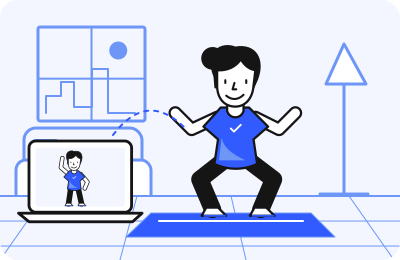
"Online personal training" is sold two ways. In one, a coach is on a video call with you for every session, watching and correcting. In the other, a coach sends you a programme in an app and checks in by chat while you train alone. The second can work well once you know how to move. For a beginner it leaves the hardest part, doing the movements correctly, to the person who knows least about them. If you're new, ask one question before anything else: is every session live, with the coach watching me?
What your first session looks like
- 1
Before: a short call
After you book a session the team calls to confirm your slot, hears what you want and makes sure a coach is right for it. If you have a health condition or an old injury, this is where you say so; a quick health check comes before your first session.
- 2
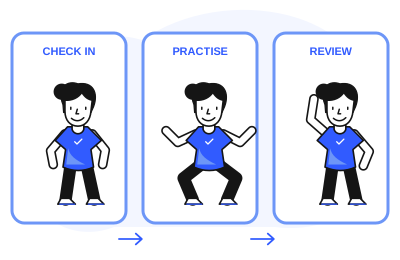
Minute 0: set up and check in
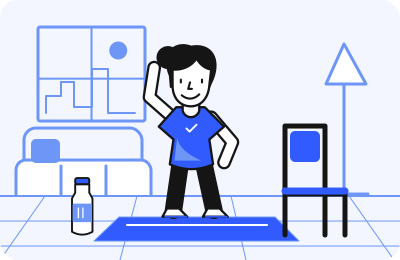
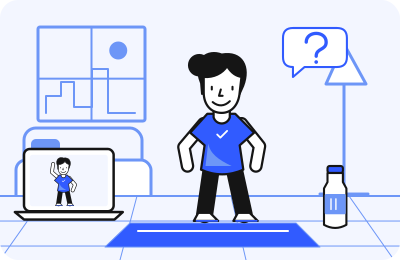
You prop your phone so your whole body is in frame, side-on. Your coach asks how you slept, whether anything hurts and what you have around you. Nothing is assumed.
- 3
Minutes 5 to 13: warm up
Easy movement to get warm and to let the coach see how you move. This is where they decide what the session will be.
- 4
Minutes 13 to 38: three or four basic movements
A squat pattern, a hinge, a push and a pull, at a level you can do well, with the coach cueing each rep: where your knees go, how you breathe, when to stop. Beginners rarely need more than four movements.
- 5
Minutes 38 to 45: cool down and the plan
A stretch, then what to do before next time and when next time is. You leave with two or three things to practise, not a 40-exercise programme.
What you need
- A phone, tablet or laptop with a camera, and a stable connection. A bigger screen helps you see demonstrations; it isn't essential.
- A mat's length of floor and room to stretch your arms. A cleared corner is enough. See personal home training.
- No equipment. Your coach builds the first weeks from bodyweight and whatever you own. Dumbbells or bands come later, if at all.
- At the gym: your own membership and a bench or bag to prop the phone on. See personal gym training.
- Water, trainers, and clothes you can move in. That's the list.
What it costs as a beginner
Start with a single session, not a plan. With MakeMyFitness a live one-to-one session is ₹899 at home or ₹799 at your gym, 45 minutes with a certified coach, paid once by a secure link with nothing renewing. If it suits you, a 4-week plan of 12 sessions brings that to about ₹673 and ₹589 a session. A live group class is ₹499 per person. What the rest of the market charges, and how to compare monthly prices fairly, is in our cost-per-month guide.
The first month: what to expect
- Two or three sessions a week is plenty. The WHO asks for two strength days; a third session is for people who want faster progress, not a requirement. Our guide on how many days a week to work out goes further.
- Soreness in the first week, especially a day or two after the first session. It fades as your body adapts; your coach plans the second session around it.
- Progress you can feel before you can see it. Stairs get easier, sleep improves and the same movements feel lighter within two to three weeks. Visible change usually takes six to eight weeks of consistent training and sensible eating.
- One habit at a time. A good coach won't change your diet, your sleep and your training in week one. The fat loss and strength pages show what the first months look like for each goal.
How to pick a coach when you can't judge one yet
Beginners are the easiest clients to sell to and the easiest to let down, so check three things even when everything sounds fine. The coach's certification, by name, and then verify it; how to is in our guide to choosing a personal trainer. Whether sessions are live and one-to-one. And whether you can book one session before committing to anything. Our coach's credentials are on his page, with the institutes that issued them.
Sources
- The role of supervision in resistance training: an exploratory systematic review and meta-analysis (2022), Fisher J, et al., International Journal of Strength and Conditioning
- WHO guidelines on physical activity and sedentary behaviour (2020), World Health Organization
- Physical activity guidelines for adults aged 19 to 64, NHS
- Strength exercises, NHS
Written by the MakeMyFitness team from the sources above. First published , last updated . Spotted something out of date? Tell us at hello@makemyfitness.com.