In short
- The American College of Sports Medicine published its 2027 Worldwide Fitness Trends on 20 October 2026.
- Wearable technology is No. 1, followed by mobile exercise apps and balance, flow and core strength.
- Group fitness classes jumped six places to No. 7.
- The list is what more than 1,400 fitness professionals say they see in the industry, not proof of what works, so use it as a prompt, not a plan.
Every year the American College of Sports Medicine (ACSM) publishes a ranked list of what the fitness industry is talking about. The 2027 edition came out on 20 October 2026. It is a useful read if you train in India, as long as you remember what the list is and what it is not. This post gives you the ranking, what moved, how the survey works, and three things worth doing in 2027.
What we could and could not confirm
ACSM's own pages and its infographic PDF blocked our automated reader on 16 November 2026. The top 10 below comes from the ACSM press release as published on Newswise, which names ranks 1 to 10. The press release says the full report has a top 20, but we could not open it, so we do not list ranks 11 to 20. Check the full report in ACSM's Health & Fitness Journal (November/December 2026) for those.
What are the top 10 fitness trends for 2027?
This is the ranking in the ACSM press release. The right-hand column is our reading of what each trend means for an ordinary person in India. It is our interpretation, not ACSM's.
| Rank | Trend | In practice for you in India |
|---|---|---|
| 1 | Wearable technology | A watch or band can show steps, heart rate and sleep trends. Treat the numbers as rough guides. |
| 2 | Mobile exercise apps | Useful for reminders and logging. An app does not watch your form. |
| 3 | Balance, flow and core strength | Yoga-style flow, single-leg work and trunk control. Easy to do at home. |
| 4 | Fitness programs for older adults | Strength, balance and walking programmes for parents and grandparents. |
| 5 | Traditional strength training | Weights, bands or bodyweight, done progressively. Still the backbone. |
| 6 | Exercise for weight management | Exercise helps, but food still sets the pace of fat loss. |
| 7 | Group fitness classes | Live classes bring routine and company, in a studio or on video. |
| 8 | Data-driven training technology | Software that turns your training numbers into decisions. |
| 9 | Exercise for mental health and well-being | Regular movement as part of looking after your mood and stress. |
| 10 | Influencer or ambassador-led fitness programs | Follow a creator if you like, but check the programme is safe for you. |
What moved compared with the 2026 list?

We could compare only the ranks we could confirm in both years. For 2026, a trade report on ACSM's release names six: 1 wearable technology, 2 fitness programs for older adults, 3 exercise for weight management, 4 mobile exercise apps, 5 balance, flow and core strength, and 9 adult recreation and sports clubs. It does not give ranks 6, 7, 8 or 10. So the comparison below is partial.
| Trend | 2026 | 2027 |
|---|---|---|
| Wearable technology | 1 | 1 |
| Mobile exercise apps | 4 | 2 |
| Balance, flow and core strength | 5 | 3 |
| Fitness programs for older adults | 2 | 4 |
| Exercise for weight management | 3 | 6 |
| Group fitness classes | 13 (per ACSM release) | 7 |
| Adult recreation and sports clubs | 9 | Not in the 2027 top 10 |
Three shifts stand out. Apps and balance work both climbed. Weight management slipped from third to sixth, though it is still in the top 10. And group fitness classes rose six places, from 13 to 7. The press release also says influencer or ambassador-led programs returned to the top 10 after falling out of the top 20 in 2026, and that traditional strength training went up two places. The release says data-driven training technology held steady at No. 8.
How is the ACSM trends survey done, and what are its limits?

The 2027 edition is the 21st annual report. According to the press release, more than 1,400 fitness professionals took part and rated 50 potential trends. They rated how widely they observed each trend in the industry, not their personal preference and not how healthy it is. The lead author is Cayla R. McAvoy, PhD, chair of ACSM's Trends Workgroup. The release does not name the countries, but says the report includes separate international rankings for participating countries and regions.
That design has clear limits. These are our points, drawn from what the release says about the method.
- The respondents are professionals who work in fitness. They tell you what is visible and marketed in their industry, not what a typical person in a Tier 2 city is doing.
- A high rank means a trend is widely seen. It does not mean it is effective, safe or good value.
- Rankings can move because professionals notice a trend more, or because sales and media attention changed, not because the evidence changed.
- We could not confirm how many respondents were in India, so do not read the list as an India ranking.
Are wearables as accurate as the trend suggests?
Wearables are No. 1, so it is fair to ask how far to trust them. A 2022 systematic review of wrist-worn activity trackers in the Journal of Medical Internet Research found poor accuracy for calories: for energy expenditure, the error rate was above 30% for every brand it looked at. For heart rate, one brand's watch had an error rate below 10% in two studies. That is thin evidence, and the review was published in 2022, so newer models may do better or worse.
The practical point: a tracker is good at showing whether you move more this month than last month. It is a poor judge of how many calories you burned. Do not eat back the calories your watch claims.
Which trends are worth your attention in India?

Here is how we would sort the ten, as a coach reading the list and not as ACSM's view.
Worth acting on
- Strength training (No. 5) and balance, flow and core (No. 3). These are the least trendy and the most useful. If you do one thing, lift something progressively twice a week. Our guide on strength training for women over 40 shows how to start.
- Programs for older adults (No. 4). Strength and balance matter more with age. See exercise for seniors at home if you are setting this up for a parent.
- Group classes (No. 7). Company and a fixed time help many people stay consistent. A live class on video counts. See our group classes.
- Exercise for mental health (No. 9). Moving regularly is a sensible part of looking after your mood. It sits alongside, not instead of, professional help if you are struggling.
Useful tools, not the point
- Wearables, apps and data-driven tools (Nos. 1, 2 and 8). They can help you notice habits. They do not teach you to squat safely or tell you why progress stalled.
- Weight management (No. 6). Exercise supports it, but nutrition does most of the work. Our guide on home workouts for weight loss covers the exercise side.
Mostly industry talk
- Influencer or ambassador-led programs (No. 10). It is on the list because it is common in the industry, not because it works. A programme built for millions of followers is not built for your knees, your job or your history. Our post on ChatGPT workout plans versus a personal trainer makes a similar point about one-size plans.
See a doctor first if you have a health condition
If you have a heart or lung condition, high blood pressure, diabetes, an injury, or you are pregnant, or if you are older and have been inactive, speak to your doctor before starting a new programme. If exercise brings on chest pain, severe breathlessness or dizziness, stop and get medical advice.
How much exercise should you aim for in 2027?

The trends list does not tell you how much to do. The World Health Organization says adults should do at least 150 minutes a week of moderate-intensity physical activity, and that muscle strengthening benefits everyone. Falling short is common: a Lancet Global Health study of 507 surveys from 163 countries estimated that the age-standardised global prevalence of insufficient activity among adults was 31.3% in 2022, up from 23.4% in 2000. We could not open a source that gives the India figure, so we do not quote one.
How you split that across the week matters less than doing it regularly. Our guide on how many days a week you should work out helps you pick a schedule you can keep.
What are three practical things to do in 2027?
- 1
Pick the boring basics first
Plan two strength sessions a week and one balance or mobility session. Use a progression you can write down: more reps, a slightly heavier load, or a harder variation, once the current one feels easy.
- 2
Use a tracker for habits, not calories
If you own a watch or use an app, track steps, sessions completed and sleep. Ignore the calorie-burn figure when planning what to eat, given the error rates in the review above.
- 3
Make it social or supervised
The rise of group classes suggests people value company. Train with a friend, join a live class, or book a coach who can watch your form and adjust the plan. Review the plan every four weeks and change what is not working.
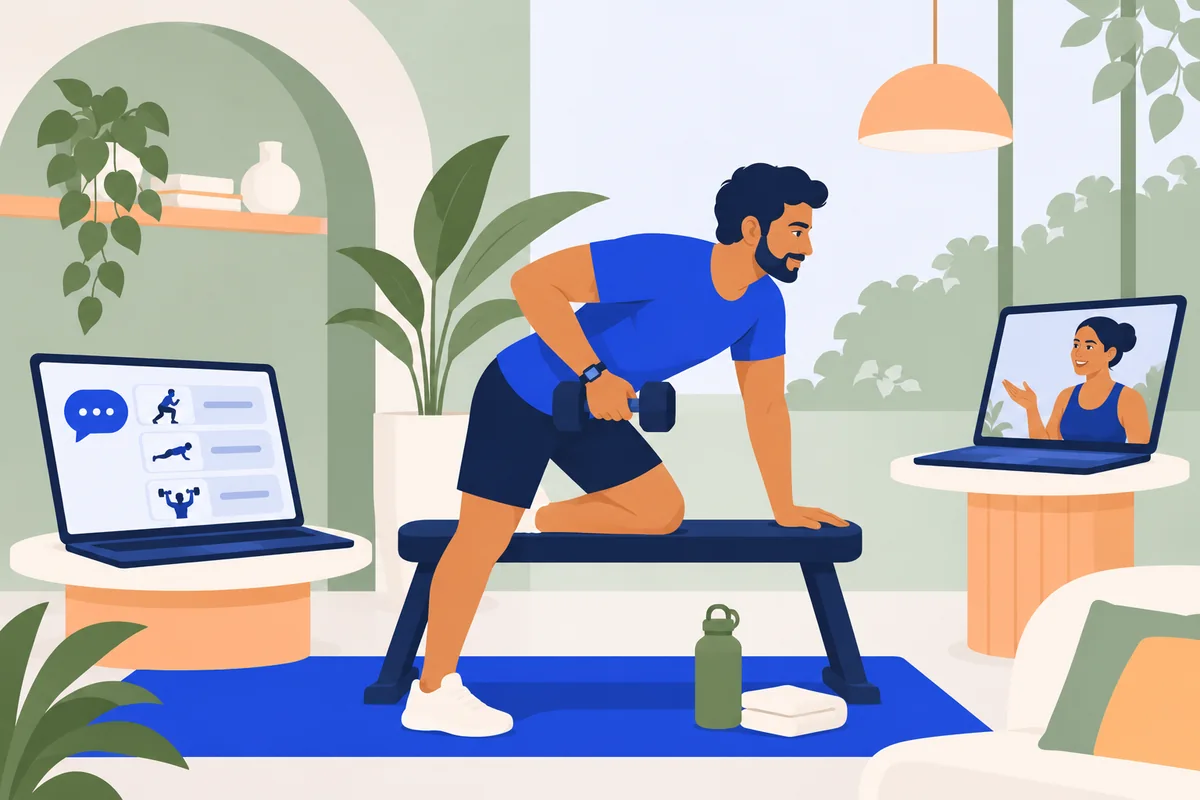
If you would rather have someone watch your form, a coach on a video call can do that at home. Our personal home training programme is one-to-one. If a group event is your goal, see how Hyrox preparation works in our post on Hyrox in India.
Sources
- ACSM Announces Top Fitness Trends for 2027, Newswise (ACSM press release)
- ACSM Announces Top Fitness Trends for 2026, Recreation Management
- Accuracy and Acceptability of Wrist-Wearable Activity-Tracking Devices: Systematic Review of the Literature, Journal of Medical Internet Research, via PubMed
- National, regional, and global trends in insufficient physical activity among adults from 2000 to 2022, The Lancet Global Health
- Physical activity fact sheet, World Health Organization
Written by the MakeMyFitness team from the sources above and reviewed by Kumar Abhishek, our lead coach (Diploma in Personal Training, K11 School of Fitness Sciences). First published , last updated . How we write and check our guides: editorial policy. Spotted something out of date? Tell us at hello@makemyfitness.com.