Resistance bands are the cheapest, quietest and most portable way to strength train at home. A set fits in a drawer, travels in a suitcase and, unlike bodyweight alone, gives you a proper way to train your back with rows and pulldowns. This guide explains which bands to buy, how to anchor them safely, 18 exercises and the routines to put them in.
Do resistance bands really build strength?
Yes. A 2019 systematic review and meta-analysis in SAGE Open Medicine by Lopes and colleagues pooled 8 randomized trials with 224 participants, ranging from university students and football players to people with heart disease, and compared training with elastic bands against training with conventional weights and machines. Neither the upper-body nor the lower-body strength results differed between the two. The authors concluded that elastic resistance provides similar strength gains and is a low-cost, easy option. The trials were small, so treat it as good evidence rather than the final word.
Health guidelines agree that bands count. The NHS lists working with resistance bands alongside lifting weights as muscle-strengthening activity, which adults should do on at least 2 days a week. The catch with bands is the same as with any light load: the last few reps of each set have to be genuinely hard.
Types of resistance bands: loop, mini band and tube with handles
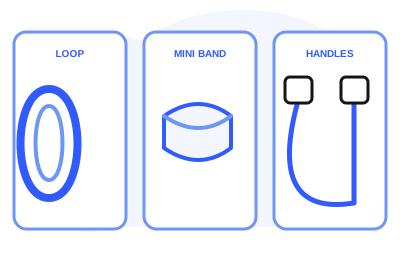
| Band type | What it looks like | Best for | Watch out for |
|---|---|---|---|
| Long loop band (power band) | A large, continuous flat loop | Squats, deadlifts, rows, presses, assisted pull-ups | Hard to fine-tune; heavy loops snap back hard |
| Mini band | A short loop, worn around the thighs or ankles | Glute bridges, lateral walks, clamshells, warm-ups | Rolls up on bare skin; fabric versions grip better |
| Tube with handles (resistance tube) | A rubber tube with a handle at each end, often with a door anchor | Chest press, rows, curls, pulldowns, anything you'd do with a cable machine | Check the clips and handles for wear |
| Flat therapy band | A long, flat strip with no loops or handles | Light rehab-style and seniors' exercises, mobility | Knots and grips can slip; usually light resistance |
For most people starting a resistance band workout at home, a set of tube bands with handles and a door anchor plus one set of mini bands covers almost everything. Add a long loop band later for heavier squats and deadlifts.
Resistance levels and band colours
Bands are sold in colour-coded levels, but the colours mean different things between brands, so go by the level printed on the band, not the colour. TheraBand, for example, names its tubing levels from Extra Thin (tan) and Thin (yellow) through Medium (red), Heavy (green), Extra Heavy (blue) and Special Heavy (black) to Super Heavy (silver). Whatever the brand, a band pulls harder the further you stretch it, so you can make any band harder by standing further from the anchor or choking up on it.
- Start lighter than you think. Pick a level where you can do 15 controlled reps of a row with 2 or 3 to spare.
- You'll need two or three levels. Legs and back need a stronger band than shoulders and arms.
- Stack bands to go heavier: hold two tubes together, or clip two to the same handles.
How to anchor a resistance band safely at home
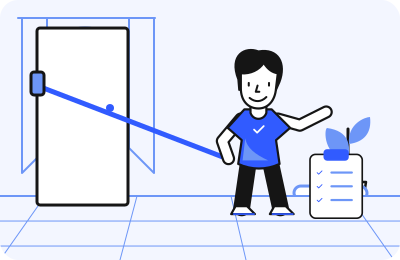
Anchoring is the part of band training that can go wrong at home. A band under tension stores energy, and a slipping anchor sends it straight back at you.
- Use a proper door anchor, the padded strap that comes with tube sets, never a loose knot.
- Put it on the hinge side of a solid door, and stand on the side the door opens away from, so pulling the band presses the door into its frame instead of opening it.
- Lock the door or tell the household so nobody opens it mid-set.
- Never anchor to furniture that can move, a curtain rod, a window grill you haven't checked, a bedpost or a table leg.
- Check the band before every session for nicks, cracks, sticky patches or worn clips, and replace it at the first sign. Store bands out of direct sunlight.
- Keep your face out of the line of pull on presses and pulldowns, and never let go of a stretched band: return it slowly.
18 resistance band exercises to do at home
Control matters more with bands than with weights, because the band pulls hardest at the end of each rep and wants to snap you back. Take 2 to 3 seconds to return each rep.
Lower body
- 1
Banded squat
Stand on a long loop band, feet shoulder-width, loop over your shoulders or handles at your shoulders. Sit down between your heels and stand tall. The band is hardest at the top, so squeeze your glutes there.
- 2
Banded Romanian deadlift
Stand on the band, hands holding it in front of your thighs. Push your hips back with a flat back until your hamstrings stretch, then drive your hips forward to stand.
- 3
Split squat
Front foot on the band, handles at your shoulders. Lower your back knee towards the floor and push up through the front heel.
- 4
Glute bridge with mini band
Mini band just above your knees. Lie on your back, press your knees out gently against the band, lift your hips until your body is straight from shoulders to knees.
- 5
Lateral band walk
Mini band above the knees or around the ankles, slight squat. Step sideways 10 to 15 steps each way without letting your knees cave in.
- 6
Standing kickback
Mini band around the ankles, hands on a wall. Push one leg straight back a short distance, squeezing the glute, without arching your lower back.
Push: chest, shoulders and triceps
- 1
Chest press
Anchor at chest height behind you, or wrap a tube around your upper back. Step forward into tension and press the handles straight out, then return slowly.
- 2
Overhead press
Stand on the band, handles at your shoulders. Brace your stomach and press straight up without arching your lower back.
- 3
Banded push-up
Loop band across your upper back, ends under your hands. Do push-ups from the floor or knees; the band adds load at the top.
- 4
Triceps pressdown
Anchor high on the door. Elbows pinned at your sides, push the band down until your arms are straight, return slowly.
Pull: back and biceps
- 1
Seated row
Sit with legs straight, band looped around your feet. Pull the handles to your lower ribs, squeeze your shoulder blades together, return slowly. No anchor needed.
- 2
Standing row
Anchor at chest height in front of you. Step back into tension, pull your elbows back past your ribs, keeping your shoulders down.
- 3
Lat pulldown
Anchor at the top of the door. Kneel facing it and pull the handles down to your upper chest, elbows driving towards your hips.
- 4
Face pull
Anchor at face height. Pull the middle of the band towards your forehead with elbows high, ending in a "double biceps" position. Excellent for posture.
- 5
Band pull-apart
Hold a light band at shoulder height, arms straight. Pull it apart until it touches your chest, squeeze, return.
- 6
Biceps curl
Stand on the band, elbows at your sides. Curl up, lower over 3 seconds. Step wider to make it harder.
Core
- 1
Pallof press
Anchor at chest height to your side. Hold the handle at your chest, step out into tension and press it straight out, resisting the pull that tries to twist you. Hold 2 seconds, return.
- 2
Woodchop
Anchor high to one side. Rotate from your hips and chest to pull the band diagonally down across your body, then return under control.
Resistance band workout routines
Do each routine 2 to 3 times a week on non-consecutive days, as the American College of Sports Medicine recommends for beginners. Warm up for 5 minutes with marching, arm circles and band pull-aparts with the lightest band.
Routine 1: beginner, no anchor needed
| Exercise | Sets x reps | Rest |
|---|---|---|
| Banded squat | 2 x 12 to 15 | 60 seconds |
| Seated row | 2 x 12 to 15 | 60 seconds |
| Glute bridge with mini band | 2 x 15 | 45 seconds |
| Overhead press | 2 x 10 to 12 | 60 seconds |
| Banded Romanian deadlift | 2 x 12 to 15 | 60 seconds |
| Band pull-apart | 2 x 15 to 20 | 45 seconds |
Routine 2: full body with a door anchor
| Exercise | Sets x reps | Rest |
|---|---|---|
| Split squat | 3 x 10 to 15 each leg | 60 seconds |
| Chest press | 3 x 10 to 15 | 60 seconds |
| Lat pulldown | 3 x 12 to 15 | 60 seconds |
| Banded Romanian deadlift | 3 x 12 to 15 | 60 seconds |
| Standing row | 3 x 12 to 15 | 60 seconds |
| Lateral band walk | 2 x 12 steps each way | 45 seconds |
| Pallof press | 2 x 10 each side | 45 seconds |
Routine 3: advanced, supersets
| Pair | Exercises | Sets x reps | Rest after the pair |
|---|---|---|---|
| 1 | Banded squat (doubled band) + face pull | 4 x 10 to 15 | 90 seconds |
| 2 | Banded push-up + standing row | 3 x 10 to 15 | 90 seconds |
| 3 | Split squat + lat pulldown | 3 x 10 to 12 | 90 seconds |
| 4 | Banded Romanian deadlift + triceps pressdown | 3 x 12 to 15 | 75 seconds |
| 5 | Woodchop + biceps curl | 2 x 12 to 15 | 60 seconds |
Resistance band workout at home for beginners, female and male
There is no separate resistance band workout for women or for men: the same routines work for both, and only the band level changes. Women searching for a beginner plan often want glute and posture work, which the mini band bridges, lateral walks, rows and face pulls cover well. Men often want chest and arms, which the chest press, banded push-up and curls provide, but the back and leg exercises do more for overall strength. If you also have dumbbells, mix both: our dumbbell workout at home guide covers the free-weight versions. With no equipment at all, start with the home workout plan for beginners.
Resistance band exercises at home for seniors
Resistance bands suit older adults well because the load is light to start, adjustable in small steps and easy to do seated. The World Health Organization's 2020 guidelines recommend that adults over 65 do varied activity that emphasises balance and strength training on 3 or more days a week, and the NHS guidance for older adults names resistance bands as one way to do the strength part.
The evidence is encouraging. A 2025 meta-analysis in Frontiers in Sports and Active Living pooled 25 randomized trials with 1,318 older adults, training 2 to 4 times a week for 4 to 28 weeks, and concluded that elastic band training may improve lower-limb strength and balance in older adults, with or without health conditions.
| Exercise | How | Sets x reps |
|---|---|---|
| Seated row | Band around the feet, sit tall on a sturdy chair | 2 x 10 to 12 |
| Seated chest press | Band around the upper back | 2 x 10 to 12 |
| Seated leg press | Band around one foot, push the leg straight | 2 x 10 each leg |
| Seated knee-out | Mini band above the knees, press knees apart | 2 x 12 |
| Sit to stand | No band at first; hold a light band across the thighs later | 2 x 8 to 10 |
| Pull-apart | Lightest band, at chest height | 2 x 10 to 12 |
Use a chair without wheels or armrests, keep a wall or counter within reach when standing, and pick the lightest band to start. Our guide to exercise for seniors at home adds balance work, a weekly plan and red flags to watch for. After an injury or surgery, and once a doctor or physiotherapist has cleared you, Rehab & Recovery offers one-to-one exercise coaching on video.
Resistance band training at home for weight loss
Bands help with weight loss the same way any strength training does: they help you keep muscle while you eat a little less, and you burn some energy doing them. The weight loss itself comes from a modest calorie deficit. Pair two or three band sessions with daily walking, set a target with the calorie deficit calculator, and follow our home workout for weight loss plan. No band exercise burns fat from one area, so skip programs that promise a flat stomach or slimmer arms. See the fat loss goal page for the full picture.
How to progress with resistance bands
Because bands don't come in neat kilogram steps, progression needs a plan. The ACSM position stand recommends making it harder once you can do one or two reps more than your target. With bands, a 2017 meta-analysis showing that light loads build as much muscle as heavy ones when sets reach failure means higher reps are fine, as long as the last few are hard. Work through these in order:
- Add reps, up to about 20 per set.
- Add tension by stepping further from the anchor or shortening the band.
- Slow down: 3 seconds to return each rep, with a 1 to 2-second hold at full stretch.
- Move up a level, or stack two bands, and drop back to 10 to 12 reps.
- Go single-arm or single-leg to double the load on each side.
- Log every session: band level, distance from the anchor, reps and how hard it felt.
When a coach helps
Bands are forgiving, but it's easy to let them do the work on the way back, to pick a band that's too light, or to anchor them badly. Personal Home Training costs ₹899 a session, or ₹8,080 for a 4-week plan of 12: 45 minutes one-to-one, live on video, built around the bands you own. Compare options on the pricing page, see what happens in a first session, and read the strength training goal page.
Sources
- Effects of training with elastic resistance versus conventional resistance on muscular strength: a systematic review and meta-analysis (2019), SAGE Open Medicine
- Effects of elastic band resistance training on lower limb strength and balance function in older adults: a systematic review and meta-analysis (2025), Frontiers in Sports and Active Living
- Strength and hypertrophy adaptations between low- vs. high-load resistance training: a systematic review and meta-analysis (2017), Journal of Strength and Conditioning Research
- Progression models in resistance training for healthy adults (position stand, 2009), American College of Sports Medicine
- World Health Organization 2020 guidelines on physical activity and sedentary behaviour, British Journal of Sports Medicine
- Physical activity guidelines for adults aged 19 to 64, NHS
- Physical activity guidelines for older adults, NHS
- TheraBand resistance tubing: resistance levels, OPTP
Written by the MakeMyFitness team from the sources above. First published , last updated . Spotted something out of date? Tell us at hello@makemyfitness.com.