Online personal training vs group classes at a glance
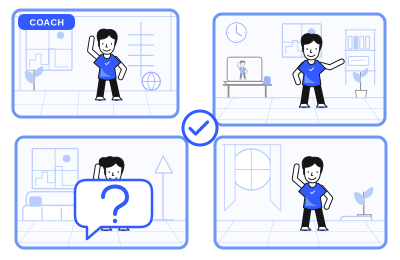
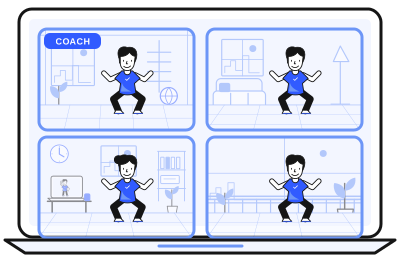
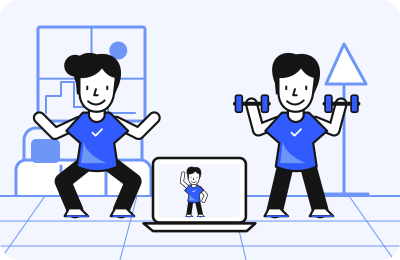
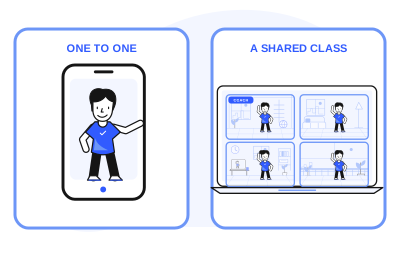
Both formats of online fitness coaching at MakeMyFitness are live: a certified coach is on a Google Meet call in real time, and nothing is pre-recorded. The difference is who the coach is watching. In a one-to-one session it is only you, for 45 minutes. In a group class, one coach leads a small group through the same workout and shares their attention across everyone on the call. Almost every other difference follows from that.
| One-to-one (1:1) | Group class | |
|---|---|---|
| Coach's attention | All of it, on you, for 45 minutes | Shared across the group |
| Form correction | Every rep, with camera angles set per exercise | Live cues to the group, plus individual cues where the coach sees a problem |
| Plan | Built around your goal, history, equipment and how you feel that day | One workout for everyone, with easier and harder options |
| Equipment | Whatever you have, at home or at your own gym | Bodyweight only |
| Social side | Just you and the coach | Train alongside other people, or with friends you bring |
| Price at MakeMyFitness | ₹799 at your gym, ₹899 at home | ₹499 per person |
| 4-week plan (12 sessions) | ₹7,070 (gym) or ₹8,080 (home) | ₹4,040 per person |
Neither format is better for everyone. The useful question is which one fixes the thing most likely to stop you making progress: poor technique, a plan that doesn't fit you, or simply not turning up.
Attention and form correction: where one-to-one wins

In a one-to-one online session your coach asks you to move the phone side-on for a squat, then to 45 degrees for a lunge, so they can see your knees, hips and back on every rep. They hear your breathing, see when a set is slowing down and change the next set on the spot. If something twinges, the session changes direction. That is what you pay the higher price for.
Supervision has measurable value, mostly for strength. An exploratory meta-analysis by Fisher and colleagues (2022) compared supervised with unsupervised resistance training across 12 studies and found a moderate advantage for supervision on strength, with little difference in body composition. A 2024 review in Sports Medicine of 34 trials in adults over 60 found that supervised exercise improved knee strength more than unsupervised exercise, while attendance was similar (about 81%) in both.
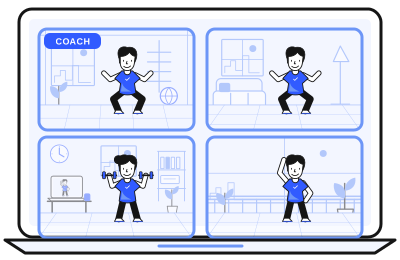
A live group class is still supervised: the coach demonstrates each round, watches the group and gives live cues as you train. It is a long way from following a recorded video. But a coach watching several small video tiles cannot check every rep for every person, and the camera angle is set for the whole class rather than for your weakest movement. If you have never been taught a squat or a hinge, or you are coming back from a niggle, that difference matters most in the first few weeks.
Programming: a plan for you or a class for everyone
One-to-one training is programmed for one person. Your coach plans around your goal (fat loss, muscle, strength, mobility), your injury history, the kit you own or the machines at your gym, and how you slept. Weights and reps are tracked week to week, so the plan moves when you do. At the gym that means heavier compound lifts; at home it might be dumbbells, bands or nothing at all. See Personal Gym Training and Personal Home Training.
A group class is programmed for the room. Everyone does the same HIIT, strength or mobility workout at the same time, and the coach offers an easier and a harder version of each exercise so a beginner and a regular can share a class. Classes are designed to work with just your bodyweight. That suits general fitness, fat loss and routine well. It is less suited to a specific target, such as your first full push-up by a certain date or building leg strength with heavier loads, because the class can't progress at your exact pace. Our guide to live online HIIT and strength classes describes what a class is like from start to finish.
Motivation and social support: what the research on group exercise says
The strongest argument for group training is that people keep coming back. The evidence is real but more nuanced than gyms usually admit.
- Cohesive groups beat standard classes. A 2006 meta-analysis by Burke, Carron, Eys, Ntoumanis and Estabrooks pooled 44 studies (214 effect sizes) across outcomes including adherence. Exercising in a “true group”, a class run deliberately to build team spirit, was superior to a standard exercise class. Standard classes did not differ from home exercise with contact from a professional, and home exercise with contact beat home exercise with none.
- Group and individual approaches both work. A 2026 update in Nature Human Behaviour by Kritz and colleagues analysed 71 studies (523 effect sizes), including technology-based and virtual programs. Group-based interventions showed small advantages for physical activity, psychosocial and health outcomes that were not statistically significant, and a significant small advantage for functional outcomes such as strength and flexibility. The authors concluded that both individual and group-based approaches, in person or online, may be effective.
- Group classes may lift mood. In a small, non-randomised 12-week study of 69 medical students published in 2017, those who took group fitness classes reported lower perceived stress and better physical, mental and emotional quality of life, while students who exercised alone showed no significant change in most measures.
- Company helps people stick with it. In a 1999 trial of 166 people in a weight-loss program, 95% of those who joined with friends and were given social-support strategies completed treatment, against 76% of those who joined alone. Two-thirds (66%) of the friends group kept all their weight off over the next six months, against 24% of the solo group.
What this means in practice: a group helps most when it feels like a group, with the same faces, a regular time and a coach who knows your name. A one-to-one session gives a different kind of accountability: a specific person is waiting for you at a fixed time and will notice if you skip. Consistency is what builds the habit either way. A 2015 study by Navin Kaushal and Ryan Rhodes in the Journal of Behavioral Medicine followed 111 new gym members for 12 weeks and found that exercising at least four times a week for six weeks was the minimum needed to establish an exercise habit in that group, with consistency the strongest predictor.
Personal training vs group training: cost per session and per month
These are MakeMyFitness prices, the same in every city, checked against our pricing page in October 2026. One-to-one sessions last 45 minutes. A 4-week plan is 12 sessions, three a week, paid once with nothing renewing by itself.
| Program | One session | 4-week plan (12 sessions) | Per session on the plan |
|---|---|---|---|
| Personal Gym Training1:1, 45 minutes | ₹799 | ₹7,070 | about ₹589 |
| Personal Home Training1:1, 45 minutes | ₹899 | ₹8,080 | about ₹673 |
| Rehab & Recovery1:1, once a doctor or physio has cleared you | ₹1,299 | ₹12,121 | about ₹1,010 |
| Group ClassesPer person, small group | ₹499 | ₹4,040 | about ₹337 |
On a plan, a group class costs about half as much per session as one-to-one training: about ₹337 against ₹589 at the gym or ₹673 at home. Over four weeks, the group plan is ₹3,030 cheaper than the gym plan and ₹4,040 cheaper than the home plan.
| Sessions a week | 1:1 at your gym | 1:1 at home | Group class |
|---|---|---|---|
| 2 a week, booked one at a time (8 sessions) | ₹6,392 | ₹7,192 | ₹3,992 |
| 3 a week, booked one at a time (12 sessions) | ₹9,588 | ₹10,788 | ₹5,988 |
| 3 a week on the 4-week plan (12 sessions) | ₹7,070 | ₹8,080 | ₹4,040 |
If you train three times a week, the plan saves ₹2,518 at the gym, ₹2,708 at home and ₹1,948 on group classes compared with booking one session at a time. Work out your own schedule below, and see how online prices compare with gym-floor and home-visit trainers in our personal trainer fees guide.
Which program?
How many sessions a week?
Rupees for your month on 4-week plans
- 12 live sessions a month, about ₹673 each on a plan.
- ₹10,788 if you pay ₹899 per session instead.
- No subscription. A plan is 12 sessions to use within 6 weeks of the first, so at two a week it simply lasts longer.
Turn your number into a plan
A good place to start: Personal Home Training
Book one session first and see what a live coach is like before you commit to a plan.
Who one-to-one online training suits
- Complete beginners who need each movement taught from scratch. Our guide for online personal training for beginners explains the first month.
- People with a specific goal, such as building muscle, getting stronger on the big lifts or a date-bound target. See strength training and muscle building.
- Anyone with a gym membership but no plan, who wants a coach to plan every set around their gym's equipment.
- People returning after a break, or with an old injury that a doctor or physiotherapist has cleared. If you are coming back from a specific injury, Rehab & Recovery is one-to-one coaching built on their advice.
- Anyone self-conscious on camera in front of other people. Nobody else is on a one-to-one call.
- Irregular schedules. One-to-one slots run from 6 AM to 8 PM India time, every day, and can be moved with notice.
Who group fitness classes suit
- People who already move reasonably well and mainly need routine, structure and a reason to show up.
- Anyone motivated by company. You can join on your own, or bring friends, family or colleagues to the same class. See online fitness classes for couples and friends.
- Tighter budgets. At ₹499 a class, or about ₹337 on a plan, it is the lowest price per session we offer.
- General fitness and fat loss. HIIT, strength and mobility classes three times a week, paired with a modest calorie deficit, cover what most people need. See fat loss.
- No equipment. Classes are designed for bodyweight only, so a mat's worth of floor is enough.
Mixing one-to-one and group classes in a week
You don't have to choose one format forever. Many people learn technique one-to-one and then use group classes for volume and company. The two fit together naturally: the one-to-one session teaches and adjusts, and the classes keep you moving on the other days. Here is what some common mixes cost over four weeks, using single-session prices for one-to-one and either single or plan prices for classes.
| Weekly mix | Sessions in 4 weeks | Cost for 4 weeks | Good for |
|---|---|---|---|
| 1 home 1:1 + 2 group classes | 12 | ₹7,588 (4 × ₹899 + 8 × ₹499) | Beginners who want a weekly technique check |
| 1 gym 1:1 + 2 group classes | 12 | ₹7,188 (4 × ₹799 + 8 × ₹499) | Gym-goers who lift with a coach and do conditioning in class |
| Group plan + 1 home 1:1 every other week | 14 | ₹5,838 (₹4,040 + 2 × ₹899) | Fit people who want occasional form checks |
| First 2 weeks 1:1 at home, then group classes | 12 | ₹8,388 (6 × ₹899 + 6 × ₹499) | Learning the basics, then moving to classes |
- 1
Start with one session
Book a single one-to-one session first. It doubles as an assessment: your coach sees how you move and tells you honestly whether you're ready for classes. Read what happens in your first session.
- 2
Keep the hard skills in the one-to-one slot
Use the one-to-one session for whatever needs watching most: new lifts, heavier loads, an exercise that keeps going wrong.
- 3
Use classes for frequency
Classes on the other days add conditioning and mobility at about half the price, and keep you on a fixed timetable.
- 4
Review after four weeks
If your technique is solid and you are turning up, shift more of the week to classes. If you are stuck or sore, shift back.
Not sure how many sessions you need at all? Our guide on how many days a week to work out covers it, and the WHO's 2020 guidelines ask adults for 150 to 300 minutes of moderate activity a week plus muscle-strengthening on 2 or more days.
Sources
- The role of supervision in resistance training: an exploratory systematic review and meta-analysis (2022), Fisher J, et al., International Journal of Strength and Conditioning
- Supervised versus unsupervised exercise for the improvement of physical function and well-being outcomes in older adults: a systematic review and meta-analysis (2024), Gómez-Redondo P, et al., Sports Medicine
- Group versus individual approach? A meta-analysis of the effectiveness of interventions to promote physical activity (2006), Burke SM, Carron AV, Eys MA, Ntoumanis N, Estabrooks PA, Sport & Exercise Psychology Review, via University of Birmingham
- Individual versus group-based interventions: a systematic review and meta-analysis of physical activity, functional, psychosocial and health outcomes (2026), Kritz M, et al., Nature Human Behaviour, via York St John University repository
- Effects of group fitness classes on stress and quality of life of medical students (2017), Yorks DM, Frothingham CA, Schuenke MD, Journal of the American Osteopathic Association, via PubMed
- Benefits of recruiting participants with friends and increasing social support for weight loss and maintenance (1999), Wing RR, Jeffery RW, Journal of Consulting and Clinical Psychology, via PubMed
- Exercise habit formation in new gym members: a longitudinal study (2015), Kaushal N, Rhodes RE, Journal of Behavioral Medicine, via Springer Medicine
- World Health Organization 2020 guidelines on physical activity and sedentary behaviour, British Journal of Sports Medicine
Written by the MakeMyFitness team from the sources above. First published , last updated . Spotted something out of date? Tell us at hello@makemyfitness.com.