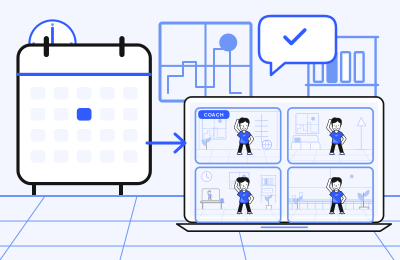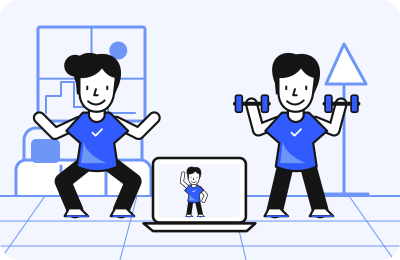
The best ways for couples and friends to train together online
“Best” here means the set-up that keeps both of you training, not a ranking of apps or companies. For two people, or a group of friends, there are four realistic ways to train together with a live coach online. They differ in how much attention each person gets, how much time you actually spend together and what it costs.
| Set-up | How it works | Cost for two, 4 weeks | Best for |
|---|---|---|---|
| A live group class together | Both of you join the same live class, from one room or two cities | ₹8,080 (₹4,040 plan each) | Couples and friends who want shared workouts and a fixed routine |
| Each partner on their own 1:1 | Separate 45-minute sessions, each planned for one person | ₹16,160 at home (₹8,080 each) | Different goals, injuries or very different levels |
| Alternating days | One partner trains 1:1 while the other covers kids, cooking or work, then you swap | ₹16,160 at home, or ₹14,140 at your gym | Parents and busy households who can't both stop at once |
| Mix: classes together, 1:1 apart | Two shared classes a week, plus one 1:1 each | ₹15,176 at home (₹7,588 each) | Couples where one or both want weekly form checks |
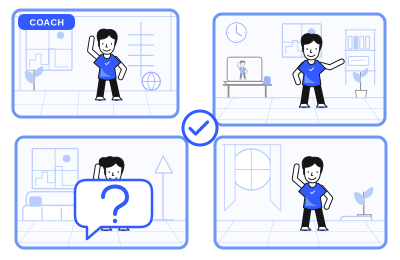
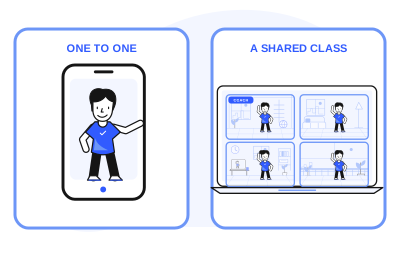
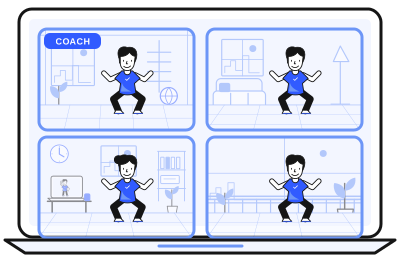
For most couples the shared group class is the natural fit, because it is the only set-up where you actually work out side by side with a coach on the call. Group Classes are priced per person at ₹499 a class, or ₹4,040 for a 4-week plan of 12. One-to-one sessions are planned and priced for one person each; our price list has no couples rate, so if you both want coaching on the same call, book a group class each.
Why working out with a partner helps you keep going: the evidence
The reason to train with your partner or a friend isn't romance. It's that people who train with someone they know tend to keep training. The research is consistent, though most of it comes from small or observational studies rather than large trials.
- When one partner gets active, the other often follows. A 2015 study in JAMA Internal Medicine followed 3,722 married or cohabiting couples aged 50 and over in England. Among people who were inactive at the start, 67% of men and 66% of women became more active when their partner also did, against 26% and 24% when their partner stayed inactive. A partner who newly changed had a bigger effect than one who had always been active.
- Couples who join together drop out less. A small 1995 study of a university fitness program compared 16 married couples who joined together with 30 married people who joined without their spouse. Over 12 months, the couples attended 54.2% of sessions a month on average against 40.3%, and 6.3% dropped out against 43.0%. Self-motivation didn't differ between the groups, so the authors credited spousal support.
- Friends help with weight loss too. In a 1999 trial of 166 people, those who joined a weight-loss program with three friends or family members and received social-support strategies completed treatment more often (95% against 76% for people who joined alone without them), and 66% kept all their lost weight off over the following six months, against 24%.
- A slightly stronger partner can make you persist longer. In a 2011 study by Feltz, Kerr and Irwin, people holding planks in an exercise game kept going longer when paired with a virtual partner who was always a little better than them, in every partner condition tested, than when exercising alone. Psychologists call this the Köhler effect: nobody wants to be the weak link.
- Groups help most when they feel like a team. A 2006 meta-analysis of 44 studies found that classes run to build group spirit outperformed standard exercise classes. A 2026 review of 71 studies, including virtual programs, found group-based programs had small advantages over individual ones that were mostly not statistically significant, and concluded that both approaches, in person or online, can work.
Put plainly: training with a partner makes it more likely you'll both keep going, and the effect is strongest when you start together. It won't do the work for you, and it can backfire if one person's schedule keeps cancelling both. The fix for that is in the set-up, below.
Couple workout online: setting up two people in front of one camera
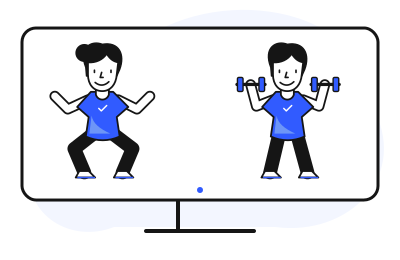
Training side by side in the same room is the most fun way to do a couple workout online, but a camera framed for one person won't show two. This set-up lets the coach see both of you from head to toe. Each of you still books and pays for your own place in the class; tell us in the booking questions that you'll share one screen and how many of you there are, so your places are arranged together.
- 1
Clear twice the floor
One person needs about two by two metres. For two, put two mats side by side with at least an arm's length between them, so nobody clips the other on a lunge or a twist.
- 2
Move the camera back
Put the phone or laptop further away than you would for one person, at about hip height, until both of you fit head to toe with a little space above your heads. Turn the phone to landscape so you both fit across the frame.
- 3
Light from the front
Face a window or a lamp rather than standing with one behind you, so the coach can see both of you clearly rather than as silhouettes.
- 4
One device, one sound source
Join the call on one device. Two phones in the same room on the same call usually cause echo, so if you each want your own screen, train in separate rooms.
- 5
Say who's who
At the start, tell the coach which of you is on the left and anything they should know about each of you, such as a stiff knee or a first class.
- 6
Two rooms if the space is small
If your living room only fits one mat, join from two rooms on two devices. You'll still be in the same live class and can see each other on screen.
Matching different fitness levels when you train together
Most couples and friends are not equally fit, and that's the biggest reason partner workouts fall apart: one person is bored, the other is overwhelmed. Here's how to keep it working for both.
- Use the options, not the same version. Every exercise in a MakeMyFitness class has an easier and a harder version. One of you can do incline push-ups on a sofa while the other does full push-ups, in the same round and the same time.
- Match effort, not numbers. Agree that both of you finish each round at a similar effort, around the point where talking gets hard, rather than doing the same reps.
- Let the Köhler effect work, gently. Training next to a slightly fitter partner can help the other person push longer. Keep it to a small gap. If the gap is large, the less fit partner should take the easier option and nobody should race.
- Don't copy each other's weights. In any exercise with a load, each of you uses what you can control for every rep.
- Book separate 1:1 sessions if the gap is big. If one of you is a complete beginner, is coming back from an injury or has a health condition, a few one-to-one home sessions first make shared classes far more comfortable. People returning after an injury who have been cleared by a doctor or physio can use Rehab & Recovery.
Partner workout at home: exercises for two
You don't need equipment for a partner workout at home. These exercises work well for couples and friends, either on your own or between classes. The first rule of every partner exercise: the weaker or less steady person sets the pace.
| Exercise | How to do it together | Easier | Harder |
|---|---|---|---|
| Hand-hold squat | Face each other, hold forearms, squat together using each other as a counterweight | Squat to a chair behind you | Pause for 3 seconds at the bottom |
| High-five push-up | Face each other in push-up position; after each rep, one high-fives the other | From the knees, or hands on a sofa | Alternate hands each high-five |
| Mirror lunge | Face each other and lunge back at the same time, one on the left leg, one on the right | Hold a wall or chair | Slow 3-second lowering |
| Plank shoulder taps | Face each other in a plank and tap your own opposite shoulder in time | Plank on the knees | Tap your partner's hand instead |
| Back-to-back wall sit | Stand back to back, walk feet forward and lower together until you hold a sitting position | Use a real wall and sit higher | Hold longer, 30 to 60 seconds |
| Feet-together bridge | Lie with feet touching your partner's, lift your hips together | Smaller lift | One leg at a time |
| Towel row hold | Hold a rolled towel between you, lean back gently and squeeze your shoulder blades | Lean back less | Hold longer |
Do them as a circuit: 40 seconds on, 20 seconds rest, three rounds, with a 5-minute warm-up of marching, arm circles and easy squats first. For more home routines, see our guides to a home workout plan for beginners and resistance band workouts at home.
Workout with friends online: different homes, one class
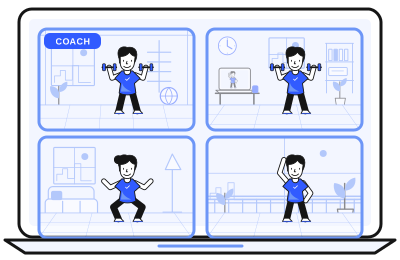
You don't need to live together to train together. Friends, siblings and colleagues can join the same live class from different homes, different cities or even abroad, because every class runs on a video call in India time, between 6 AM and 8 PM. Tell us who you're joining with and how many of you there are in the booking questions so your places are arranged together. A standing class three times a week works well for friends who used to meet at a gym or a park and have since scattered.
Office teams can do the same: colleagues working from home or the office join one live workout, with no venue or equipment. What a class actually looks like, minute by minute, is in our guide to live online HIIT and strength classes.
Training together before a wedding
Many couples start training together in the months before a wedding, which is a good time to build a habit you'll both keep afterwards. Plan for steady change rather than a crash: our pre-wedding workout plan sets out a realistic 12 to 24-week plan with strength sessions, walking and food. Shared group classes three times a week plus a daily walk together covers most of it, alongside the eating habits on our fat loss page, and if either of you wants more individual attention before the big day, add one-to-one sessions on the other days.
What online fitness classes for couples cost
All MakeMyFitness prices are per person and the same in every city, checked against our pricing page in October 2026. You pay once, by a secure link, with no contract and nothing that renews by itself.
| Option | Per person | For two people |
|---|---|---|
| One live group class | ₹499 | ₹998 |
| Group Classes, 4-week plan (12 classes) | ₹4,040 (about ₹337 a class) | ₹8,080 |
| Personal Home Training 1:1, one session | ₹899 | ₹1,798 (two separate sessions) |
| Personal Home Training 1:1, 4-week plan | ₹8,080 | ₹16,160 |
| Personal Gym Training 1:1, 4-week plan | ₹7,070 | ₹14,140 |
If you're not sure which suits you, start with one group class each; how live online fitness coaching works in general is explained on its own page. If one of you wants to learn the basics first, a single first session one-to-one shows how coaching over video works. The trade-offs between the two formats are covered in one-on-one vs group online fitness classes.
Sources
- The influence of partner's behavior on health behavior change: the English Longitudinal Study of Ageing (2015), Jackson SE, Steptoe A, Wardle J, JAMA Internal Medicine, via PubMed
- Twelve month adherence of adults who joined a fitness program with a spouse vs without a spouse (1995), Wallace JP, Raglin JS, Jastremski CA, Journal of Sports Medicine and Physical Fitness, via PubMed
- Benefits of recruiting participants with friends and increasing social support for weight loss and maintenance (1999), Wing RR, Jeffery RW, Journal of Consulting and Clinical Psychology, via PubMed
- Buddy up: the Köhler effect applied to health games (2011), Feltz DL, Kerr NL, Irwin BC, Journal of Sport and Exercise Psychology, via PubMed
- Group versus individual approach? A meta-analysis of the effectiveness of interventions to promote physical activity (2006), Burke SM, Carron AV, Eys MA, Ntoumanis N, Estabrooks PA, Sport & Exercise Psychology Review, via University of Birmingham
- Individual versus group-based interventions: a systematic review and meta-analysis of physical activity, functional, psychosocial and health outcomes (2026), Kritz M, et al., Nature Human Behaviour, via York St John University repository
Written by the MakeMyFitness team from the sources above. First published , last updated . Spotted something out of date? Tell us at hello@makemyfitness.com.