What can exercises to reduce chest fat actually do?
Exercises to reduce chest fat usually means two things: training the muscles of the chest and trying to reduce body fat. Those are related goals, but they are not the same process. A press or push-up directly challenges your chest and arms. It does not let you select the layer of fat above those muscles as the place your body must lose weight.
Use chest work within a complete routine rather than repeatedly adding push-ups to every day. Include your legs and back, choose regular aerobic activity, and review food habits if overall fat loss is appropriate for you. The CDC's weight-management guidance explains the role of activity and food intake together. No chest exercise can guarantee a particular shape or a timetable for changing it.
This guide gives generally healthy adults a practical starting framework. It does not diagnose why someone's chest looks the way it does. You can want a stronger chest without needing to lose weight, and you can train consistently without your appearance matching a reference photo. Choose a goal you can act on, such as learning a controlled incline push-up, alongside any longer-term body-composition goal.
Chest fat and gynaecomastia are not the same thing
Cleveland Clinic distinguishes excess chest fat from gynaecomastia, an increase in glandular breast tissue in males. The two can coexist. General weight loss may change fatty tissue, but exercise is not a reliable treatment for glandular enlargement. Do not use a photograph, a pinch test or a workout result to diagnose the difference yourself.
If a medicine might be involved, discuss it with the prescriber rather than stopping it yourself. A fitness coach can adapt exercise around appropriate guidance but cannot decide whether enlargement is fat, glandular tissue or something else. If you already have a diagnosis, follow the clinician's advice about activity. The training routine below is general exercise guidance, not a treatment plan for gynaecomastia.
Choose one chest exercise you can control
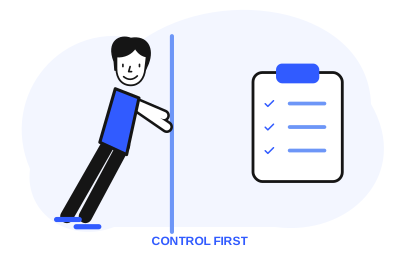
For your first sessions, choose one push-up or press variation. You do not need wall push-ups, incline push-ups, floor push-ups and dumbbell presses all in the same workout. Start with one or two manageable sets, resting between them, and stop while another couple of good repetitions would still be possible. The suggested repetition ranges are starting options, not a test you must pass.
- 1
Wall push-up: start with 6 to 10 repetitions
Place your hands on a wall around chest height, slightly wider than your shoulders. Step back a comfortable distance. Bend your elbows and bring your body towards the wall, then press away without letting your hips move first. Keep the elbows in a comfortable diagonal position rather than forcing them straight out to the sides. Move closer if the set feels too difficult.
- 2
Incline push-up: an alternative when the wall is easy
Use a fixed counter or a stable exercise bench that cannot slide. Set your hands, step back and keep your trunk steady as you lower and press. Begin with a high support and a modest range. A lower surface adds difficulty, so only lower it when the current setup feels controlled. Avoid wheeled chairs, folding tables and unsecured furniture.
- 3
Dumbbell floor press: an option with suitable weights
Lie on a mat with knees bent and light dumbbells held securely above your chest. Lower slowly until your upper arms gently meet the floor, then press up without banging the weights together. Keep wrists comfortable and avoid forcing the elbows wide. Use weights you can safely get into and out of position; ask for help learning the setup before progressing.
- 4
Chest-press machine: an option at your gym
Ask a trainer to help set the seat so the handles start at a comfortable chest height. Begin with a light setting, keep your back supported and press through a range that feels smooth. Return the handles slowly rather than letting the weight stack drop. Record the machine and seat setting so you can reproduce the movement next time.
Normal muscular effort is different from sharp pain. If a push or press irritates your shoulder, elbow or wrist, shorten the range or use an easier option. If discomfort persists, stop that exercise and get individual advice. You do not need to prove that you can do a floor push-up before you are allowed to use a machine or a wall.
Train the back and legs in the same session
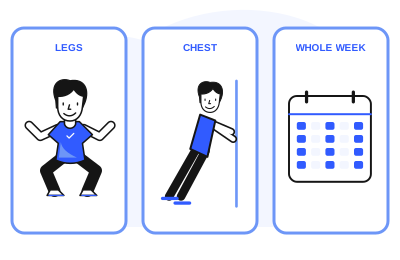
A balanced session gives chest training a sensible place in the week. Choose a pull, a squat and a hip movement alongside your press. A review of resistance-based exercise supports resistance training during weight loss, including its role in retaining lean mass. The aim here is broad strength development rather than repeatedly exhausting one visible area.
| Movement | Starting option | Suggested practice |
|---|---|---|
| Squat | Sit-to-stand from a stable chair | 6 to 10 controlled repetitions |
| Push | One of the push-up or press options above | 6 to 10 controlled repetitions |
| Pull | Supported dumbbell row or seated cable row | 8 to 12 repetitions; each side for a single-arm row |
| Hip movement | Glute bridge or an unloaded hip hinge | 8 to 12 controlled repetitions |
| Core | Wall plank | A short hold while breathing normally |
Warm up with easy movement and practice repetitions before starting the working sets. Rest long enough to repeat the next set with control. The fat loss exercises guide explains the squat, hinge and row in more detail, while the dumbbell workout at home offers an equipment-based routine. Use one coherent session rather than joining several complete workouts together.
If you only have a short window, keep a small amount of each major movement instead of spending the whole session on presses. Write down what you did. That makes it easier to balance the next session and notice whether pushing is progressing while the rest of the routine is being neglected. A training log can be a note on your phone; it does not need a complicated spreadsheet.
A weekly routine that includes cardio and recovery
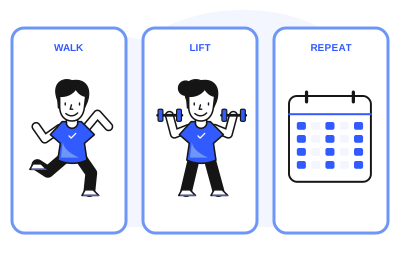
The CDC recommends at least two strengthening days and 150 minutes of moderate aerobic activity weekly for adults. The example below has two full-body sessions and 150 minutes of planned brisk walking. It is something to build towards gradually. If you are starting from little activity, shorter sessions still give you a useful place to begin.
| Day | Plan |
|---|---|
| Monday | Full-body strength, including one chest exercise, plus a 15-minute brisk walk |
| Tuesday | 30-minute brisk walk or comparable moderate cardio |
| Wednesday | 20-minute brisk walk |
| Thursday | Full-body strength, including one chest exercise, plus a 15-minute brisk walk |
| Friday | 30-minute brisk walk or comparable moderate cardio |
| Saturday | 40-minute brisk walk, split into shorter outings if preferred |
| Sunday | Rest or comfortable easy movement |
You can use cycling instead of walking if you prefer it and can match an appropriate moderate effort. Do not add hard cardio as a penalty for missing a strength day. Resume the planned week and adjust the schedule if the same conflict keeps occurring. For chest training, consistency with a manageable load is more useful than doing a large catch-up session that leaves you avoiding movement afterwards.
Progress the exercise, not the promise
Use a simple progression rule: when all your planned sets reach the upper end of the repetition range with control, make the smallest sensible change. For wall push-ups, that might be a slightly greater distance from the wall. For an incline, it might eventually be a lower stable support. For a machine or dumbbells, use the smallest available load increase and return to fewer repetitions if needed.
Keep the exercise recognisable as it becomes harder. If you shorten every repetition, shrug your shoulders or bounce to finish, the new version may be premature. Return to the previous setup and practise there. Keep your back and leg movements progressing too. Stronger presses are a clear training outcome; a promised number of centimetres off your chest is not something an exercise plan can honestly guarantee.
Eating habits and chest fat loss
If reducing overall body fat is appropriate for you, review the meals and snacks that make up an ordinary week. Keep meals satisfying and familiar, with a suitable protein source and other foods you enjoy. The high-protein vegetarian Indian diet guide can help if you rely on vegetarian meals. You do not need a special chest-fat diet or a supplement sold for one body part.
Avoid cutting food more aggressively because your chest changes slowly. Your appearance is not a precise measure of whether today's meal or workout was right. If you are already lean or have unexplained breast enlargement, pursuing more weight loss may not answer the underlying concern. Discuss that concern with a clinician rather than repeatedly lowering your food intake.
Measure useful progress and know when to ask for help
- Track the variation, load and repetitions of your chest exercise. Better control at the same setup is progress.
- Keep a record of walking and whole-body training so the chest goal does not crowd out everything else.
- If body measurements or photos help you, use similar conditions and compare over longer intervals. Skip them if they encourage constant checking or distress.
- Take persistent pain, a lump, discharge or other unusual breast changes to a clinician. A training log cannot rule out a medical cause.
There is no fixed deadline by which this routine must change your chest. Review whether it is making you stronger, more active and able to train consistently. If you want feedback on pressing technique, a coach can observe the movement and adjust the exercise. If you want to understand a breast change, the right next step is medical assessment, even if you are also working on fitness.
Sources
- Gynaecomastia, NHS
- Gynecomastia: What It Is, Causes, Diagnosis and Treatment, Cleveland Clinic
- Physical Activity and Your Weight and Health, Centers for Disease Control and Prevention
- Adult Activity: An Overview, Centers for Disease Control and Prevention
- Resistance training effectiveness on body composition and body weight outcomes (2022), Obesity Reviews / Edith Cowan University
Written by the MakeMyFitness team from the sources above. First published , last updated . Spotted something out of date? Tell us at hello@makemyfitness.com.