What does exercise do to blood sugar in type 2 diabetes and prediabetes?
Exercise makes your muscles take glucose out of the blood with less insulin, and the effect outlasts the session. The 2022 consensus statement on exercise and type 2 diabetes from the American College of Sports Medicine (Kanaley et al.) states that improvements in insulin sensitivity after any physical activity can last from 2 to 72 hours, with the fall in blood glucose closely tied to how long and how hard you moved. That is why every major guideline asks for activity on most days rather than one long weekend session.
Over months the effect shows in HbA1c, the three-month average of blood sugar. The American Diabetes Association's Standards of Care in Diabetes 2025 state that structured exercise of at least 8 weeks has lowered HbA1c by 0.66% on average in people with type 2 diabetes, even without a significant change in BMI. The ACSM puts regular aerobic training at 0.5 to 0.7%, and the 2016 ADA position statement (Colberg et al.) reports that resistance training improved HbA1c by 0.57%. These are study averages, not a promise: your own change depends on where you start, what you eat, what your doctor has prescribed and how consistently you train.
For prediabetes the evidence is about risk. The 2016 ADA statement summarises lifestyle trials with 150 to 175 minutes a week of activity and 5 to 7% weight loss as cutting the risk of developing type 2 diabetes by 40 to 70% in people with impaired glucose tolerance, and the ACSM notes that in the Diabetes Prevention Program people who met the activity goal but not the weight-loss goal still had a 44% lower incidence.
Who should see a doctor before starting exercise with diabetes?
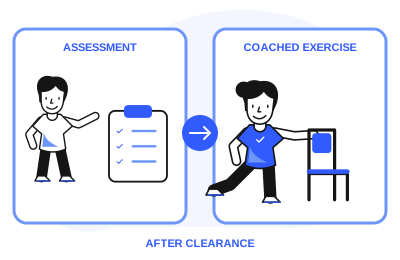
The ADA's 2016 position statement and the ACSM agree that a person with diabetes who has no symptoms does not need a medical check before low to moderate activity such as brisk walking, but the ACSM asks currently sedentary adults to get clearance before moderate to high intensity exercise, and the ICMR-NIN Dietary Guidelines for Indians 2024 advise anyone with a chronic disease such as diabetes to consult a physician before taking up an exercise program. The ADA lists what the doctor should look for: uncontrolled high blood pressure, untreated proliferative retinopathy, autonomic neuropathy, dizziness on standing, peripheral neuropathy, poor balance and a history of foot ulcers.
MakeMyFitness coaches are fitness coaches, not doctors, dietitians or physiotherapists. We follow the limits your doctor gives you, and Rehab & Recovery is exercise coaching after a clinician has cleared you, not treatment. Our personal trainer vs physiotherapist guide explains the difference, and our medical disclaimer sets out what we do and do not do.
How much exercise per week for type 2 diabetes?
The target is 150 minutes a week of aerobic activity, two or three strength sessions, and far less sitting. ADA recommendation 5.35 (2025) asks most adults with type 2 diabetes for 150 minutes or more of moderate to vigorous aerobic activity a week, spread over at least 3 days, with no more than 2 consecutive days without activity; 5.36 adds 2 to 3 resistance sessions a week on non-consecutive days; 5.37 recommends flexibility and balance training 2 to 3 times a week for older adults; and 5.38 says prolonged sitting should be interrupted at least every 30 minutes. Fitter people may manage on 75 minutes a week of vigorous or interval training.
| Guideline | Aerobic activity | Strength | Sitting |
|---|---|---|---|
| ADA 2025 | 150+ min/week, 3+ days, never 2 days off in a row | 2–3 sessions/week, non-consecutive | Break every 30 min |
| ACSM 2022 | 150–300 min/week moderate or 75–150 vigorous | 8–10 exercises, 10–15 reps, 1–3 sets, 2–3 days/week | 3 min of light walking or simple resistance moves every 30 min |
| ICMR-NIN 2024 | 30–60 min moderate on 5+ days/week | All muscle groups, 2+ days/week | Stand every half hour |
| NHS | 2.5 hours a week that leaves you out of breath | Not specified | Not specified |
The two-day rule exists because, as the ACSM puts it, the improvement in insulin action after exercise is transient. Moderate intensity means you can talk but not sing; brisk walking, cycling on the flat, swimming and dancing all count. The ADA notes that many people with type 2 diabetes do not reach 150 minutes a week, so start with 10-minute walks and build up. Pace and step targets are in our walking for weight loss guide.
Does walking after meals lower blood sugar?
Yes. A short walk after eating lowers the post-meal rise in blood glucose more than the same walking done at another time. In a randomised crossover study of 41 adults with type 2 diabetes published in Diabetologia in 2016 (Reynolds et al.), advice to walk 10 minutes after each main meal produced post-meal glucose 12% lower than advice to walk 30 minutes once a day, and the effect was largest after the evening meal, where post-meal glucose was 22% lower. Everyone walked 30 minutes a day in both periods; only the timing changed.
Breaking up sitting works the same way. A 2022 meta-analysis in Sports Medicine (Buffey et al.) of seven trials found that interrupting prolonged sitting with light walking cut post-meal glucose (effect size 0.72) and insulin (0.83) compared with staying seated, and beat standing breaks. The ACSM's summary: post-meal exercise blunts the glucose spike whatever the intensity or type, with sessions of 45 minutes or more giving the most consistent benefit, while fasted morning interval sessions sometimes raised glucose in men with type 2 diabetes. If you train before breakfast, check how your own readings respond.
Why does strength training matter in diabetes?
Muscle is where most of the glucose from a meal ends up, so more muscle, used regularly, means more places for sugar to go. The ACSM reports that resistance training in adults with type 2 diabetes typically produces 10 to 15% improvements in strength, bone density, blood pressure, lipids, muscle mass and insulin sensitivity, that combining it with modest weight loss may reduce HbA1c three-fold more in older adults than diet alone, and that combined aerobic and resistance training may lower HbA1c more than either alone.
The ACSM prescription is specific: 8 to 10 exercises covering the major muscle groups, 10 to 15 repetitions per set, 1 to 3 sets, on 2 to 3 non-consecutive days a week at 50 to 69% of your one-repetition maximum, increasing the weight first, then sets, then days. Bands and body weight qualify, so a resistance band workout at home counts as much as a gym session. ICMR-NIN adds that regular strength training is necessary to maintain muscle mass. Our strength training goal page explains how we progress loads.
A 7-day diabetes workout plan at home or at the gym
This plan gives about 165 minutes of aerobic activity, three strength sessions on non-consecutive days and a walk after dinner every day, so no day is inactive. It assumes your doctor has agreed to moderate exercise. Start at the low end of every range. Readers over 60 can use the strength routine in our exercise for seniors at home guide.
- 1
Day 1: strength A, 35 to 40 minutes
Home: chair squats, hip hinge holding a filled backpack, incline push-ups on a table, band or towel rows, glute bridges, dead bugs; 2 sets of 10 to 15. Gym: leg press, seated row, chest press, lat pulldown, leg curl, cable crunch; 2 sets of 10 to 15. Walk 10 minutes after dinner.
- 2
Day 2: aerobic, 30 minutes
Home: three brisk 10-minute walks, one after each meal. Gym: 30 minutes on the treadmill, cycle or cross-trainer at a pace where you can talk in short sentences.
- 3
Day 3: strength B, 35 to 40 minutes
Home: step-ups on the lowest stair, split squats holding a wall, band shoulder press, band pull-aparts, farmer's carry with two water cans, side plank. Gym: goblet squat, Romanian deadlift with light dumbbells, dumbbell shoulder press, one-arm row, hip thrust, pallof press. Walk 10 minutes after dinner.
- 4
Day 4: aerobic plus balance, 30 to 35 minutes
A 25-minute walk, cycle or cardio machine, then 10 minutes of balance work: tandem stance, single-leg stand holding a chair, heel-to-toe walking along a line.
- 5
Day 5: strength C, 35 to 40 minutes
Repeat Day 1 and add one repetition per set, or a third set once two sets have felt easy for two weeks: load first, then sets, then frequency, as the ACSM advises. Walk 10 minutes after dinner.
- 6
Day 6: longer aerobic, 45 minutes
A 45-minute walk in a park, a cycle ride or a swim; at the gym, split it between two machines to spare your feet. Do it after breakfast or lunch rather than fasted.
- 7
Day 7: light day, 20 to 30 minutes
Ten-minute walks after two meals plus 10 minutes of mobility, yoga or stretching. A recovery day, not a day off: the two-consecutive-days rule means the lightest day still has movement in it.
What should I eat around exercise if I have diabetes?
Keep carbohydrate to whole grains and pulses, measure it, and pair it with protein. The ICMR-NIN guidelines recommend no more than 45% of calories from cereals and millets, added sugar of 25 g a day or less, and a protein RDA of 0.83 g per kg of body weight (about 54 g for a 65 kg adult). They warn that sugar and refined cereals have a high glycaemic index and produce a sharp rise in insulin, while fibre-rich pulses, millets, vegetables and fruit help steady blood glucose. The ADA's eating-pattern advice points the same way: non-starchy vegetables, whole fruit, legumes, lean protein, whole grains and low-fat dairy, and less sweetened drink, sweets and refined grain.
| Food (100 g, raw) | Carbohydrate (g) | Fibre (g) | Glycaemic index |
|---|---|---|---|
| Rice, raw, milled | 78.2 | 2.8 | 78 (cooked rice) |
| Wheat flour, atta | 64.2 | 11.4 | 66 (chapati) |
| Ragi (finger millet) | 66.8 | 11.2 | Not listed |
| Bajra (pearl millet) | 61.8 | 11.5 | Not listed |
| Bengal gram (chana) dal | 46.7 | 15.2 | 38 |
| Green gram (moong), whole | 46.1 | 17.0 | 42 |
| Red gram (toor) dal | 55.2 | 9.1 | 43 |
| Banana, ripe (robusta) | 23.6 | 1.9 | Not listed |
| Guava, white flesh | 5.1 | 8.6 | Not listed |
The table shows why ICMR-NIN pushes cereal-pulse mixes: wheat with chana dal has a listed glycaemic index of 32 against 78 for plain rice, and whole pulses carry three to six times the fibre of milled rice. Among breakfasts, ICMR-NIN lists pesarattu at a GI of 61, idli with sambar at 69 and plain dosa at 79, so a dal-based tiffin is the better pre-training meal. For protein, IFCT 2017 gives paneer 18.9 g, boiled egg 13.4 g and moong 22.5 g per 100 g; more options are in our high protein vegetarian Indian diet guide.
On timing: the ACSM says people whose glucose is handled through lifestyle alone have minimal risk of a low during exercise, so a normal meal two to three hours before a 30 to 45 minute session is enough, and a post-meal walk needs nothing extra. If you take insulin or sulfonylureas, the ADA notes you may need carbohydrate when pre-exercise glucose is below 90 mg/dL (5 mmol/L); ask your doctor what to carry and when to test. The NHS advises against a very strict low-calorie diet without talking to a health professional first. Find your maintenance calories with the TDEE calculator and a starting point to track with the BMI calculator.
How common are type 2 diabetes and prediabetes in India?
Very common, and prediabetes is now more common than diabetes. The ICMR-INDIAB study (Anjana et al., Lancet Diabetes & Endocrinology, July 2023) surveyed 113,043 adults aged 20 and over across 31 states and union territories and found a weighted prevalence of 11.4% for diabetes and 15.3% for prediabetes, with hypertension at 35.5%, generalised obesity at 28.6% and abdominal obesity at 39.5%. Every condition except prediabetes was more frequent in urban areas, and in many states with a lower human development index there were more people with prediabetes than with diabetes, which the authors read as an epidemic still rising in most of the country. That 15.3% is the group the lifestyle trials were run on. Our fat loss goal page explains how coaching pairs training with a modest calorie deficit; it is fitness coaching, not a diabetes-prevention program.
How does MakeMyFitness coaching fit in?
MakeMyFitness is live one-to-one fitness coaching on video across India, at ₹799 a session at your gym or ₹899 at home, and it suits adults with type 2 diabetes or prediabetes whose doctor has cleared them for moderate exercise and who want a coach to watch their form, keep the two-consecutive-days rule and progress the weights safely. Lead coach Kumar Abhishek is a certified Human Performance Nutritionist (K11) who asks about your medicines, complications and your doctor's limits before the first session and will not change any of them. If you are starting as an overweight beginner, the first weeks are built around walking, bodyweight strength and making the post-meal walk stick.
What results can you expect from exercise with type 2 diabetes?
These are study averages, not a forecast for you. The ACSM says insulin sensitivity improves for 2 to 72 hours after each bout, so a glucose meter would show the change in post-meal readings on training days first. In programs of at least 8 weeks, the ADA reports an average HbA1c reduction of 0.66%. With resistance training over months, strength, bone density, blood pressure and lipids typically improve by 10 to 15% with resistance training, according to the ACSM, even without weight loss. Your own readings may move more or less than these averages, and only your doctor can interpret them against your treatment, so keep every check-up and treat training as something you add to your care, not something that replaces it. When your doctor has cleared you, book a first session and bring the limits you were given.
Sources
- 5. Facilitating Positive Health Behaviors and Well-being to Improve Health Outcomes: Standards of Care in Diabetes 2025, American Diabetes Association, Diabetes Care (PMC)
- Exercise/Physical Activity in Individuals with Type 2 Diabetes: A Consensus Statement from the American College of Sports Medicine (Kanaley et al., 2022), Medicine & Science in Sports & Exercise (PMC)
- Physical Activity/Exercise and Diabetes: A Position Statement of the American Diabetes Association (Colberg et al., 2016), Diabetes Care (PMC)
- Advice to walk after meals is more effective for lowering postprandial glycaemia in type 2 diabetes mellitus than advice that does not specify timing (Reynolds et al., 2016), Diabetologia (PubMed)
- The Acute Effects of Interrupting Prolonged Sitting Time in Adults with Standing and Light-Intensity Walking on Biomarkers of Cardiometabolic Health (Buffey et al., 2022), Sports Medicine (PubMed)
- Metabolic non-communicable disease health report of India: the ICMR-INDIAB national cross-sectional study (Anjana et al., 2023), The Lancet Diabetes & Endocrinology (PubMed)
- Dietary Guidelines for Indians (2024), ICMR-National Institute of Nutrition (PDF hosted by Nutrition Connect)
- Indian Food Composition Tables 2017, ICMR-National Institute of Nutrition
- Type 2 diabetes: Food and keeping active, NHS
- Low blood sugar (hypoglycaemia), NHS
Written by the MakeMyFitness team from the sources above. First published , last updated . This is general fitness information, not medical advice: see the medical disclaimer.