In short
- On most smoggy days you do not have to stop training, but you may have to change where and how hard you train.
- The CPCB's own bands say that Very Poor air may affect people on prolonged exposure and Severe air may affect healthy people.
- A sensible plan is to keep easy outdoor sessions on better days, shorten them on Poor days and move hard work indoors when the AQI is above 300.
If you live in Delhi-NCR, you have probably asked this week whether your morning walk or run is doing you good or harm. The honest answer is that it depends on how bad the air is, how long you are out, and your own health. This post goes through what the official bands say, what the research can and cannot tell you, and what to do instead on the worst days.
How bad is the air in Delhi-NCR right now?

On Friday, 6 November 2026, the Commission for Air Quality Management (CAQM) invoked Stage 3 of the Graded Response Action Plan (GRAP) across the entire Delhi-NCR with immediate effect, according to All India Radio's news site. That report put the AQI at 380, in the Very Poor category. A separate report gave a citywide AQI of 389 at 8 am the same day, also Very Poor, with some stations in the Severe range: Rohini and IIT Delhi at 474 each and Punjabi Bagh at 465.
Readings have moved day by day since then, and the 6 November figures show how much they differ between stations. We could not confirm a citywide Severe average for the week that followed from a source we opened, so do not rely on a headline number: check the station nearest you on the CPCB's air quality portal or the Sameer app before you step out.
What do the CPCB AQI bands mean for your health?

India's National Air Quality Index has six categories, from Good to Severe. Each one comes with a statement of likely health effects. The wording below follows the table published on the Indian Economic Service's Arthapedia page for the index. We could not load the CPCB's own page to compare it word for word, so read the live CPCB table for the exact text.
| AQI range | Category | Associated health impact |
|---|---|---|
| 0–50 | Good | Minimal impact. |
| 51–100 | Satisfactory | May cause minor breathing discomfort to sensitive people. |
| 101–200 | Moderately polluted | May cause breathing discomfort to people with lung disease such as asthma, and discomfort to people with heart disease, children and older adults. |
| 201–300 | Poor | May cause breathing discomfort to people on prolonged exposure, and discomfort to people with heart disease. |
| 301–400 | Very Poor | May cause respiratory illness to people on prolonged exposure. The effect may be more pronounced in people with lung and heart diseases. |
| 401–500 | Severe | May cause respiratory impact even on healthy people, and serious health impacts on people with lung or heart disease. The health impacts may be experienced even during light physical activity. |
Notice the last line. At Severe levels the index says health impacts may be experienced even during light physical activity. Exercise makes you breathe faster and deeper, often through the mouth, so you take in more air, and more of whatever is in it, than when you sit still.
Does air pollution cancel out the benefits of exercise?

The best-known study on this is Tainio and colleagues, published in Preventive Medicine in 2016. It is a modelling study of walking and cycling for travel, not a trial of people doing workouts. The figures refer to long-term average levels of activity and exposure, not a single session. The authors modelled the effect on all-cause mortality across different amounts of activity and PM2.5 levels from 5 to 200 µg/m³.
- In this modelling study, the benefits of physical activity by far outweighed the risks from air pollution even under the most extreme levels of active travel they tested, at the global average urban PM2.5 level of 22 µg/m³.
- At a PM2.5 level of 100 µg/m³, the model found that harms would exceed benefits after 1 hour 30 minutes of cycling per day or after more than 10 hours of walking per day.
- If the alternative was driving rather than staying at home, benefits would exceed harms from pollution up to 3 hours 30 minutes of cycling per day.
- The results were sensitive to the assumptions used for how PM2.5 and physical activity affect health.
Read that carefully. It says that for most people in most cities, being active is better than not being active, and that the tipping point comes only at very high pollution and long daily durations. It does not say that a hard session in Severe air is safe, and its abstract does not say it looked at people with asthma or heart disease. It also uses PM2.5 concentrations, which are not the same thing as the AQI number on your phone.
A 2023 position statement in the British Journal of Sports Medicine (Hung and colleagues) reviewed personal strategies for athletes, such as limiting outdoor exercise, minimising exposure by time and distance, and wearing N95 masks. The abstract says the limited evidence supports these strategies and acknowledges that the evidence base is limited. In plain terms, nobody has run the big trials that would give you an exact AQI cut-off for your workout.
Why are winter mornings often the worst time to go out?

It feels healthy to be out at dawn, but in Delhi's winter it can be the opposite. Normally air gets cooler as you go up. In a temperature inversion, a layer of warmer air sits above cooler air near the ground. The warm layer acts like a lid, so cold surface air cannot rise and carry pollution away, and there is often little wind as well. The Week's explainer notes that smog and low visibility are most noticeable in the mornings and evenings.
A drone study over South Delhi, reported by Mongabay India in March 2026, found that overnight the air layer near the ground can drop below about 200 metres, and that PM2.5 was up to 60% higher at about 100 metres than at street level on hazy mornings. That study flew in March 2021, so it does not describe this November, but it shows how shallow layers can hold pollution close to where you breathe. For your own timing, our guide on the best time to work out covers the general case. In smog season, check the live AQI first rather than assuming morning is best.
What should you do with your session at each AQI level?

This is a rule of thumb, not an official guideline
The table below is a practical rule of thumb built on the CPCB's categories. The CPCB and CAQM have not published exercise cut-offs, and no authority has endorsed these actions. It is not meant for people with lung or heart disease, pregnant women, children or older adults, who should follow their doctor's advice instead. Everyone else should adjust it for their own health and how they feel.
| AQI band | What to do with your session |
|---|---|
| Good (0–50) | Keep your session as planned. |
| Satisfactory (51–100) | Keep it. If you are sensitive to dust or smoke, watch how you feel. |
| Moderately polluted (101–200) | Keep it, but ease off if you cough, wheeze or feel tight. Sensitive groups should ask their doctor first. |
| Poor (201–300) | Shorten it and keep it easy, or move the hard part indoors. |
| Very Poor (301–400) | Move it indoors. If you go out, keep it to a short, easy walk. |
| Severe (401–500) | Train indoors. Skip outdoor exercise. |
Two habits help. First, check the AQI at the time you plan to leave, not the day's average. Second, if you do go out, avoid busy roads and choose a quieter, greener route, since the BJSM statement lists minimising exposure by time and distance among its strategies.
Do masks help when you exercise?
The evidence is limited. The BJSM position statement lists N95 masks among the strategies athletes may use, while saying the evidence behind them is limited. A well-fitted N95-type respirator is the kind of mask that is designed to filter fine particles. A cloth or surgical mask is not designed for that.
There are practical costs too. Any mask makes breathing harder when you are working hard, and we did not find a source that tells you how much effort is safe with a mask on in Severe air. If you wear one, keep the effort low, stop if you feel dizzy or short of breath, and do not treat a mask as a reason to do a hard session on a Severe day.
What can you do indoors when the air is too bad?

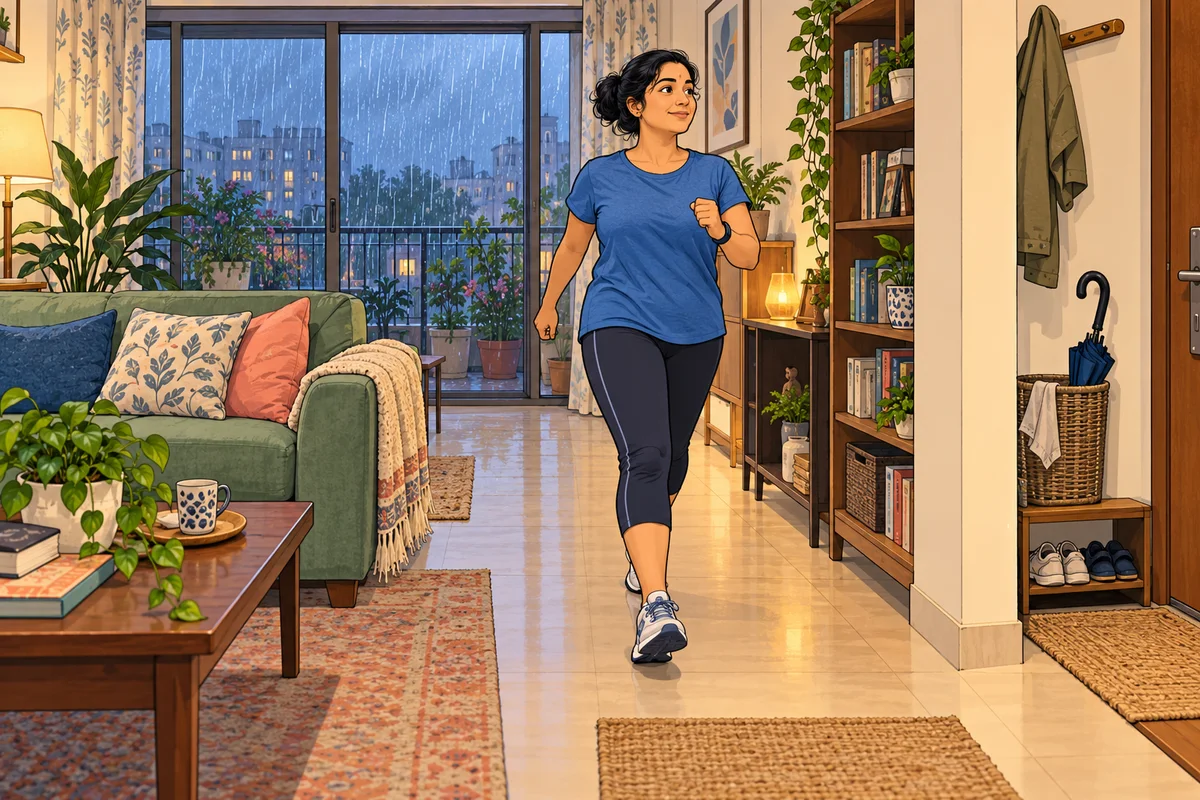
You do not need a gym. Indoors you can keep your routine going and protect your sleep, mood and fitness. Outdoor smog can still get in, so this is not a guarantee of clean air, but you avoid the extra breathing load of hard exercise right in the smog.
- Walk indoors: the indoor walking workout at home turns a living room into a track.
- Follow a plan: the home workout plan for beginners needs no equipment.
- Add stairs: stair climbing for fat loss is a compact option if your building has a stairwell.
- Skip: skipping rope for weight loss works in a small space, but it is harder on the joints, so build up slowly.
Check with your doctor first
If you have asthma, COPD or other lung disease, heart disease, or if you are pregnant, or you are exercising with children or older adults, follow your doctor's advice and the official health advisories on days when the AQI is high. This article is general fitness information, not medical advice. Stop and seek medical help if you get chest pain, severe breathlessness, wheeze that does not settle, or dizziness.
Do the same rules apply in other cities?
Yes. The CPCB bands are national, so the same logic holds in Lucknow, Kolkata, Mumbai or anywhere else on a day when the AQI is high. Look at the live reading, pick a band from the rule-of-thumb table, and move indoors as the number climbs. Cities differ in how often they cross the high bands, but a Very Poor reading means the same thing wherever you are.
Sources
- CAQM in NCR and adjoining areas invoked Stage 3 of GRAP with immediate effect, News on AIR (All India Radio)
- Delhi AQI hits 389 as Rohini and IIT Delhi record Severe air at 474, Open magazine
- National Air Quality Index, Arthapedia, Indian Economic Service, Government of India
- Can air pollution negate the health benefits of cycling and walking?, Preventive Medicine, via PubMed
- Personal strategies to mitigate the effects of air pollution exposure during sport and exercise, British Journal of Sports Medicine, via PubMed
- Thermal inversion adds to the suffocation in Delhi, The Week
- Pollution concentrations soar higher above ground during haze, Mongabay India
Written by the MakeMyFitness team from the sources above and reviewed by Kumar Abhishek, our lead coach (Diploma in Personal Training, K11 School of Fitness Sciences). First published , last updated . How we write and check our guides: editorial policy. This is general fitness information, not medical advice: see the medical disclaimer.