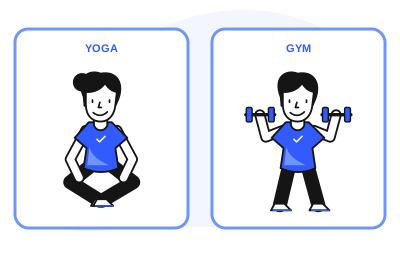
Yoga is one of India's great gifts to the world's health, and it has been practised here for far longer than any gym has existed. Strength training in a gym is a newer tool with a large body of research behind it. Comparing them isn't about picking a winner; it's about matching each to what you want from your body. A note on where we stand: MakeMyFitness coaches strength and conditioning, not yoga classes, so we've tried to be even-handed and let the studies speak.
In this guide, gym means resistance training (machines, free weights, bodyweight strength work) plus some cardio. Yoga means a typical asana-based practice such as Hatha yoga, often with breathing and meditation. Styles vary a lot: a slow restorative class and a fast power yoga class are very different workouts.
Yoga vs gym, which is better: the comparison at a glance
| Outcome | Yoga | Gym strength training | Edge |
|---|---|---|---|
| Maximum strength and muscle | Improves in beginners, then hard to keep loading | Easy to keep adding load | Gym |
| Flexibility and mobility | Clear improvements in trials | Similar range-of-motion gains to stretching in trials | Roughly even; yoga feels more direct |
| Cardio fitness | Small gains; most sessions are light intensity | Depends on the cardio you add | Gym, or brisk walking alongside yoga |
| Weight loss | No overall effect on weight in a 30-trial review | Keeps muscle during a diet; burns more per minute | Gym, with a calorie deficit |
| Stress and mood | Reduces anxiety in people with elevated symptoms | Reduces depressive symptoms in trials | Both |
| Bone density | No significant effect in a 2021 review | Improved spine and hip density in a supervised trial | Gym |
| Balance and body awareness | Built into most practices | Only if you train it | Yoga |
Yoga vs gym for strength and muscle
For strength and muscle, the gym has a clear advantage because you can keep adding load, but yoga does build strength in people starting from little. In a 12-week controlled trial in Hong Kong by Caren Lau, Ruby Yu and Jean Woo, published in 2015, 173 adults with an average age of 52 did one 60-minute Hatha yoga class a week plus home practice, or continued their routine. The yoga group improved push-ups by about 3 to 3.4 more reps and curl-ups by about 1.7 to 2.2 more reps than the control group.
The limit is progression. Once you can hold a pose comfortably, the main ways to make it harder are holding longer or moving to a harder variation; your body weight stays the same. In a gym you can keep adding small amounts of weight to a lift, week after week. That is why strength coaches use weights for building muscle, and why the WHO recommends muscle-strengthening activities for the major muscle groups on 2 or more days a week for adults. Our strength training and muscle building pages explain how we program it, and the gym workout plan for beginners is a good first month.
Yoga vs gym for flexibility and mobility

For flexibility, yoga works well, and strength training works better than most people expect. In the same Hong Kong trial, the yoga group improved a sit-and-reach flexibility test by about 6.4 to 6.7 cm more than controls in both legs. Meanwhile, a 2021 systematic review and meta-analysis by José Afonso and colleagues in the journal Healthcare pooled 11 randomised trials with 452 participants that compared strength training directly with stretching and found no difference in range-of-motion gains between them.
So the gym can keep you mobile if you lift through a full range of motion: deep squats, full-depth presses, stretched-position rows. Yoga gives you a more direct, deliberate way to work on positions, and many people simply enjoy it more as a way to loosen up. If stiffness is your main complaint, our mobility and flexibility page covers how we work on it within strength sessions.
Yoga vs gym for cardio fitness
For cardio fitness, typical yoga is gentler than people assume. A 2007 study by Marshall Hagins and colleagues in BMC Complementary and Alternative Medicine measured 20 experienced practitioners doing a 56-minute beginner yoga session inside a respiratory chamber. Averaged across the session, yoga used 2.5 METs, below the 3.0 MET threshold for moderate activity; the sun salutation sections reached about 2.9 METs. The authors concluded that a whole session represents low-intensity activity, though more than 10 minutes of sun salutations may help unfit or sedentary people.
Yoga still nudged cardio fitness upward in the Hong Kong trial: estimated VO2max rose by about 1.9 mL/kg/min more than controls in men and 1.8 more in women. But if you want the WHO's 150 minutes of moderate activity a week, most yoga practice won't cover it by itself. Adding brisk walking, cycling or a cardio machine does.
Yoga vs gym for weight loss: which is better?
For weight loss, the gym is usually the better tool, mostly because it burns more energy per minute and protects muscle while you diet. The 2024 Adult Compendium of Physical Activities, the standard reference for the energy cost of activities, lists these values (1 MET is roughly your energy use at rest):
| Activity | METs |
|---|---|
| Yoga, Hatha | 2.3 |
| Yoga, Surya Namaskar (sun salutation) | 3.5 |
| Yoga, power | 4.0 |
| Bodyweight exercises (squat, lunge, push-up), general | 3.0 |
| Calisthenics, moderate effort | 3.8 |
| Weight training, multiple exercises, 8 to 15 reps | 3.5 |
| Weight training, squats and deadlifts | 5.0 |
| Circuit training, moderate effort | 5.0 |
| Elliptical trainer, moderate effort | 5.0 |
Trials on yoga and body weight are mixed. A 2016 systematic review and meta-analysis by Romy Lauche and colleagues in Preventive Medicine pooled 30 randomised trials with 2,173 participants and found no overall effect of yoga on body weight, BMI, body fat percentage or waist size. In people with overweight or obesity, yoga did reduce BMI compared with usual care, but the authors called this preliminary because the result wasn't robust to bias.
Gym training isn't magic either. The American College of Sports Medicine's 2009 position stand on weight loss found that 150 to 250 minutes a week of moderate activity gives only modest weight loss, more than 250 minutes is associated with clinically significant loss, and resistance training doesn't speed weight loss by itself but can increase fat-free mass and fat loss. The diet does most of the work: use the calorie deficit calculator for a starting target, and see our fat loss page. Yoga's real contribution to weight loss may be the habits that come with it: calmer eating and a routine you enjoy.
Yoga vs gym for stress, anxiety and mood
Both yoga and gym training help with stress and mood, in different trials. A 2018 systematic review and meta-analysis by Holger Cramer and colleagues in Depression and Anxiety, covering 8 randomised trials with 319 participants, found yoga reduced anxiety compared with no treatment, mainly in people with elevated anxiety; the evidence for diagnosed anxiety disorders was inconclusive. On the gym side, a 2018 meta-analysis by Brett Gordon and colleagues in JAMA Psychiatry, covering 33 randomised trials with 1,877 participants, found resistance training produced a moderate reduction in depressive symptoms.
Yoga vs gym for bone health
For bone density, the strongest evidence is for heavy, supervised strength training. In the LIFTMOR trial, published by Steven Watson and colleagues in the Journal of Bone and Mineral Research in 2018, 101 postmenopausal women with low bone mass did either supervised high-intensity resistance and impact training (two 30-minute sessions a week) or a low-intensity home program for 8 months. Lumbar spine bone density rose 2.9% in the training group and fell 1.2% in the home group; at the femoral neck it rose 0.3% versus a 1.9% fall. One minor adverse event was reported.
For yoga, a 2021 systematic review and meta-analysis by Rubén Fernández-Rodríguez and colleagues in PLOS ONE pooled 11 studies of Pilates and yoga in 591 women aged about 45 to 78 and found no significant improvement in bone density compared with control groups, though the authors noted that holding bone density steady after menopause is itself worthwhile. If you have osteoporosis, get your doctor's advice first; LIFTMOR was carefully supervised and built up gradually.
Yoga vs gym for women
For women, the yoga vs gym question has the same answer as for men, with one extra reason to lift: bone. Bone density falls after menopause, and the LIFTMOR results above came from postmenopausal women. Strength training also won't make most women bulky; building large muscles takes years of deliberate training and eating for it. Yoga remains excellent for flexibility, balance and calm, and many women enjoy it more than a gym floor. If you're choosing one, choose the one you'll keep doing; if you can, add two strength sessions a week to your yoga. Our guides to strength training for women over 40 and online personal training for women go deeper.
Yoga vs gym vs calisthenics
Calisthenics, bodyweight strength training such as push-ups, pull-ups, squats and lunges, sits between yoga and the gym. It builds real strength when you keep progressing to harder variations. In a 2018 trial by Christopher Kotarsky and colleagues in the Journal of Strength and Conditioning Research, 23 moderately trained young men did either progressive push-up variations or bench press three times a week for four weeks; both groups increased their one-rep-max bench press. Neither group showed a significant change in muscle thickness over that short period.
| Yoga | Gym | Calisthenics | |
|---|---|---|---|
| Equipment | A mat | A membership | A floor, a bar for pull-ups |
| Strength progression | Limited by body weight | Easiest to progress | Good, with harder variations |
| Flexibility | Strong | Good with full range | Moderate |
| Cardio | Light unless fast-paced | Machines available | Moderate in circuits |
| Best for | Mobility, balance, calm | Strength, muscle, bone, fat loss | Strength at home, travel, small budgets |
Our build muscle at home guide covers bodyweight progressions in detail.
What yoga and the gym cost in India
Costs vary widely by city and by teacher or gym. Yoga can be practised at home or in a park for nothing once you've learned the basics from a good teacher; paid classes and studios charge very different amounts, so ask for a trial class before paying for a month. For gyms, our guide to gym membership fees in India compares neighbourhood gyms, chains and premium clubs.
If you want strength coaching rather than just a membership, Personal Gym Training puts a certified coach on a live video call at your own gym for ₹799 a session or ₹7,070 for a 4-week plan of 12 sessions. Personal Home Training is ₹899 a session, and Group Classes are ₹499 a session per person. All prices are on our pricing page.
How to combine yoga and gym training in a week
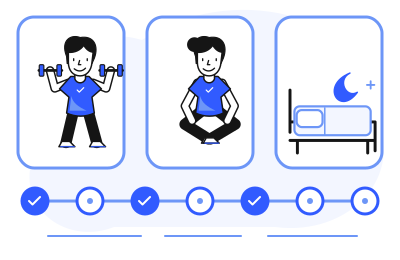
Combining yoga and gym training gives you most of the benefits of both, and the WHO guidelines fit neatly: strength on 2 or more days, and moderate activity on others. Three ways to arrange a week:
| Priority | Strength (gym or home) | Yoga | Other |
|---|---|---|---|
| Mostly yoga, adding strength | Tue, Fri: full body | Mon, Wed, Sat | Brisk walks on 2 days |
| Balanced | Mon, Wed, Fri: full body | Tue, Sat | Walk 30 minutes on Thu or Sun |
| Mostly strength, yoga for mobility | Mon, Tue, Thu, Fri: upper/lower split | Sun, plus 10 minutes after lifting | Walks on rest days |
- Keep hard leg sessions and long, deep hip practice on different days if one leaves you tired for the other.
- Short yoga sequences make a good cool-down after strength work.
- Count brisk walking or a faster flow toward your cardio minutes, not a slow restorative class.
- Track both. Weights and reps for strength; poses and how they feel for yoga.
Who should choose yoga, and who should choose the gym
- Choose the gym if your priorities are strength, muscle, fat loss or bone density, or if you're over 40 and want to slow the loss of muscle and bone.
- Choose yoga if your priorities are flexibility, balance, calm and body awareness, or if a gym puts you off so much you wouldn't go.
- Choose calisthenics if you want strength at home on a small budget and are willing to work through harder variations.
- Do both if you can: two or three strength sessions plus one or two yoga sessions a week covers almost every outcome in the table above.
- Recovering from an injury? Get cleared by a doctor or physio first. Our Rehab & Recovery program coaches exercise after clearance; it isn't treatment.
Sources
- Physical activity (Be He@lthy, Be Mobile), World Health Organization
- Effects of a 12-week Hatha yoga intervention on cardiorespiratory endurance, muscular strength and endurance, and flexibility in Hong Kong Chinese adults: a controlled clinical trial (2015), Lau C, Yu R, Woo J, Evidence-Based Complementary and Alternative Medicine, via PubMed Central
- Does practicing hatha yoga satisfy recommendations for intensity of physical activity which improves and maintains health and cardiovascular fitness? (2007), Hagins M, Moore W, Rundle A, BMC Complementary and Alternative Medicine, via PubMed Central
- 2024 Adult Compendium of Physical Activities: conditioning exercise, Compendium of Physical Activities
- A systematic review and meta-analysis on the effects of yoga on weight-related outcomes (2016), Lauche R, et al., Preventive Medicine, via University of Technology Sydney
- Appropriate physical activity intervention strategies for weight loss and prevention of weight regain for adults (position stand, 2009), American College of Sports Medicine, Medicine & Science in Sports & Exercise, via PubMed
- Strength training versus stretching for improving range of motion: a systematic review and meta-analysis (2021), Afonso J, et al., Healthcare, via PubMed
- High-intensity resistance and impact training improves bone mineral density and physical function in postmenopausal women with osteopenia and osteoporosis: the LIFTMOR randomized controlled trial (2018), Watson SL, et al., Journal of Bone and Mineral Research, via PubMed
- Effectiveness of Pilates and yoga to improve bone density in adult women: a systematic review and meta-analysis (2021), Fernández-Rodríguez R, et al., PLOS ONE, via PubMed Central
- Yoga for anxiety: a systematic review and meta-analysis of randomized controlled trials (2018), Cramer H, et al., Depression and Anxiety, via PubMed
- Association of efficacy of resistance exercise training with depressive symptoms: meta-analysis and meta-regression analysis of randomized clinical trials (2018), Gordon BR, et al., JAMA Psychiatry, via PubMed
- Effect of progressive calisthenic push-up training on muscle strength and thickness (2018), Kotarsky CJ, et al., Journal of Strength and Conditioning Research, via PubMed
Written by the MakeMyFitness team from the sources above. First published , last updated . Spotted something out of date? Tell us at hello@makemyfitness.com.