Should everyone with knee pain avoid squats and lunges?
No single squat or lunge rule fits every painful knee. Pain after a twist, discomfort around the kneecap and symptoms after surgery are different situations. The first step is to understand what happened and whether you have a diagnosis or restrictions. Do not treat the name of an exercise as proof that it is either harmful or essential. A movement can be useful in one person's rehabilitation and inappropriate for someone else's current injury.
The AAOS knee-conditioning program includes half squats among exercises selected with professional guidance. This is a useful correction to the idea that any knee pain means never squatting again. It does not mean you should start that program during an unassessed injury. The appropriate range, resistance and timing depend on the problem and your response.
Describe the knee problem before changing the workout
Tell the clinician where the pain is, whether there was a specific injury and which ordinary tasks are difficult. Include swelling, a sense of giving way, loss of movement and symptoms on stairs. The NHS knee-pain page explains that several conditions can cause knee pain and cautions against self-diagnosis. An online exercise list cannot distinguish them reliably.
Write down any recent change in your week: new running, more stairs, a harder leg workout or a return after time off. That is useful context, not proof of a particular diagnosis. A coach can help describe your training load, while a clinician can assess the knee itself. Keep those roles separate rather than asking the coach to name a damaged structure from a squat video.
Squats, lunges and other exercises to review
| Exercise | When to pause the current version | A possible discussion point |
|---|---|---|
| Deep or loaded squat | Pain increases with depth or resistance, or restrictions prohibit it | A shallower supported squat or sit-to-stand from a higher seat |
| Forward or walking lunge | Stepping and lowering cause pain or uncertainty | A supported stationary split stance, only if cleared and comfortable |
| Jump squat or jump lunge | Landing or repeated impact aggravates symptoms | A controlled non-jumping option appropriate to the diagnosis |
| Step-up or stair circuit | The step height or repeated effort causes a flare | A lower step, less volume or a different cleared activity |
| Leg machine | Its position, range or load is painful | Adjust the setup or choose another assessed option; machines are not automatically safer |
The goal is to remove the provoking demand without turning the entire leg into something you must never use. In an acute injury, the first priority may be assessment and reducing weight-bearing as advised. Later, a return plan may deliberately rebuild that capacity. A temporary restriction and a long-term exercise ban are different instructions, so ask which one you have actually been given.
How to discuss a squat modification
Start with the part of the squat that is difficult. Is it the first bend, the deepest position, standing back up or the last repetitions of a tiring set? Does the knee feel painful, unstable or blocked? These descriptions help decide whether a training adjustment is appropriate or whether the symptom needs another clinical review. Do not force through a locking sensation by changing your foot angle.
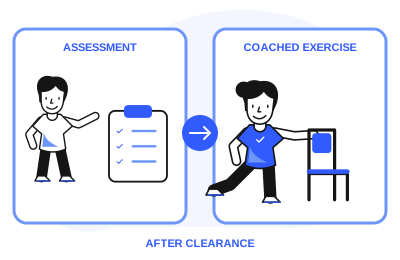
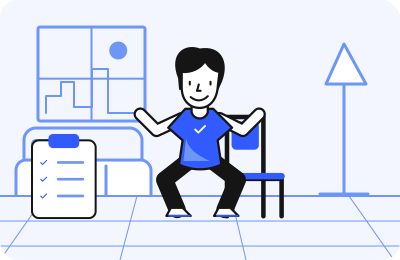
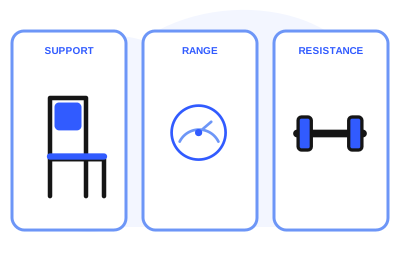
After clearance, a stable chair can provide a repeatable height for a sit-to-stand. Hand support or a higher target may be considered if the current version is too demanding. Keep the setup secure and the movement controlled. A softer sofa that sinks deeply is not equivalent to a firm higher chair, so note the actual equipment rather than recording only that you did bodyweight squats.
There is no need to chase a depth standard during a return from pain. Use the range chosen for your situation and ask how it should progress. Do not force the knees to stay behind the toes as a universal correction, or assume that a particular foot width guarantees safety. Individual comfort, control and any clinical restrictions matter more than copying the outline of somebody else's squat.
Lunges add a stepping and balance demand
A lunge combines leg loading with positioning and, in some versions, a step. If a walking lunge is provoking symptoms, adding weight or moving faster is unlikely to clarify the problem. Pause that version. If your clinician approves a return, discuss whether a stationary stance and hand support would make the task more manageable before reintroducing repeated steps.
A reverse lunge is sometimes suggested as an alternative, but it is not automatically suitable for a painful knee. It still requires controlled loading and balance. The same applies to split squats and step-ups. Choose a modification because it fits your assessment and response, not because a video labels it knee-friendly. If support is needed, use a fixed surface rather than furniture that can move.
You do not need to include a lunge in every leg session. If the current goal is rebuilding general leg strength, another cleared exercise may serve that purpose while the lunge waits. If returning to a sport requires stepping and direction changes, ask the clinician what milestones should come before those tasks. Fitness coaching should follow that sequence rather than inventing return-to-sport clearance.
Why strengthening may still belong in the plan
For one specific condition, AAOS guidance on patellofemoral pain describes modifying aggravating activities and using targeted rehabilitation. This is not a diagnosis for everyone whose knees hurt on stairs. It illustrates why the answer can include an adjusted activity plan and strengthening rather than eliminating movement indefinitely.
Ask which muscle groups and movements your rehabilitation plan is meant to address. You may be given exercises that look much easier than your previous gym session. Follow their purpose and instructions rather than making every drill heavier to feel that it counts. If an exercise is uncomfortable, report that response; do not silently remove all strengthening or replace it with aggressive stretching.
Plan the whole day, including stairs and walking
| Demand | Useful adjustment to consider |
|---|---|
| Gym leg work | Use the agreed exercise dose and avoid adding a second unfamiliar leg routine |
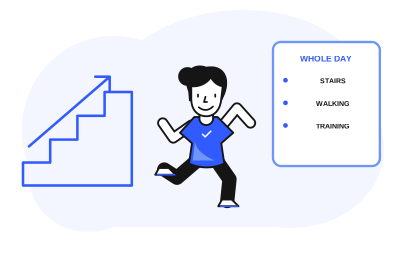
| Stairs at home or work | Account for repeated trips when planning the day's workload |
| Walking | Use the distance and pace currently tolerated or prescribed, rather than a compulsory step target |
| Cardio equipment | Check whether cycling or another option is appropriate; a low-impact label is not enough |
| Recovery and review | Record swelling, stiffness, walking changes and the response after sessions |
If you are rebuilding a routine, make the first week easy to interpret. Avoid introducing a new walking target, a leg class and extra stairs at the same time. You may otherwise struggle to explain why the knee feels worse later. A simpler plan gives you and the clinician clearer information about what is manageable and which demand needs adjustment.
A return checklist after you are cleared
- 1
Know the limits
Confirm any weight-bearing, range or resistance restrictions, particularly after an operation or specific injury. Ask how to monitor symptoms and when the plan should be reviewed. Do not replace a surgical protocol with a general beginner workout.
- 2
Choose one reproducible setup
Record seat height, support, step height or machine settings. Use a movement you have been shown and can stop safely. Consistent equipment makes it easier to compare sessions and avoid accidental jumps in difficulty.
- 3
Monitor the session and later response
Tell your coach if pain increases, the knee feels unstable or the movement changes. Follow clinical advice about acceptable discomfort. Review walking, stairs and swelling afterwards rather than judging the session only by whether you completed it.
- 4
Progress a single demand
When appropriate, change one feature such as repetitions, range or resistance. Keep the others similar. If the new version is not manageable, step back and review; repeated worsening deserves clinical input rather than endless trial and error.
Use coaching to follow the plan, not diagnose the knee
Keep the agreed support close enough to use without reaching or twisting suddenly. A stable setup makes the exercise easier to repeat and the feedback easier to understand.
Physiotherapy can assess and manage movement problems. After appropriate clearance, a personal trainer can help you implement the agreed exercise advice and rebuild a consistent fitness routine. They cannot identify a meniscus or ligament injury from appearance, and they should not promise that one squat correction prevents every recurrence.
Bring the instructions and your recent symptom record to the first session. For live online coaching, make sure the full movement and support surface are visible. If a new problem appears, the session can be stopped rather than improvised around. The hip-pain guide covers a related but separate set of questions; pain location alone should not lead you to diagnose one joint from another.
Sources
- Knee pain, NHS
- Knee Conditioning Program, American Academy of Orthopaedic Surgeons
- Patellofemoral Pain Syndrome, American Academy of Orthopaedic Surgeons
- Physiotherapy, NHS
Written by the MakeMyFitness team from the sources above. First published , last updated . This is general fitness information, not medical advice: see the medical disclaimer.