Why is weight loss harder with an underactive thyroid?
An underactive thyroid lowers your resting metabolism, and the tiredness that comes with it makes you move less. The effect is smaller than most people assume. The American Thyroid Association's patient article on thyroid and weight (reproduced by the British Thyroid Foundation) says the fall in basal metabolic rate in hypothyroidism is usually much less dramatic than the rise seen with an overactive thyroid, that in general, 5–10 pounds of body weight may be attributable to the thyroid depending on severity, and that most of that extra weight is excess accumulation of salt and water, not fat.
If you have gained 15 kg since diagnosis, the thyroid alone did not do it; the same article notes that when weight gain is the only symptom, the thyroid is less likely to be the cause. The NHS lists feeling extremely tired and putting on weight among the common symptoms and says they develop slowly, which is how months of fatigue become months of less walking before anyone names the problem. The condition is common in India: an eight-city study of 5,360 adults (Unnikrishnan et al., 2013, Indian Journal of Endocrinology and Metabolism) found hypothyroidism in 10.95% of participants, 15.86% of women against 5.02% of men.
Can I lose weight with hypothyroidism?
Yes. Once treatment is stable the usual rule applies: you lose fat when you eat less energy than you use, consistently, for weeks. The honest caveat comes from the same American Thyroid Association article: treating hypothyroidism brings a small weight loss, usually less than 10% of body weight, and it is fairly common to find there is no significant weight loss after successful treatment. The salt and water go; the fat stays until you create a deficit. The article also says thyroid hormone is not very useful for treating obesity and that pushing the dose up carries real risks. Nobody should take extra thyroid hormone to slim down.
Work out your resting needs with the BMR calculator, your daily total with the TDEE calculator and a modest target with the calorie deficit calculator. Two adjustments follow from the thyroid. If fatigue has cut your daily movement, pick the calculator's lower activity level until your steps recover. And because water weight shifts with thyroid status, judge progress on a four-week average, not a week. Our fat-loss coaching page explains how we set and review a deficit.
| Common belief | What the evidence says | What to do |
|---|---|---|
| My thyroid caused all my weight gain | About 5–10 lb (roughly 2–5 kg) is attributable to the thyroid, much of it salt and water (ATA via BTF) | Plan for fat loss the usual way; do not wait for the medicine to do it |
| Once my levels are normal the weight will fall off | Usually less than 10% of body weight, and often no significant loss (ATA via BTF) | Set a calorie target and a weekly exercise target |
| My metabolism is wrecked | The fall in BMR is usually much less dramatic than people assume (ATA via BTF) | Use a BMR calculator; pick the lower activity level if you move less |
| Exercise will fix my thyroid levels | A 2023 meta-analysis of 10 studies found no significant effect of exercise on TSH or thyroid hormones | Exercise for fitness, mood and fat loss; leave levels to your doctor |
| I should take more hormone to lose weight | Thyroid hormone is not useful for treating obesity and carries risks (ATA via BTF) | Never change a dose yourself; ask your doctor about any concern |
Which exercise helps with hypothyroidism, and how much?
The same mix that helps any adult lose fat helps a person with a treated underactive thyroid: aerobic work plus strength training, most weeks. The WHO's 2020 guidelines on physical activity (Bull et al., British Journal of Sports Medicine) recommend 150–300 minutes of moderate-intensity aerobic activity a week, or 75–150 minutes of vigorous activity, plus muscle-strengthening activity for all major muscle groups on 2 or more days a week. They add that doing some physical activity is better than doing none, that people should start with small amounts and gradually increase, and that adults with chronic conditions who cannot meet the targets should be active according to their abilities. That last line is written for someone starting tired.
On hypothyroidism specifically, a 2023 systematic review and meta-analysis (Duñabeitia et al., Scandinavian Journal of Clinical and Laboratory Investigation) found 10 studies of low to moderate quality, mostly in women with subclinical hypothyroidism. Exercise seemed to be safe, and aerobic and resistance training led to improvements in outcomes related to physical and mental health, but it did not significantly change TSH, FT3 or FT4. The realistic promise of exercise with hypothyroidism is fitness, strength, mood and fat loss, not a better blood test.
| Type | What it does for you | How to start when tired |
|---|---|---|
| Brisk walking | Counts toward the 150–300 moderate minutes; easy to recover from | Two or three 10-minute walks a day; see walking for weight loss |
| Strength training | Keeps muscle while you diet; 2 or more days a week | Two 15-minute sessions of 4–5 exercises, bodyweight or light dumbbells |
| Cycling or swimming | Moderate aerobic work with little joint load | 15–20 minutes at a pace where you can still talk |
| Yoga or stretching | Mobility and breathing; little direct evidence on thyroid levels | A 15-minute routine on rest days |
| Hard intervals (HIIT) | Efficient once fit; the hardest to recover from | Not in the first 4 weeks; only once treated, stable and cleared |
How do I exercise with hypothyroidism fatigue?
Start lower than you think you should and add a small step each week. A 2014 systematic review of 38 studies (Lankhaar et al., Research Quarterly for Exercise and Sport) found that reduced exercise tolerance in untreated hypothyroidism has many causes at once, with the cardiovascular, cardiopulmonary, musculoskeletal, neuromuscular and cellular metabolic systems acting in concert, and that it is not always reversible even on adequate hormone replacement. A pace that is moderate for someone else can be hard for you, so measure effort by how it feels, not by a generic heart-rate chart.
- Use the talk test. Moderate means you can speak in full sentences but could not sing. If you cannot talk, slow down.
- Rate the day before you train. On a 1 to 10 energy scale, train as planned at 6 or above, do the easy version at 4 or 5, and walk or rest below 4. Write it down; the pattern across weeks tells you and your doctor more than any one session.
- Judge recovery at 24 hours. Muscle soreness is fine. Feeling flattened the whole next day means the session was too big; cut it by a third next time rather than skipping the week. Keep a rest day between strength sessions.
If fatigue is worse rather than better after a month of gentle, consistent training, that is information for your doctor, not a cue to train harder, and keep your follow-up blood tests. MakeMyFitness coaches are fitness coaches, not doctors, dietitians or physiotherapists. We work within your clinician's limits, and Rehab & Recovery is exercise coaching after a clinician has cleared you, not treatment. See our medical disclaimer.
A 4-week starter plan for hypothyroidism, at home or in the gym
For an adult whose hypothyroidism is treated and stable, with the doctor's go-ahead. It starts at about 75 minutes of moderate activity in week one and reaches about 150 minutes plus two strength sessions by week four, the floor of the WHO target. Each week has a home and a gym version; if a week feels too much, repeat it. It is a template for a coach to adjust, not a prescription.
- 1
Week 1: establish the habit (about 75 minutes)
Walk 15 minutes on five days at a talk-test pace. Two strength sessions of 15 minutes, 48 hours apart. Home: sit-to-stand from a chair, wall push-ups, glute bridges, towel or band rows, 2 sets of 8–10. Gym: leg press, chest press machine, seated row, 2 sets of 10 at a weight you could lift 15 times.
- 2
Week 2: add five minutes (about 100 minutes)
Walk 20 minutes on five days. Strength sessions grow to 20 minutes: add a third set to two exercises and introduce a hinge, a hip hinge with a broomstick at home or a Romanian deadlift with light dumbbells in the gym. If the day-before energy score is 4 or 5, do the walks and skip the extra set.
- 3
Week 3: one longer walk (about 125 minutes)
Four walks of 20 minutes plus one 30-minute walk at the weekend, before the heat. Strength: 25 minutes, 3 sets of 8–12 for five exercises. Home: add a split squat holding the kitchen counter and a floor press with water bottles. Gym: goblet squat, lat pulldown, dumbbell bench press. Rest 60–90 seconds between sets.
- 4
Week 4: reach the floor of the WHO target (about 150 minutes)
Five walks of 25 minutes plus one 30-minute cycle, swim or hill walk. Strength: two sessions of 30 minutes, 3 sets of 8–12 for six exercises, raising the weight only when every set reaches 12 clean reps. Re-rate fatigue, sleep and waist against week one, then hold for a month or build toward 200–300 minutes with your coach.
Does strength training boost metabolism with hypothyroidism?
A little, and that is not the main reason to lift. Muscle burns more at rest than fat, but not by as much as gym folklore says. Wang and colleagues (American Journal of Clinical Nutrition, 2010) give the standard figures of about 13 kcal per kg per day for skeletal muscle and 4.5 kcal per kg per day for fat tissue. Swapping 2 kg of fat for 2 kg of muscle raises resting energy use by roughly 17 kcal a day, less than a biscuit. Strength training will not offset the metabolic effect of an underactive thyroid.
What it does do is worth more. It keeps muscle while you eat in a deficit, so what you lose is mostly fat. It makes stairs and shopping bags easier when fatigue has made you move less, and it gives a measurable win each week when the scale is slow. The NHS also lists osteoporosis among the risks of an under-treated thyroid, and loading your bones through strength training is the exercise side of looking after them. Women over 40 have the most to gain, as our guide to strength training for women over 40 explains.
What should I eat for thyroid and weight loss in India?
There is no thyroid diet. The British Thyroid Foundation's diet factsheet says plainly that there are no specific foods or dietary supplements that you can use to treat your thyroid disorder, and that a balanced diet is the best way to get what you need. For weight, the rules are the same energy-balance rules as for anyone. Three thyroid-specific questions come up in Indian kitchens, and the answers are calmer than social media suggests.
- Iodine and salt. The thyroid needs iodine to make its hormone. The ICMR-NIN Dietary Guidelines for Indians 2024 advise people to use iodised salt and restrict added salt to at most 5 g a day (as reported by News On AIR, 9 May 2024). Use iodised salt, not loose or rock salt, and keep the amount small. The BTF adds that if you take levothyroxine there is no need to take iodine supplements.
- Soy. The sources disagree here. A review in the journal Thyroid (Messina and Redmond, 2006) concluded that hypothyroid adults need not avoid soy foods, while noting that soy may reduce absorption of thyroid medicine and that soy eaters should make sure their iodine intake is adequate; the British Thyroid Foundation's factsheet, by contrast, advises people on levothyroxine to avoid soya. How tofu or soya chunks sit with your medicine is a question for your doctor.
- Cabbage, cauliflower, broccoli and mustard greens (goitrogens). The BTF factsheet says brassicas may contribute to goitre only at very high intakes and that under normal dietary conditions the risk is very low. Normal portions of gobi and sarson, cooked as Indian food usually is, are not the problem.
- Medicine timing. How your medicine, your breakfast, any supplements and a morning workout should be ordered is a question for your doctor or pharmacist. We do not give dose or timing advice.
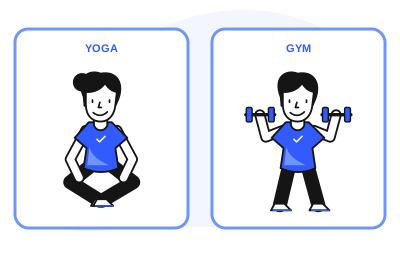
Yoga vs gym for thyroid: which is better?
Neither has been shown to change thyroid levels, and the better choice is the one you will do three times a week. The evidence for yoga is thin: a 2016 Indian pilot study (Nilakanthan et al., Journal of Complementary and Integrative Medicine) followed 22 women aged 30 to 40 through six months of yoga, one hour a day, four days a week, and found improved cholesterol but a non-significant 9.7% fall in TSH, with no control group and a call for randomised trials. For weight loss, the gym or a strength routine at home has the edge, because it loads muscle and bone, which yoga mostly does not, and is easier to progress week by week. For stiffness and sleep, yoga on rest days is a sensible addition. Our yoga vs gym comparison goes through calories, strength and flexibility in detail.
How MakeMyFitness coaching fits an underactive thyroid
MakeMyFitness is live 1:1 fitness coaching on video across India, ₹799 a session at your own gym with Personal Gym Training or ₹899 at home with Personal Home Training, and it suits a person with treated hypothyroidism who needs a plan that starts low, is adjusted each week to their energy, and is watched set by set so form does not slip when they are tired. Our coaches are fitness coaches, not doctors, dietitians or physiotherapists; we work within your doctor's limits and do not comment on your medicine or blood tests. Sessions run 6 AM to 8 PM every day and last 45 minutes, and a 4-week plan is three sessions a week, the same rhythm as the plan above. Because the condition is far more common in women, our guide to an online personal trainer for women answers the practical questions people ask most. Your first session is an assessment, not a test.
Sources
- Thyroid and weight: the science (American Thyroid Association patient information), British Thyroid Foundation
- Underactive thyroid (hypothyroidism), NHS
- Heart palpitations and ectopic beats, NHS
- World Health Organization 2020 guidelines on physical activity and sedentary behaviour (Bull et al., 2020), British Journal of Sports Medicine (PubMed Central)
- Effect of physical exercise in people with hypothyroidism: systematic review and meta-analysis (Duñabeitia et al., 2023), Scandinavian Journal of Clinical and Laboratory Investigation (PubMed)
- Impact of overt and subclinical hypothyroidism on exercise tolerance: a systematic review (Lankhaar et al., 2014), Research Quarterly for Exercise and Sport (PubMed)
- Prevalence of hypothyroidism in adults: an epidemiological study in eight cities of India (Unnikrishnan et al., 2013), Indian Journal of Endocrinology and Metabolism (PubMed Central)
- Specific metabolic rates of major organs and tissues across adulthood (Wang et al., 2010), American Journal of Clinical Nutrition (PubMed Central)
- Effects of soy protein and soybean isoflavones on thyroid function in healthy adults and hypothyroid patients (Messina and Redmond, 2006), Thyroid (PubMed)
- Thyroid and diet factsheet, British Thyroid Foundation
- ICMR releases upgraded Dietary Guidelines for Indians (2024), News On AIR, Prasar Bharati
- Effect of 6 months intense yoga practice on lipid profile, thyroxine medication and serum TSH level in women suffering from hypothyroidism: a pilot study (Nilakanthan et al., 2016), Journal of Complementary and Integrative Medicine (PubMed)
Written by the MakeMyFitness team from the sources above. First published , last updated . This is general fitness information, not medical advice: see the medical disclaimer.