What an online gym trainer for form correction can and can't see
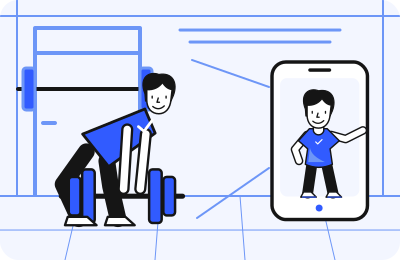
An online personal trainer corrects your gym form the same way a trainer on the gym floor mostly does: by watching you move and telling you what to change. The difference is that the coach sees you through one camera instead of walking around you. That makes the camera angle the single biggest factor in how good the coaching is. With the right angle, a live coach can see almost every error that matters for a beginner or intermediate lifter, and fix it between rep two and rep three rather than in a message the next day.
This guide is about live coaching on a video call, the kind we run at MakeMyFitness, not sending recorded clips for review. If you're still deciding between coaching types, online fitness coaching, explained compares app plans, check-in coaching, live one-to-one sessions and group classes.
| Easy to see on video | Needs the right angle | Not possible on video |
|---|---|---|
| Depth on squats and lunges | Knee tracking (front view) | Spotting a failed rep |
| Back position on hinges and rows | Bar path on presses (side or 45 degrees) | Moving your hips or shoulders by touch |
| Tempo, pauses and rushed reps | Elbow angle on bench and overhead press | Feeling which muscle is working for you |
| Range of motion and lockout | Foot pressure and heels lifting | Checking a machine's pin or cable is secure |
| Breathing and bracing cues you can hear | Small wrist and grip details | Catching a dropped dumbbell |
Where to put your phone for each lift
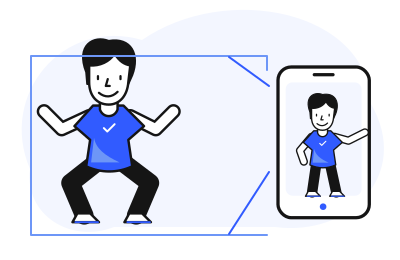
Every lift has one angle that shows its most common error. A good coach will ask you to move the phone between exercises, and it takes ten seconds once you know where it goes. Prop the phone on a bench, a plate stack, a water bottle or a cheap tripod, about 2 to 3 metres away, at roughly hip height, with your whole body and the weight in frame.
| Exercise | Camera position | What the coach checks |
|---|---|---|
| Squat (barbell, goblet, leg press) | Side-on, hip height | Depth, back angle, heels down, bar over mid-foot |
| Squat or lunge, knee check | Straight in front, knee height | Knees tracking over toes, hips level |
| Deadlift and Romanian deadlift | Side-on, hip height | Neutral back, bar close to the legs, hips and chest rising together |
| Bench press and dumbbell press | About 45 degrees from the head end | Bar path, elbow angle, shoulder blades, feet planted |
| Overhead press | About 45 degrees, or side-on | Bar path past the face, ribs down, no lean-back |
| Rows and pulldowns | Side-on | Torso still, shoulders not shrugging, full stretch |
| Hip thrust and glute bridge | Side-on | Ribs down, full hip extension, no arching |
| Push-ups and planks | Side-on, floor level | Straight line from head to heels |
Connection matters less than people expect. Google's network guidance for Meet lists up to 1.7 Mbps each way for 720p video for an individual, and Meet lowers the resolution by itself when bandwidth is short. A steady 4G signal or ordinary home or gym Wi-Fi is usually enough. If the video freezes during a set, keep lifting: your coach can still hear you, and audio uses far less data.
Earphones and what live coaching cues sound like
Wear earphones. Gym music and the clang of plates drown out a phone speaker, and a cue you don't hear is a rep you can't fix. Wireless earbuds with a microphone are ideal because your coach can also hear your breathing, which tells them a lot about effort. Keep the volume moderate so you still hear what's going on around you.
Live cues are short, because you have about a second to act on them. Good coaches also tend to cue the effect of a movement rather than the body part. A 2010 review of motor learning by Wulf, Shea and Lewthwaite in Medical Education found that instructions directing attention outward, at the movement's effect, were consistently more effective than instructions about the body's own movements, and that feedback has a motivational effect as well as an informational one. In practice, live cues sound like this:
- Squat: "Spread the floor apart with your feet" (for knees caving in), "Sit between your heels", "Chest to the wall in front".
- Deadlift: "Push the floor away", "Drag the bar up your shins", "Hips and chest rise together".
- Bench press: "Bend the bar", "Bar to the bottom of your chest", "Drive your feet into the floor".
- Rows and pulldowns: "Elbows to your back pockets", "Long neck, shoulders away from your ears".
- Tempo and effort: "Three seconds down", "Pause", "Two more, same speed", "That's the set, rack it".
Common form errors a coach catches live
Most technique problems are the same handful of errors, and each one shows up best from a particular angle. Here is what a coach looks for and what you'll hear when they see it.
Knee cave (knee valgus)
Knees collapsing inward as you stand up from a squat, lunge or leg press, usually when the set gets hard. It shows best from the front. The fix is a cue ("knees out over your little toes"), sometimes a slightly wider stance or toes turned out a little, and often a lighter load until the pattern holds. Video is a respected tool for this: a 2012 study in the Journal of Sport Rehabilitation found 2D video measurement of knee valgus during single-leg squats and landings was reliable within a day and between days.
Butt wink and a rounding lower back
The pelvis tucking under at the bottom of a deep squat, or the lower back rounding as a deadlift leaves the floor. It shows best side-on. A coach will usually set your depth to just above the point where it happens, work on bracing, and adjust stance or bar position. On deadlifts, raising the starting height with plates or blocks often solves it at once.
Bar path drifting
A deadlift bar swinging away from your legs, a squat where the bar drifts in front of mid-foot, or an overhead press that loops around your face. It shows side-on or at 45 degrees. You'll hear "bar closer" or "head through" mid-set, and the next rep usually looks different straight away.
Elbow flare on presses
Elbows flaring straight out to the sides on a bench press, dumbbell press or push-up, which puts the shoulder in a less comfortable position. It shows at 45 degrees from the head end. The usual fix is to tuck the elbows a little closer to your sides and lower the bar slightly further down the chest.
Rushed reps and cut range
The most common error of all is simply going too fast and stopping short. A coach counts tempo out loud, calls for pauses and decides when a set should end because form is slipping, which is hard to judge on your own in the last two reps.
What video can't do, and how good coaches work around it
Be honest about the limits. A coach on a phone can't catch a bar, can't nudge your hips into place and can't check that a machine pin is fully in. That matters, because dropped weights are a real cause of gym injuries: in a study of weight-training injuries treated in US emergency departments from 1990 to 2007, published in the American Journal of Sports Medicine, the most common mechanism was weights dropping on the person (65.5%), and 90.4% of injuries involved free weights. A good online coach plans so that a missed rep is never dangerous:
- Load selection. Working sets end with one to three reps left in reserve, not at grinding failure. Heavy single-rep testing isn't part of online coaching.
- Safety bars and pins. For barbell squats and bench press in a rack, the coach checks on camera that the safety arms are set just below your lowest point before the first working set.
- Safer exercise choices. Without safety arms, bench press becomes a dumbbell press (you can drop dumbbells to the side) and back squats become goblet squats, leg press or Smith machine work.
- Asking a gym-mate to spot. For a top set close to your limit, asking someone nearby for a spot is normal gym etiquette. Your coach can tell them what to do.
- Verbal and visual cues instead of touch. Where an in-person trainer would tap your back, an online coach demonstrates on their own camera, gives an external cue or uses a simpler drill, such as a pause at the bottom of a squat.
What the research says about supervision and feedback
There are two questions here: does being supervised help, and does feedback during training help? The research on both is encouraging, though most of it was done in person.
- Supervision and strength. In a 12-week trial in Medicine & Science in Sports & Exercise (Mazzetti and colleagues, 2000), moderately trained men supervised by a personal trainer increased their training loads faster and ended with greater squat and bench press strength than men doing the same program unsupervised.
- Coach-to-lifter ratio. In a trial of 124 untrained young men (Gentil and Bottaro, 2010), a 1:5 coach-to-trainee ratio led to bigger strength gains than 1:25, with bench press gains of 15.9% against 10.22%, probably because the closely supervised group trained harder.
- Pooled studies. An exploratory meta-analysis by Fisher and colleagues (2022) compared supervised with unsupervised resistance training across 12 studies and found a moderate advantage for supervision on strength.
- Feedback during sets. A 2023 systematic review and meta-analysis of 20 studies in Sports Medicine (Weakley and colleagues) found feedback during resistance training improved acute performance and motivation, with greater improvements in strength and technical competency when feedback was given over a training period. Feedback after every rep worked best for performance within a session, and both verbal and visual feedback beat none.
- Live video works. A 2025 meta-analysis in Age and Ageing pooled 28 randomised trials (2,086 adults over 65) of exercise supervised live by videoconference: attendance averaged about 80%, and it improved physical function and muscle strength.
None of these studies tested an online coach correcting a young adult's squat over a phone, so treat them as the reasons live coaching should help, not proof of a result. The full case is in is online personal training worth it.
How to check your own form between sessions
Most people train on some days without a coach. You can still keep your technique honest with the same tools your coach uses.
- 1
Film one set of each main lift
Use the angle from the table above, always the same one, so this week's clip can be compared with last week's.
- 2
Watch it once at normal speed, then slowed down
Check one thing per lift: depth on the squat, back position on the deadlift, bar path on the press. Trying to judge everything at once means judging nothing.
- 3
Use your coach's cues as your checklist
Write down the two cues you heard most in your last live session. Those are your personal errors, and they're what to watch for.
- 4
Log reps in reserve
Note how many more good reps you could have done. If form breaks with three left in the tank, the load is too heavy for an unsupervised day.
- 5
Keep heavy sets for safe set-ups
On solo days, use safety arms, dumbbells or machines for anything near your limit, and save top sets for coached sessions.
If you're new to the gym and building your first routine, start with our gym workout plan for beginners and how to start going to the gym.
How a live form-coaching session at your gym runs
A personal gym training session with us lasts 45 minutes on Google Meet: a 5-minute check-in on sleep and niggles, an 8-minute warm-up with ramp-up sets where your coach sets the camera angles, 25 minutes of main lifts with live cues on form, tempo and load, a 4-minute finisher and a 3-minute cool-down and recap of what to work on before next time. Your first session is an assessment of how you move, explained in what happens in your first session.
| Option | Price | Per session |
|---|---|---|
| One live session | ₹799 | ₹799 |
| 4-week plan, 12 sessions (3 a week) | ₹7,070 | about ₹589 |
Slots run from 6 AM to 8 PM India time, every day, and sessions can be moved with 24 hours' notice. Your gym membership stays separate. Full details are on the pricing page, and our lead coach's certifications are on Kumar Abhishek's profile. If you'd rather train at home, the same live form coaching works with dumbbells or bodyweight through personal home training.
Sources
- The influence of direct supervision of resistance training on strength performance (Mazzetti et al., 2000), Medicine & Science in Sports & Exercise, via PubMed
- Influence of supervision ratio on muscle adaptations to resistance training in nontrained subjects (Gentil and Bottaro, 2010), Journal of Strength and Conditioning Research, via PubMed
- The role of supervision in resistance training: an exploratory systematic review and meta-analysis (2022), Fisher J, et al., International Journal of Strength and Conditioning
- The effect of feedback on resistance training performance and adaptations: a systematic review and meta-analysis (Weakley et al., 2023), Sports Medicine, via PubMed
- Motor skill learning and performance: a review of influential factors (Wulf, Shea and Lewthwaite, 2010), Medical Education, via PubMed
- Reliability of 2-dimensional video assessment of frontal-plane dynamic knee valgus during common athletic screening tasks (Munro et al., 2012), Journal of Sport Rehabilitation, via PubMed
- Epidemiology of weight training-related injuries presenting to United States emergency departments, 1990 to 2007 (Kerr et al., 2010), American Journal of Sports Medicine, via PubMed
- Feasibility and effectiveness of physical exercise for older adults delivered remotely via videoconferencing: systematic review and meta-analysis (Age and Ageing, 2025), Toledano-Shubi A, et al., via PubMed
- Prepare your network for Meet meetings and live streams, Google Workspace Admin Help
Written by the MakeMyFitness team from the sources above. First published , last updated . Spotted something out of date? Tell us at hello@makemyfitness.com.