How do people stay fit in Miami?
People in Miami stay fit by training early, near water, and indoors when the weather turns. The city's fitness life runs along the ocean and the bay: the Beachwalk on Miami Beach, the causeways that cross Biscayne Bay, and the shaded strip of The Underline under the Metrorail tracks. By 9 AM in summer the air is already in the 80s, so runners and cyclists are out in the dark, and the rest of the year's training happens in the air conditioning: condo amenity gyms, chain clubs and living rooms.
This guide maps where Miamians run and work out, with distances from the people who run those paths; what each season does to training, using NOAA's 1991–2020 normals for Miami International Airport; the big race on the calendar; and how a live session fits around a Miami workday.
Where can you run in Miami?

Miami's running routes are flat, waterside and mostly in the sun, so distance comes easy and shade doesn't. These are the routes the city, the county's tourism board and the park operators publish, with their measured lengths.
| Route | Distance | Where | Good to know |
|---|---|---|---|
| Miami Beach Beachwalk | 9 miles end to end; 7 miles South Beach to North Beach | South Pointe Park to 87th Street, along the sand | Paver path, open 24 hours, water fountains along the way |
| Sands of South Beach | 2.4 miles | Hard-packed sand, 23rd Street to South Pointe Park | Run it at low tide, when the sand is firm |
| Lummus Park sidewalk | 1.1 miles | Ocean Drive, 5th Street to 14th Place | Flat and busy; go at sunrise |
| South Pointe Park | 0.5 mile | Southern tip of Miami Beach | Paved promenades and a pier, a short warm-up loop |
| Venetian Causeway | 2.5-mile path (2.8-mile causeway) | Miami to Miami Beach across the Venetian Islands | Separate pedestrian and bike path; cars pay a toll |
| Rickenbacker Causeway | 5.4 miles | Miami to Virginia Key and Key Biscayne | Crosses the high-rise William Powell Bridge |
| The Underline | 10 miles planned; 5 continuous miles open since May 2026 | Brickell to Dadeland | Trail, outdoor gyms and courts |
The Rickenbacker: Miami's only hill
Miami has no hills, so its runners and cyclists use bridges. The Rickenbacker Causeway runs 5.4 miles from the mainland to Virginia Key and Key Biscayne, and the high-rise William Powell Bridge near the toll plaza is the climb everyone repeats. At the far end, Crandon Park on Key Biscayne covers 808 acres with about 2 miles of Atlantic beach, so a dawn ride can finish with a swim. The causeway is shared with fast-moving cars and bikes; wear a light and keep to the path.
The Venetian Causeway: the bay crossing on foot
The Venetian Causeway is 2.8 miles long, crossing Biscayne Bay from Miami to Miami Beach over a chain of man-made islands. It's the quiet crossing: drivers pay a toll, and Greater Miami & Miami Beach lists a 2.5-mile separate path for walkers, runners and cyclists. Joined to the Beachwalk, it turns into a long-run route from Downtown or Edgewater to the ocean and back.
Where can you work out outdoors for free in Miami?

The free outdoor gyms in Miami are along The Underline, the 10-mile linear park running from Brickell to Dadeland. Its operators reported five continuous miles open as of May 13, 2026. The Urban Gym section has body-weight fitness equipment, a running track and a fenced Flex Court; The Fitness Room is an outdoor gym with body-weight and equipment stations and a half basketball court. Some stretches look finished but aren't officially open yet, so check the map before you go.
- Under the tracks, out of the sun. The Underline's position beneath the elevated Metrorail gives you shade that the Beachwalk doesn't.
- Pull-ups and dips, not a full program. Outdoor stations cover pulling, pushing and core. Bring a resistance band for the leg and hip work they don't.
- Pair it with the train. You can ride Metrorail to a station on the route, train, and ride home.
What is Miami's weather like for training, month by month?

Miami's weather gives you a cool, dry season for outdoor training and a hot, wet one for training indoors. NOAA's 1991–2020 normals for Miami International Airport put the year's high at 84.2°F (29°C) on average and its total rain at 67.41 inches. The rainy season officially runs from May 15 to October 15, and Atlantic hurricane season from June 1 to November 30.
| Month | Average high | Average low | Rain |
|---|---|---|---|
| January | 76.2°F (24.6°C) | 61.0°F (16.1°C) | 1.83 in |
| March | 80.6°F (27.0°C) | 65.6°F (18.7°C) | 2.46 in |
| May | 86.7°F (30.4°C) | 73.4°F (23.0°C) | 6.32 in |
| June | 89.3°F (31.8°C) | 76.3°F (24.6°C) | 10.51 in |
| August | 90.7°F (32.6°C) | 77.7°F (25.4°C) | 9.58 in |
| September | 89.0°F (31.7°C) | 76.9°F (24.9°C) | 10.22 in |
| October | 85.9°F (29.9°C) | 74.2°F (23.4°C) | 7.65 in |
| December | 78.2°F (25.7°C) | 64.3°F (17.9°C) | 2.44 in |
- 1
December to April: outdoor season
Highs of 76–84°F and under 3.5 inches of rain a month make this the time for long runs on the Beachwalk, causeway rides and the race calendar. January is the driest month, at 1.83 inches.
- 2
May: the switch
Rain jumps to 6.32 inches and the rainy season starts on May 15. Move hard sessions earlier in the day.
- 3
June to September: indoor season
Highs of 89–91°F, lows that barely drop below 77°F in July and August, and 9–10.5 inches of rain a month in June, August and September. The 1961–1990 records put August's average dew point at 73.8°F, which is why a 6 AM run still feels like a sauna.
- 4
October and November: easing out
October still brings 7.65 inches of rain; November falls to 3.53 inches with highs of 81.3°F. NOAA's National Hurricane Center puts the season's peak on September 10, with activity concentrated from mid-August to mid-October.
What's the coolest time of day to exercise in Miami?

The coolest time to exercise in Miami is just before sunrise, when the temperature sits at its overnight low. In August that low averages 77.7°F; by the afternoon the normal high is 90.7°F, and the rainy season's storms tend to build later in the day. That's why the Beachwalk and the Rickenbacker are busiest in the dark. Greater Miami & Miami Beach's own running advice is early morning or sunset.
If you'd rather not run in 78°F air at 5 AM, train indoors at the same hour. Our coaches are based in India, and the hours that work in Miami all year are 5 to 9:30 AM and 8:30 PM to midnight Eastern time. A 5:30 AM session in your living room with the AC on beats the heat, and it leaves the evening free for a walk on the Beachwalk once the sun is down.
How do you use a Miami condo or building gym properly?
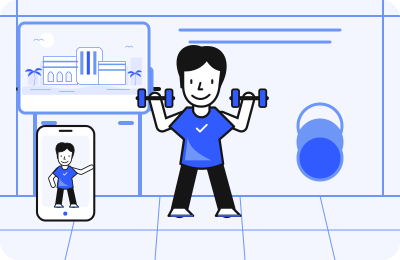
A Miami condo gym works well if you go when it's empty and plan around the kit it has. The towers of Brickell, Edgewater and Downtown, and the newer buildings in Doral and on Miami Beach, usually come with an amenity gym: dumbbells, a bench, a cable station, a treadmill or two. They're quiet before 7 AM and after 9 PM, which happens to be when our Miami sessions run.
- List the kit. Photograph the dumbbell rack (note the heaviest pair), the bench, any cable machine and the floor space. Your coach plans every session around what's actually there.
- Find the phone spot. A shelf or a water bottle on the floor, angled so your coach can see you from head to toe.
- Check the Wi-Fi in the gym. Many amenity gyms sit on a low floor or the pool deck, where the building signal is weak. Test a video call there once before your first session.
- Book the slot that's empty. A 5:30 AM or 9 PM session means no one waiting for the bench.
No building gym? On Miami Beach, the city's Scott Rakow and North Shore fitness centers cost residents $29 a month and non-residents $52. Their weekday hours from August 18, 2025 to June 7, 2026 started at 7:30 AM, so a coached session there at 7:30 AM sits inside our Miami window.
When is the Miami Marathon, and how do you train for it?

The Life Time Miami Marathon and Half is on Sunday, January 31, 2027, with the Life Time Tropical 5K the day before, Saturday, January 30. Both full and half finish at Bayfront Park, downtown on Biscayne Bay. From October 28, 2026, race day is about 13 weeks away, enough for a half-marathon build if you can already run 3 miles (5 km).
- 1
November: build the base
Three runs a week on the Beachwalk or the Venetian path, plus two strength sessions. Rain falls to 3.53 inches in November, so you'll lose fewer runs to storms.
- 2
December: add the long run
Stretch one run a week by a mile at a time. December's normal low of 64.3°F (17.9°C) makes dawn long runs on the Rickenbacker comfortable.
- 3
January: hold steady and taper
Keep strength work going for the hips and calves, then cut the miles in the last week or two before January 31.
Strength is where most first-time Miami Half runners fall short: flat, hard paths and humid air pound the calves, knees and hips. Two 45-minute strength sessions a week, coached live, keep them working. Fit those sessions at 5 or 6 AM on the mornings you don't run.
How does a live session fit a Miami workday?

A live session fits a Miami workday at either end: before the commute on I-95, the Palmetto or the Metrorail, or after the kids are in bed. Many Miami families live in Kendall, Doral or Hialeah and work in Brickell, Downtown or near the airport, and the drive eats the time a gym would need. A session on video doesn't need a drive.
| Day | Session | Where | Why it works |
|---|---|---|---|
| Monday | 5:30 AM, 45 minutes | Condo amenity gym in Brickell | Empty gym, done before the commute |
| Wednesday | 9:00 PM, 45 minutes | Living room in Kendall | Kids asleep, traffic gone |
| Saturday | 7:30 AM, 45 minutes | The gym you already belong to | After a short Beachwalk run, before the heat |
Every session is 45 minutes, live, with a certified coach who watches and corrects your form. Our coaches are based in India, so Miami sessions run 7:30 PM to 9:30 AM Eastern time in winter and 8:30 PM to 10:30 AM in summer; book between 5 and 9:30 AM or 8:30 PM and midnight and your slot works all year. Plans are charged in dollars, and you can move any session with 24 hours' notice when a storm watch rearranges your week.
| Program | One session | 4-week plan (12 sessions) | Per session on the plan |
|---|---|---|---|
| Personal Gym Training1:1, 45 minutes | $25 | $223 | about $19 |
| Personal Home Training1:1, 45 minutes | $28 | $255 | about $21 |
| Rehab & Recovery1:1, once a doctor or physio has cleared you | $41 | $382 | about $32 |
| Group ClassesPer person, small group | $16 | $127 | about $11 |
See a coached Miami day on our Miami page. Compare our prices with Miami trainers and gym dues in what a personal trainer costs in Miami, and fuel the training with healthy eating in Miami, from the Cuban sandwich to Pollo Tropical. For other cities, start from our US page.
Sources
- Climate of Miami (NOAA 1991–2020 normals, Miami International Airport), Wikipedia
- Tropical Cyclone Climatology, NOAA National Hurricane Center
- Miami Beach Beachwalk, City of Miami Beach
- Walking and running routes in Miami Beach, Greater Miami & Miami Beach
- Venetian Causeway, Wikipedia
- Rickenbacker Causeway, Wikipedia
- Crandon Park, Wikipedia
- The Underline, Friends of The Underline
- Life Time Miami Marathon and Half, Life Time
- Indoor Fitness Centers: Scott Rakow and North Shore, City of Miami Beach
Written by the MakeMyFitness team from the sources above. First published , last updated . Spotted something out of date? Tell us at hello@makemyfitness.com.