In short
- Online personal training in the US can be worth it, but it depends on which kind.
- An app with a coach who answers by message is a different product from a coach live on a video call.
- The evidence on supervision is modest and mixed.
- MakeMyFitness runs live one-to-one video sessions from $25 for 45 minutes, so you can test the format for the price of one session.
Is online personal training worth it in the US?
In the US, online personal training is worth it for some people and not for others, and the first question is which kind you mean. A live coach on a video call who watches you move is one product. An app that sends a plan and lets you message a coach is another. A workout app with no coach is a third. Most of the disagreement online comes from people judging one by the other.
This page is a decision guide, not a sales page, so here is the short version. Online training tends to suit people who need someone to watch their form, who live far from a good gym, or whose schedule makes fixed gym appointments hard. It suits you less if you need a person physically spotting heavy lifts, if you only show up when someone is waiting for you in the building, or if you want a session before 4:30 AM or after 9:30 PM.
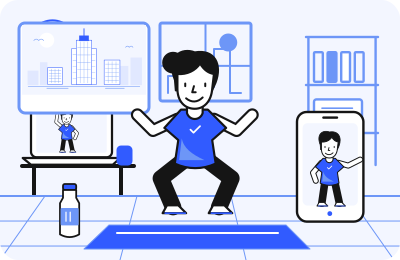
We run one of these services, so weigh what we say accordingly. MakeMyFitness is live one-to-one training on a video call: a coach is on the call for the whole 45 minutes, watching and correcting your form as you move. A session is $25 at your own gym or $28 at home. Below we say plainly where a different option fits you better. If you only want the price comparison, see our online personal trainer cost guide.
What are the four kinds of personal training people compare?
The four kinds of personal training that US readers compare are in-person with a trainer, live one-to-one video, an app with a coach who replies by message, and an app on its own. They differ most in one respect: who is watching you move, and when. Price, scheduling and results all follow from that.
| In person | Live one-to-one video | App with a coach by message | App alone | |
|---|---|---|---|---|
| Who watches your form | The trainer, in the room, for the whole session | The coach, live on the call, for the whole session | A coach replies to messages or videos you send; some services also offer scheduled video calls | No one, unless the app uses your camera |
| Scheduling | Fixed appointments at the gym or studio | Fixed appointments, from home or your own gym | Flexible: train when you like, message when you like | Flexible: any time |
| Hands-on help | Yes: spotting, touch corrections, equipment set-up | No: verbal and visual cues only | No | No |
| Published price examples | Varies by city and gym; see the cost guide linked above | Holly Roser Fitness: $136 for a 60-minute session, $500 for 4 a month. MakeMyFitness: from $25 for 45 minutes | Future: $50 first month, then $199 a month. trainwell: $6 a day after a 14-day trial | Varies; not covered here |
| What you need | To travel to the trainer | A phone or laptop with a camera, and some floor space | A phone, and a gym or home equipment | A phone |
| Suits | Heavy lifting with a spotter; people who need someone waiting for them | Beginners who want form watched; people far from a good gym | Self-starters who want a plan and occasional feedback | Self-starters on a tight budget |
Prices in the table are the ones each service publishes on its own site, read on 19 November 2026: Holly Roser Fitness lists a virtual session at $136 and four sessions a month at $500; Future lists $50 for the first month, then $199 a month, for an app plus a remote coach; trainwell lists $6 a day after a 14-day trial. Kickoff, a dietitian-trainer service with weekly video calls, shows “most people pay” $250 a month or $0. Echelon Coach describes live one-to-one sessions but does not publish a price on its FAQ page. These services differ in length, format and what is included, so treat the figures as signposts, not like-for-like quotes.
Does online personal training actually work? What the research shows
The research on whether online personal training works in the US or anywhere else is thinner than most blog posts suggest. There are good studies on supervision in general, and some trials of remote supervised exercise, but few that test paid live video coaching in healthy gym-goers. Here is what the studies we opened actually say, and how far they go.
Supervised versus unsupervised resistance training
A 2023 randomized trial in the Journal of Sports Sciences (Coleman and colleagues) put 36 young, resistance-trained men and women through the same 8-week program, with one group directly supervised and the other left to train alone. Supervised lifters generally gained more muscle thickness at several sites and a larger squat one-repetition max, while bench press and isometric knee extension strength were similar between groups. The authors concluded that supervised training promoted greater muscular adaptations in this group.
Read it for what it is. It is one small study, in young people who already lifted, over 8 weeks, and the supervision was direct, in the room. It did not test video coaching. It is a reason to think that having someone watch and push you can matter, not proof that a video call does the same.
A larger 2024 systematic review and meta-analysis in Sports Medicine (Gómez-Redondo and colleagues) pooled 34 randomized trials with 2,830 adults aged 60 or older. Attendance was similar for supervised and unsupervised groups, at 81%, and no serious adverse events were reported. Supervised exercise was associated with larger gains in knee extension strength, lean mass and quality of life, but only knee extension strength held up in the sensitivity analyses. The authors concluded that both formats appear safe and beneficial and called for higher-quality research. This was older adults, not general gym-goers, and it does not say supervision improves adherence, because attendance was the same.
We looked for the broader supervised-versus-unsupervised literature on strength and body composition in healthy adults, and we are not quoting figures from papers we could not open and read. If you see a confident number for how much supervision improves results, check whether the study was in-person, how long it ran, and who was in it.
Remote and video-supervised exercise
A randomized controlled trial in the Journal of the American Heart Association (Jouini and colleagues, 2024) enrolled 70 adults with Marfan syndrome, a genetic condition. The training group did two supervised online sessions a week for 3 months and the control group did not. The training group improved on quality of life, peak oxygen uptake and measures of muscle elasticity compared with controls, and aortic diameter stayed stable in both groups. The authors suggest the online programme may be a useful part of managing the condition. It says nothing about how a paid coach compares with a gym trainer for a healthy person.
What the evidence does and does not tell you
The studies above support three cautious points: supervision may help muscular gains in some groups, supervised online exercise was linked to measurable improvements in one patient group, and attendance was not higher with supervision in the older-adult review. None of them compares paid live video coaching with in-person personal training in healthy adults. If a source claims online training is proven better or worse, it is claiming more than these papers do.
Check with your doctor first
If you have a medical condition, take medication, are pregnant or are recovering from an injury, ask your doctor or physical therapist before you start any new exercise program, online or in person. We do not diagnose or treat, and our coaching does not replace your clinician's advice.
When is online personal training not worth it?
Online personal training is not worth it in the US if you need physical help, if you will only train when someone is waiting for you, if you lack space or a decent connection, or if you need a session before 4:30 AM or after 9:30 PM. Be honest with yourself about these five, because they are the usual reasons people quit.
- You want a spotter for heavy lifts. If you are pushing a heavy squat, bench or deadlift near your limit, a person standing behind you is safer than a camera. An in-person trainer is the better choice, and so is a training partner.
- You only show up when someone is physically waiting. Some people never skip a session when a trainer is standing at the gym door. A video call is easier to put off. If that is you, book in person or join a class with a fixed time.
- You have no space or a poor connection. A session needs a few feet of clear floor and a connection that holds a video call. If your internet drops often, you will lose part of what you paid for.
- You have a condition that needs in-person supervision. If your doctor wants you supervised in person, follow that advice. Our Rehab & Recovery program is exercise coaching after a doctor or physical therapist has cleared you, and it builds on their guidance rather than replacing it.
- You can only train very early or very late. Our sessions run from 4:30 AM to 9:30 PM in your own local time. If your only free time is before 4:30 AM or after 9:30 PM, we are not the right fit.
On timing: our live hours are 4:30 AM to 9:30 PM in your own local time, every day, in every US time zone. That covers early risers, a lunch-hour session and people who train after the kids are in bed. You can see this before you pay; ask on the booking form or WhatsApp for the slots open to you.
Who is online personal training worth it for?
Online personal training is most worth it in the US for people for whom a gym trainer is hard to reach, or for whom form is the main worry. These are the groups where a live coach on video earns its place.
- Beginners who need form watched. A coach who sees every rep can correct a squat or hinge as you do it, which a plan on its own cannot.
- People far from a good gym or a trainer. In a small town or a rural area, the nearest qualified trainer may be an hour away. A video call removes that.
- Parents and shift workers. A session at home before the kids wake or after they are asleep, with no travel, is easier to keep than a gym booking.
- Travelers. You can keep the same coach in a hotel room or a building gym, with a camera and some floor.
- People who find a gym intimidating. Training at home with one coach, rather than on a busy floor, removes the thing that keeps some people away.
For these groups, the live format is the point. See how live one-to-one online personal training works for a session in detail, or read the page for online personal training over fifty if you are an older adult. If you train at your own gym, the Personal Gym Training program puts the coach on a call while you use the equipment there; Personal Home Training needs only floor space.
How do you test online personal training before you commit?
In the US, a low-risk way to test online personal training is to pay for one session or a short starter and judge the first one against a checklist. There are no free trials at MakeMyFitness, so decide what you are testing before you start.
- 1
Check that the coach is live for the whole session
Ask whether the coach is on the call for the full time, or whether you are watching a video or being checked in on. A live coach watches every set. If the answer is vague, the product is probably an app.
- 2
Ask how long a session is, and what counts toward it
Compare like with like. A 45-minute call and a 60-minute call are not the same price per minute. Ask whether set-up and chat count.
- 3
Ask about the coach's qualifications
Ask what the coach holds and who awarded it. Our lead coach, Kumar Abhishek, holds a Diploma in Personal Training from K11 School of Fitness Sciences, graded with Distinction, and is a Human Performance Nutritionist. Kumar holds no US certification, and we do not claim one.
- 4
Read the cancellation and rescheduling terms
Ask what happens if you cannot make a session. Ours can be moved with 24 hours' notice, nothing renews automatically and there is no contract.
- 5
Judge the first session on three things
Did the coach correct your form while you were moving, not after? Did the session match your level and any injury you mentioned? Could you hear and see each other clearly? If yes to all three, the format works for you.
What are the ways to start with MakeMyFitness?
MakeMyFitness offers live 45-minute online personal training in the US from $25 a session, with a coach correcting your form on video. You can start small. Book one session, a 4-session starter ($69 at your gym or $79 at home), or a 20-minute consultation call with a coach for $9, arranged on WhatsApp, to talk through your goals before you pay for a session.
| Program | One session | 4-week plan (12 sessions) | Per session on the plan |
|---|---|---|---|
| Personal Gym Training1:1, 45 minutes | $25 | $223 | about $19 |
| Personal Home Training1:1, 45 minutes | $28 | $255 | about $21 |
| Rehab & Recovery1:1, once a doctor or physio has cleared you | $41 | $382 | about $32 |
| Group ClassesPer person, small group | $16 | $127 | about $11 |
Longer plans exist too, a 4-week plan of 12 sessions at 3 a week, but we suggest you do not start there. Do one session or the starter, use the checklist above, and only then decide. The sessions run on Google Meet, you pay with a secure link in US dollars, and international cards are accepted. Our coaches speak English and Hindi. For the full price breakdown see pricing.
Is a live video coach better than an app with a coach?
A live video coach and an app with a coach by message suit different people in the US, and neither is better for everyone. The question is whether you need someone to watch you in real time or someone to plan and check in.
An app with a coach by message gives you flexibility. You train when you like, send a video or a note, and get feedback after. If you already know how to lift and you are self-driven, that can be enough, and the monthly price covers a lot. If you want to train at 11 PM, we cannot offer that and an app-based service can.
A live coach suits people who want form corrected while they move, who like an appointment to turn up to, or who have learned that messages and plans are easy to ignore. You need a fixed time. Whichever you pick, look at what the coach does in real time, not just what the marketing calls it.
If you are building muscle or strength, see our pages on muscle building and strength training; if fat loss is the aim, the fat loss page explains a sensible pace. In your own city, the cost guides for New York and Los Angeles show what in-person trainers charge, so you can compare before you decide.
Sources
- Supervision during resistance training positively influences muscular adaptations in resistance-trained individuals, Journal of Sports Sciences (Coleman et al., 2023)
- Supervised Versus Unsupervised Exercise for the Improvement of Physical Function and Well-Being Outcomes in Older Adults: A Systematic Review and Meta-analysis of Randomized Controlled Trials, Sports Medicine (Gómez-Redondo et al., 2024)
- Online Personal Training in Patients With Marfan Syndrome: A Randomized Controlled Study of Its Impact on Quality of Life and Physical Capacity, Journal of the American Heart Association (Jouini et al., 2024)
- Train online with Holly Roser Fitness (session prices, checked 19 November 2026), Holly Roser Fitness
- Future (pricing, checked 19 November 2026), Future
- Virtual personal trainer (pricing, checked 19 November 2026), trainwell
- Kickoff (pricing, checked 19 November 2026), Kickoff
- Virtual personal training FAQ (checked 19 November 2026), Echelon Coach
Written by the MakeMyFitness team from the sources above and reviewed by Kumar Abhishek, our lead coach (Diploma in Personal Training, K11 School of Fitness Sciences). First published , last updated . Read our editorial policy. Spotted something out of date? Tell us at hello@makemyfitness.com.