How do people stay fit in Los Angeles?
People in Los Angeles stay fit mostly outdoors, on hills, reservoir loops and the beach, and squeeze it around a car commute. The weather allows it almost all year: Downtown LA averages 34 days of measurable rain a year by NOAA's 1991–2020 normals. What gets in the way is time. In Los Angeles County in 2024, 64.8% of workers drove to work alone, and the typical one-way trip took 30.4 minutes, by Census figures published in the LA Almanac. Add a drive to the gym and back and the evening is gone.
So the fit Angelenos you see on the Silver Lake loop at dawn or the Santa Monica stairs on a Saturday usually have a routine that needs no extra driving: a loop near home, a building gym, or a workout in the living room. This guide covers the places, the seasons and the scheduling.
Where can you run in Los Angeles, and how far is each loop?

The best-known running routes in Los Angeles are measured loops around reservoirs and one long path along the ocean. These are the distances, so you can plan a run without a GPS watch.
| Route | Neighborhood | Distance | What to know |
|---|---|---|---|
| Silver Lake Reservoir path | Silver Lake | 2.2 miles (3.5 km) around | Flat loop; the 3-acre Silver Lake Meadow on the east side opened in April 2011 |
| Lake Hollywood walking trail | Hollywood Hills | 3.5 miles (5.6 km) loop | Crosses Mulholland Dam, built in 1924, with views of the Hollywood Sign |
| Marvin Braude bike trail (the beach path) | Pacific Palisades to Torrance | 22.3 miles (35.9 km) end to end | 8.5 miles (13.7 km) run through Santa Monica; busy in Venice and Hermosa in summer |
| Runyon Canyon | Hollywood | Loops of about 30–45 minutes | 160 acres; high point 1,320 ft (402 m) at Indian Rock |
| Griffith Park trails | Los Feliz | 4,310-acre park | Mount Hollywood Trail starts at the Griffith Observatory lot |
For a first run, the Silver Lake loop is the easiest to get right: 2.2 miles, mostly flat, and easy to repeat for a longer run. Twice around is 4.4 miles (7 km). Lake Hollywood adds a few short climbs and fewer cars. The beach path is for long, flat miles, and on the Santa Monica stretch you can run out and back for as far as you like. Expect company: the Hermosa Beach section gets busy with people on foot in summer, and signs tell cyclists to dismount at the Redondo pier.
Runyon Canyon and Griffith Park: hills, not loops
Runyon Canyon in Hollywood and Griffith Park in Los Feliz are where Los Angeles goes to climb. Runyon's basic loops take about 30 to 45 minutes, and the steeper Hero's Trail takes 45 to 60. Dogs are allowed off-leash on 90 of its 160 acres, so expect plenty of company from the Fuller Avenue gate up. Griffith Park is far bigger, 4,310 acres, with trailheads off Vermont Canyon Road and Crystal Springs Drive, and free trail maps at the visitor center.
Where can you work out outdoors in Los Angeles without running?

Outdoor workouts in Los Angeles don't have to mean running. The Santa Monica stairs, just north of the city line, are a free interval session: the 4th Street stairway has 189 steps rising about 115 feet, and the Adelaide Drive stairs nearby have 170 steps rising about 110 feet. Ten trips up 189 steps is roughly 1,150 feet of climbing.
- 1
Warm up on the flat
Ten minutes of easy jogging on the beach path or along Ocean Avenue before the first climb.
- 2
Climb, walk down
Climb the 4th Street stairs at a steady effort, then walk down the other side to recover.
- 3
Add strength between rounds
Push-ups, split squats and planks on the grass at the top keep your heart rate up while your legs recover.
- 4
Cool down by the water
Walk back toward the pier and stretch calves and hips. Stairs are hard on the calves the next day.
What is the weather like for training in Los Angeles, season by season?

Los Angeles weather is mild year-round, with a wet winter, a dry summer and a hot, windy fall. These are NOAA's 1991–2020 averages for Downtown LA; the coast runs cooler and the inland valleys hotter. At LAX, August highs average 76.7°F (24.8°C) against 84.0°F (28.9°C) downtown.
| Season | Daytime high | Night low | Rain | What it means for training |
|---|---|---|---|---|
| Winter (Dec–Feb) | 67.4–68.0°F (20°C) | 48.2–50.0°F (9–10°C) | 2.48–3.64 in a month | The wettest months, with February the wettest of all. Between storms, cool and clear running weather |
| Spring (Mar–May) | 69.9–73.7°F (21–23°C) | 52.4–58.1°F (11–15°C) | Tapering off by May | Mild and mostly dry; late spring can turn gray. Good weeks to build mileage |
| Summer (Jun–Aug) | 77.2–84.0°F (25–29°C) | 61.4–65.4°F (16–19°C) | 0.09 in or less a month | June Gloom clouds early, then dry heat. Run at dawn or near the coast |
| Fall (Sep–Nov) | 83.0°F falling to 72.9°F (28 to 23°C) | 64.2 to 53.1°F (18 to 12°C) | Returns in November | September is nearly as hot as August, and Santa Ana winds start late in the month |
A year in Downtown Los Angeles brings 14.25 inches (362 mm) of rain, and the Wikipedia climate summary notes that 92% of it falls between November 1 and April 30. July averages 0.02 inches and August none at all. The training problems here are heat in the valleys, summer sun on exposed trails, and the dry, hot Santa Ana winds that blow from late September into early May.
Should you train outside on smoky or Santa Ana days in Los Angeles?
On smoky or very windy days in Los Angeles, check the air quality before an outdoor workout and move hard sessions indoors when it's poor. AirNow, the federal air quality site, uses these bands:
| AQI | Category | Training call |
|---|---|---|
| 0–50 | Good | Train outside as planned |
| 51–100 | Moderate | Fine for most; unusually sensitive people may ease off |
| 101–150 | Unhealthy for sensitive groups | If you have asthma or heart or lung conditions, train indoors |
| 151–200 | Unhealthy | Some of the general public may feel effects; move hard sessions indoors |
| 201 and above | Very unhealthy to hazardous | Skip outdoor exercise |
This is where a home routine pays off. When the AQI reads orange or red over the San Fernando Valley, the Silver Lake loop can wait, and a strength session in your apartment, with windows closed, keeps the week on track.
How do you fit training around an LA commute and work schedule?

Training in Los Angeles works best when it doesn't add a drive. The 2024 Census figures for LA County, published by the LA Almanac, explain why:
- 64.8% of workers drove to work alone, and 9.3% carpooled.
- 3.9% took public transportation.
- 17.1% worked from home, about 801,800 people.
- The typical trip to work took 30.4 minutes, and 12.4% of commuters spent an hour or more each way.
If you're one of the 12.4% driving an hour or more each way, two hours in the car plus a separate trip to the gym leaves little room for anything else. The workable LA routines tend to be one of three: train at a gym or building gym next to home, train at home once you're off the road, or, on work-from-home days, train early before the laptop opens.
What are the big races and fitness events in Los Angeles?
The biggest race in Los Angeles is the LA Marathon, and the next one is on March 7, 2027, according to the McCourt Foundation, which organizes it. Its course runs from “Stadium to the Stars”. The foundation also lists a Charity Half Marathon, the LA 5K, the Rose Bowl Half Marathon and 5K, and the Santa Monica Classic among its events; check its site for those dates.
Counting back, a 16-week marathon plan for March 7, 2027 starts on Sunday, November 15, 2026, a few weeks from this guide's date. If you're aiming for the LA 5K or a half first, a plan of 8 to 12 weeks is enough for most people who already run a little. Two or three strength sessions a week alongside the running, focused on hips, calves and single-leg work, help your legs handle the mileage.
How do you get the most out of an apartment or building gym in LA?
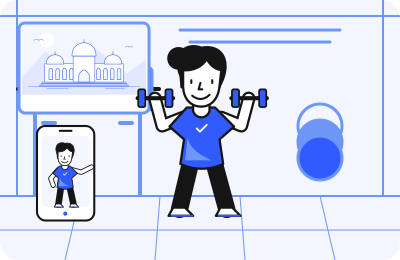
Many Los Angeles apartment buildings, especially newer ones in Downtown, Koreatown and on the Westside, have a small fitness room. A typical one has a rack of dumbbells, a bench and a few cardio machines. That's enough to train every major muscle group if you plan around it.
- Write down what's there. The heaviest dumbbell pair sets your ceiling. If it's 50 lb (23 kg), slow tempo and single-leg moves will keep the work hard.
- Go when it's empty. Notice when your building's gym is busiest and train either side of it; later evening slots can be quieter.
- Pick four moves a session. A squat or lunge, a hinge, a push and a pull, three sets each, covers the body in 40 minutes.
- Track your weights. Add a rep or a few pounds each week; that is how you get stronger with a small rack.
- Get your form checked. A building gym has no trainer on the floor. A coach on video can see your squat from the side and tell you what to fix.
How does a live online session fit an LA day?
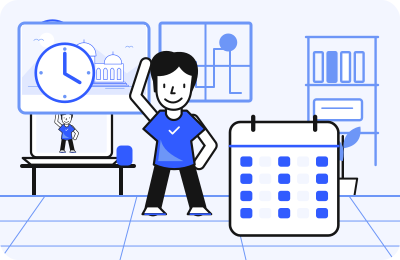
A live MakeMyFitness session fits the Los Angeles evening. Every session is a 45-minute video call with a certified coach who watches your form and corrects it as you go, at home, in your building gym or at your own gym. Our coaches are based in India, so Los Angeles sessions run from 4:30 PM to 6:30 AM Pacific time in winter and 5:30 PM to 7:30 AM in summer. The slots that work all year are 5:30 to 10 PM and 5 to 6:30 AM.
For most Angelenos that means home from work, phone propped on the bookshelf, and a session at 6 or 7 PM, done before dinner. On work-from-home days, the 5:30 AM slot works too, with a walk around the reservoir once it's light. Personal Home Training is $28 a session or $255 for 12; Personal Gym Training at your own gym is $25 or $223 for 12. You can move any session with 24 hours' notice.
For the full picture of a coached LA evening, see our Los Angeles page. If you're comparing costs, read what a personal trainer costs in Los Angeles, and for the food side, healthy eating in Los Angeles counts the calories in tacos, burritos and pho. For other cities, start at our US page.
Sources
- Climate of Los Angeles (NOAA 1991–2020 normals for Downtown LA and LAX), Wikipedia
- Commuting to work, Los Angeles County, Los Angeles Almanac (U.S. Census Bureau data)
- AQI Basics, AirNow (U.S. EPA)
- ASICS Los Angeles Marathon, The McCourt Foundation
- Marvin Braude Bike Trail, Wikipedia
- Hollywood Reservoir, Wikipedia
- Silver Lake Reservoir, Wikipedia
- Runyon Canyon Park, Wikipedia
- Griffith Park, Wikipedia
- Santa Monica Stairs, Wikipedia
Written by the MakeMyFitness team from the sources above. First published , last updated . Spotted something out of date? Tell us at hello@makemyfitness.com.